Blog

  • From Shiny Cars to Shiny ROI: Why Your Detailing Site Needs a Visual Estimate Tool

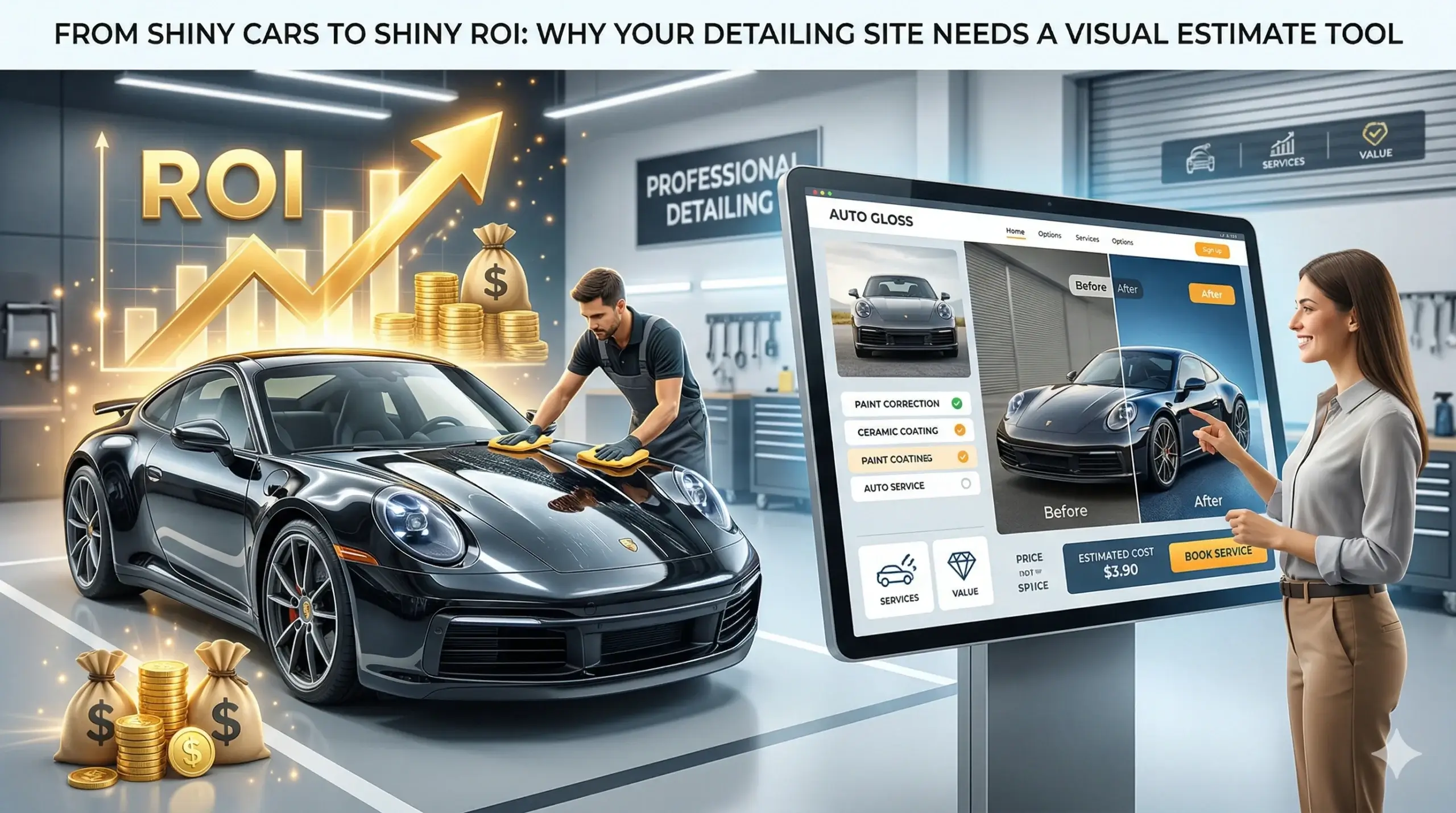
    From Shiny Cars to Shiny ROI: Why Your Detailing Site Needs a Visual Estimate Tool

    In the high-end detailing and ceramic coating industry, your work is judged by its finish. Yet, many US-based detailing businesses operate with websites that look like dull clear coats—outdated, slow, and full of friction.

    The biggest bottleneck in digital lead generation today isn’t a lack of traffic; it’s the “price barrier.” Potential clients don’t want to wait 24 hours for a quote. If your detailing website design requires a manual contact form for every inquiry, you are losing high-ticket ceramic coating jobs to competitors who provide instant, visual gratification.

    The Psychology of the Visual Estimate

    A visual estimate tool isn’t just a calculator; it’s a conversion engine. For a customer looking at a $1,500 ceramic coating package, the transition from “browsing” to “buying” requires trust and transparency.

    1. Reducing Friction in the Sales Funnel

    Traditional “Contact Us” forms are where leads go to die. A visual tool allows users to select their vehicle size, paint condition, and desired protection level. By the time they hit “submit,” they have already mentally “purchased” the service. This shifts the conversation from “How much do you charge?” to “When can you fit me in?”

    2. Establishing Authority through UI/UX

    In car website design, aesthetics equate to perceived quality. If your site is clunky, a lead assumes your shop is disorganized. A sleek, interactive estimator signals that your business utilizes modern technology—a trait highly valued by owners of luxury and exotic vehicles.

    Technical Performance: Speed vs. Functionality

    Adding interactive tools can often bloat a website, leading to poor Core Web Vitals. At Digital Trace, we prioritize the “Technical Trifecta”:

    • Page Speed: If your estimator takes more than 2.5 seconds to become interactive (Time to Interactive), your bounce rate will skyrocket. We use lightweight JavaScript frameworks to ensure the tool scales without dragging down performance.
    • Mobile-First Indexing: 70% of detailing searches happen on mobile devices. Your visual tool must be “thumb-friendly,” avoiding small dropdowns or complex fields that frustrate mobile users.
    • ADA Compliance: For US small businesses, accessibility is a legal necessity. Ensuring your estimator is screen-reader friendly protects you from litigation and opens your market to all users.

    Local SEO and Ceramic Coating Marketing

    Your website is the foundation of your ceramic coating marketing strategy. A visual estimate tool provides a unique opportunity to capture “Zero-Click” search intent.

    When Google sees users spending 3–5 minutes interacting with a tool on your site (High Dwell Time), it signals that your content is authoritative. This boosts your rankings for high-intent keywords like “ceramic coating near me” or “best car detailing [City Name].” Furthermore, the data captured—vehicle types, common paint issues in your area—allows you to refine your local SEO content to match what your market actually needs.

    The Digital Trace Edge: Aesthetics Meet Analytics

    Generic plugins often look like an afterthought. A truly effective detailing website design integrates the estimator into the brand’s visual identity. It should feel like a premium concierge service, not a spreadsheet.

    We focus on the “Digital Trace” of your customer—the trail of data they leave behind. By tracking where users drop off in your estimator, we can optimize the UI to ensure maximum completion rates and a higher ROI on your ad spend.


    Optimize Your Digital Trace Today

    Is your current website a liability or an asset? Don’t let a “dull” online presence cost you high-ticket clients.

    [Get a Free Website Audit from Digital Trace] Let’s analyze your site’s speed, SEO, and conversion path to see how a custom visual estimate tool can accelerate your business growth.

  • 5 UX Secrets of High-Converting Car Rental Websites in 2026

    5 UX Secrets of High-Converting Car Rental Websites in 2026

    In 2026, a car rental website that simply “looks nice” is a liability. For business owners, high traffic means nothing if your bounce rate is climbing and your “Book Now” button remains untouched. Most independent rental agencies lose 60-70% of potential revenue due to “friction”—the technical and psychological barriers that prevent a user from completing a reservation.

    To scale in a competitive automotive market, your website must evolve from a static brochure into a high-performance conversion engine. Here are the five UX secrets driving industry leaders this year.

    1. The “Two-Click” Booking Philosophy

    The modern traveler expects immediacy. If a user has to navigate through three pages just to see vehicle availability, they will leave for a competitor. High-converting car rental website design prioritizes a “Search-to-Selection” flow that requires minimal cognitive load.

    • The Solution: Implement a persistent, simplified booking widget on the homepage hero section.
    • Technical Depth: Use “Type-ahead” API integration for location fields and pre-populated date pickers. Reducing keystrokes directly correlates with lower abandonment rates. Your car booking system should feel like an extension of the user’s thought process, not a hurdle.

    2. Mobile-First “Thumb-Zone” Optimization

    With over 70% of car rental searches occurring on mobile devices, desktop-first design is obsolete. However, 2026 standards go beyond “responsiveness.” High-converting sites optimize for the “thumb-zone”—the area of a smartphone screen easiest to reach with one hand.

    • The Solution: Place critical CTAs (Call to Actions) and filter toggles within the bottom third of the screen.
    • Business Benefit: This reduces physical friction, making it easier for users to browse your fleet while on the go, significantly increasing mobile conversion rates for last-minute rentals.

    3. High-End Aesthetics Grounded in Performance

    Visuals sell the experience, but heavy unoptimized imagery kills SEO. In automotive website development, the “Digital Trace” angle focuses on the intersection of high-end aesthetics and technical speed.

    • The Secret: Use WebP or AVIF image formats and lazy-loading scripts to ensure your high-resolution fleet photos don’t tank your Core Web Vitals.
    • The Impact: Google’s algorithm prioritizes page speed. A site that loads in under 2 seconds isn’t just a luxury; it’s a requirement for ranking in Local SEO and retaining impatient US consumers.

    4. Radical Transparency & Trust Signals

    US consumers are increasingly wary of hidden fees (insurance, cleaning, or young driver surcharges) revealed only at the final checkout stage. This “sticker shock” is the #1 cause of cart abandonment.

    • The Solution: Use “All-in” pricing models or dynamic price breakdowns that update in real-time as users select add-ons.
    • ADA Compliance: Ensure your pricing tables and forms are fully accessible. In the US, ADA compliance is not optional. Proper ARIA labeling and keyboard navigation ensure you reach 100% of your audience while protecting your business from legal risks.

    5. Micro-Interactions and Social Proof Integration

    Trust is the currency of the rental industry. Generic “Testimonial” pages are ignored. Instead, high-converting sites embed social proof into the UX journey.

    • The Strategy: Integrate micro-interactions, such as “3 people booked this vehicle in the last 24 hours” or live Google Review snippets directly on the vehicle selection page.
    • The Result: These small psychological triggers validate the user’s choice at the exact moment of decision-making, bridging the gap between “just looking” and “confirmed booking.”

    Optimize Your Digital Trace for Growth

    Is your current website a high-performance asset or a silent drain on your marketing budget? At Digital Trace, we specialize in bridging the gap between sophisticated automotive design and raw technical performance.

    Stop losing leads to outdated UX. Book Your Free Website Audit & Consultation

    Let’s analyze your current metrics and build a digital presence that drives measurable ROI for your rental business.

  • The Fitment Factor: How Year-Make-Model Lookups Increase Automotive AOV by 40%

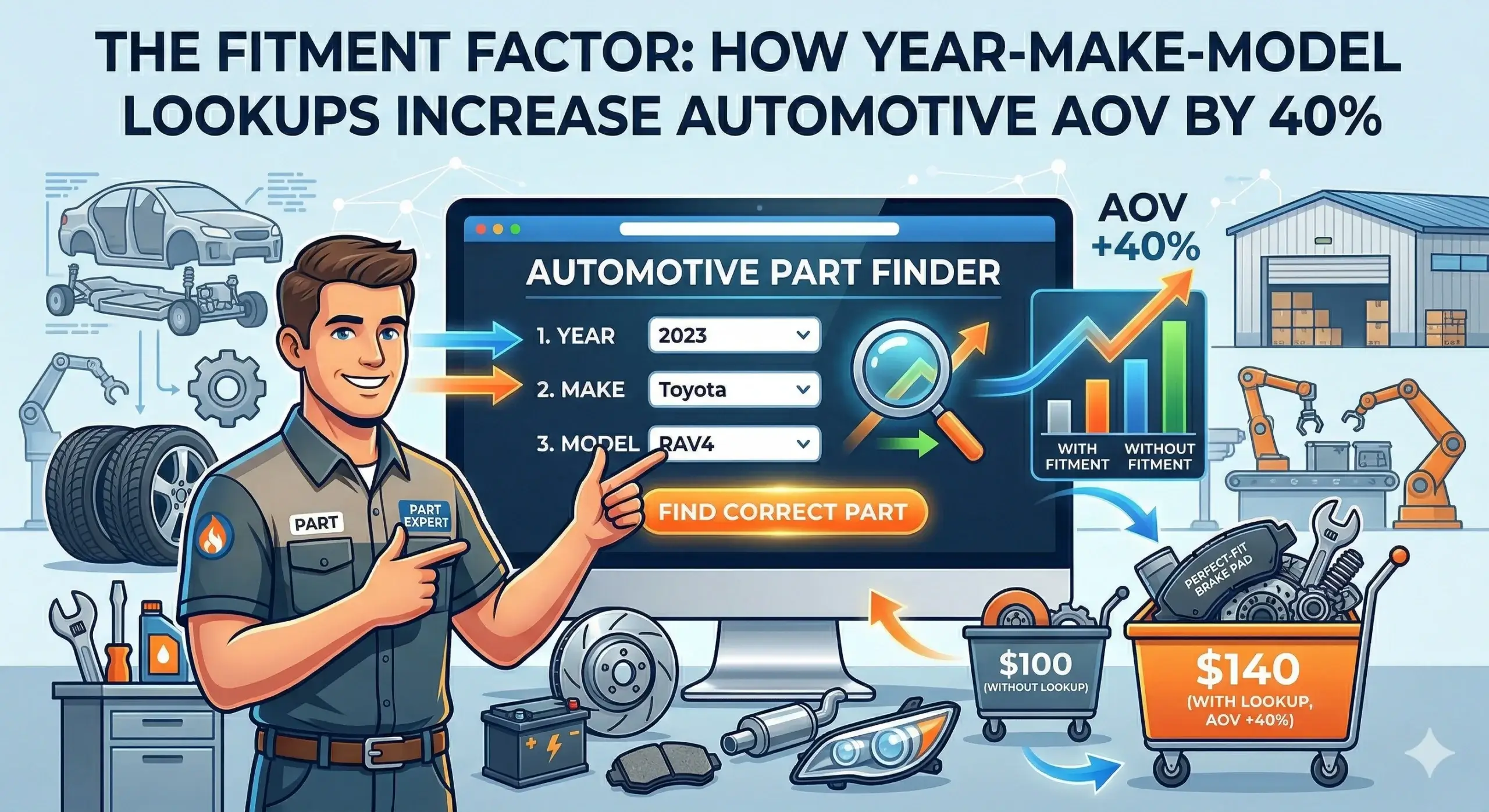
    The Fitment Factor: How Year-Make-Model Lookups Increase Automotive AOV by 40%

    In the automotive ecommerce world, “close enough” is a conversion killer. For US small business owners, the biggest hurdle isn’t just getting traffic; it’s overcoming the “Fitment Fear.” When a customer is unsure if a part fits their specific vehicle, they do one of two things: they bombard your support team with questions, or they leave for a competitor who provides certainty.

    The Year-Make-Model (YMM) lookup is not just a search tool—it is a psychological trigger that builds immediate trust, reduces return rates, and, most importantly, increases Average Order Value (AOV) by up to 40%.

    Why Precision Fitment Drives AOV

    High AOV is driven by confidence. When a car online store utilizes a robust fitment data integration, the shopping experience shifts from “search” to “solution.”

    1. The Power of “Complete the Kit”

    When a user selects their 2022 Ford F-150 via a YMM filter, your website can programmatically suggest related items—gaskets, bolts, or fluids—that are guaranteed to fit that specific trim. This cross-selling strategy is significantly more effective than generic “you may also like” widgets because it is rooted in technical necessity.

    2. Reducing Cart Abandonment

    Uncertainty leads to hesitation. By implementing a “Green Check” fitment confirmation on the product page, you remove the primary friction point in the automotive buyer’s journey. Precision eliminates the mental barrier of “What if I have to ship this back?”

    The Technical Backbone: ACES and PIES Data

    To compete in the US market, your car parts website design must go beyond aesthetics. It requires deep integration with industry standards like ACES (Aftermarket Catalog Exchange Standard) and PIES (Product Information Exchange Standard).

    • ACES manages the “fitment” (What vehicle does this fit?).
    • PIES manages the “specs” (What color is it? How much does it weigh?).

    At Digital Trace, we treat these data points as the foundation of your SEO. When your site architecture is built around structured fitment data, Google recognizes your pages as highly relevant to specific long-tail searches (e.g., “performance brake pads for 2019 Chevy Silverado”), driving high-intent traffic directly to your checkout.

    Performance: Speed vs. Complexity

    Adding a complex YMM database can often slow down a website. In ecommerce, page speed is a direct correlation to revenue. A one-second delay in load time can result in a 7% reduction in conversions.

    A senior-level build ensures that your fitment lookup is handled via optimized API calls or lightweight asynchronous loading. This ensures that while the user filters through thousands of SKUs, the interface remains snappy and responsive—a critical factor for Mobile-First Indexing.

    US Market Standards: Compliance and Growth

    Operating an automotive brand in the US requires adherence to specific digital standards that many generic agencies overlook:

    • ADA Compliance: Ensuring your search tools are accessible to all users is not just a best practice; it’s a legal necessity to avoid predatory litigation.
    • Local SEO Integration: For businesses with a physical storefront or warehouse, your online fitment data should sync with local inventory, capturing “near me” searches from DIYers and local mechanics.
    • UX for the Professional & Hobbyist: Your design must cater to both the professional mechanic who needs speed and the hobbyist who needs education.

    Beyond the Template: Why Custom Logic Wins

    Generic Shopify or WooCommerce templates are rarely equipped to handle the complexity of automotive fitment without significant bloating. A professional “Digital Trace” is one where the aesthetics reflect the quality of the parts you sell, while the backend operates with the precision of a high-performance engine.

    A custom-engineered automotive site doesn’t just look better; it functions as a 24/7 salesperson that never misquotes a part.


    Optimize Your Digital Trace

    Is your current website driving growth or causing friction? A high-performance automotive brand requires more than just a catalog; it requires a conversion engine.

    Contact Digital Trace today for a free website audit. Let’s analyze your current fitment logic and identify the technical gaps standing between you and a 40% increase in AOV.

  • Scaling Your Air Duct Cleaning Business with a Specialized Website Strategy

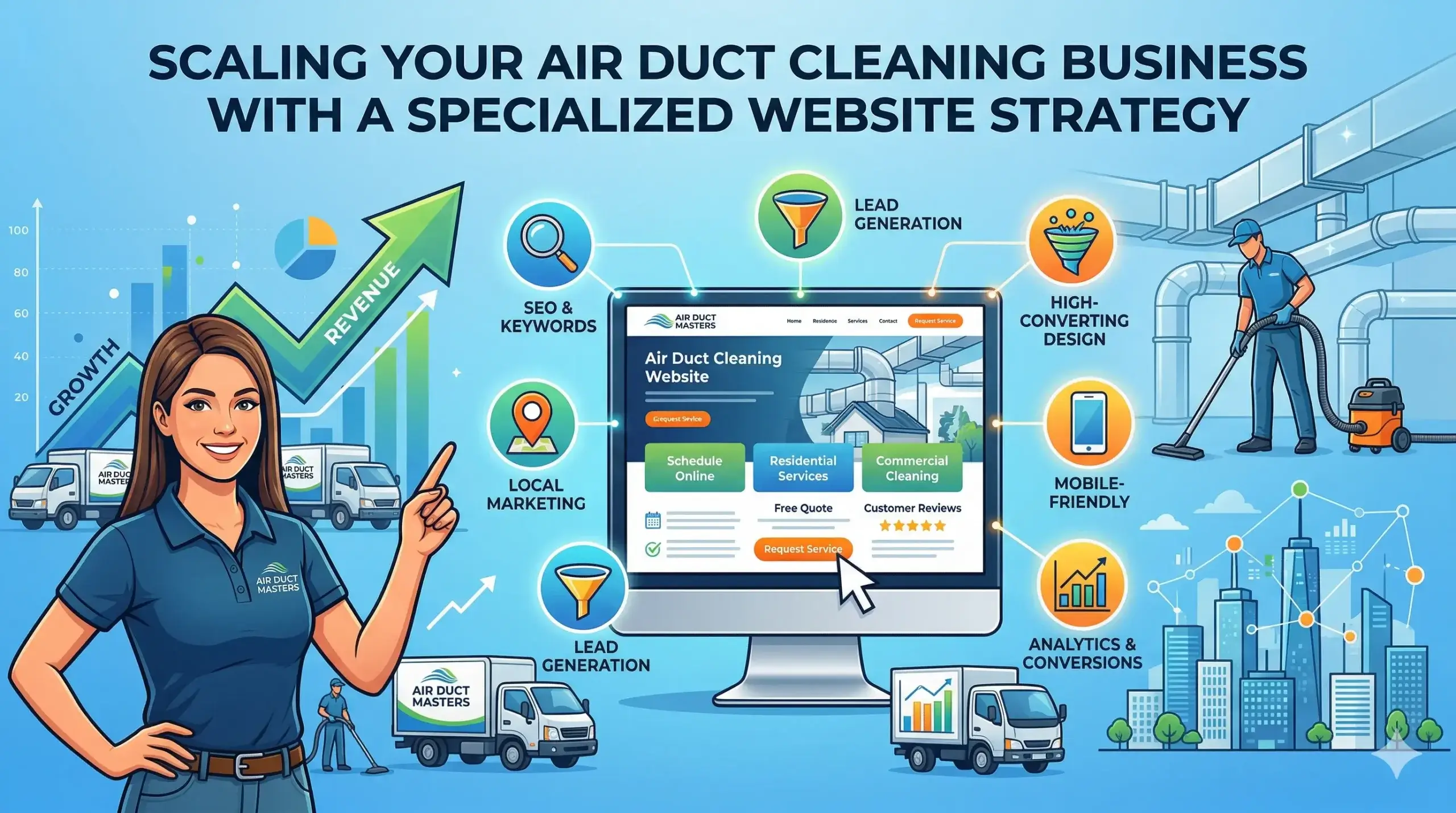
    Scaling Your Air Duct Cleaning Business with a Specialized Website Strategy

    In the air duct cleaning and HVAC industry, your website is often the first “technician” a customer meets. If that technician is slow, unresponsive, or looks unprofessional, the homeowner will call your competitor before they even see your pricing.

    For US small business owners, the gap between a “digital brochure” and a lead-generation machine is the difference between stagnation and scaling. A specialized hvac website design isn’t just about looking modern; it is about engineering a path from a Google search to a scheduled service call.

    Why “Good Enough” is Costing Your HVAC Business Revenue

    Many air duct cleaning companies rely on generic templates that fail to address the specific intent of their customers. When a homeowner searches for “ac repair website” or “air duct cleaning near me,” they are usually in a state of high intent or urgency.

    If your site takes more than three seconds to load, you lose 53% of mobile visitors. In the context of hvac services, speed isn’t just a technical metric—it’s a customer service metric. A slow site tells the customer that your business is inefficient. To scale, you need a platform built for conversion, not just a placeholder on the web.

    The Anatomy of the Best HVAC Websites

    The top hvac websites in the US market share three critical pillars that Digital Trace integrates into every build:

    1. Mobile-First Indexing & Responsive UX

    The majority of HVAC leads are generated via mobile devices—often by homeowners standing in their mechanical rooms. We prioritize mobile-first indexing to ensure your site ranks higher on Google and provides a seamless “click-to-call” experience. If your air conditioning website isn’t optimized for a thumb-driven interface, you are handing leads to your competitors.

    2. Local SEO and Authority Architecture

    Ranking for hvac website design companies is one thing, but ranking in your specific service area requires a deep dive into Local SEO. This includes:

    • Schema Markup: Telling search engines exactly what services you offer (e.g., duct sealing, dryer vent cleaning).
    • Localized Service Pages: Creating dedicated landing pages for every city you serve to dominate local map packs.
    • ADA Compliance: Ensuring your site is accessible to all users, which is a critical legal and SEO standard in the US.

    3. Trust Signals and Conversion Optimization

    High-end aesthetics must be backed by social proof. We integrate real-time reviews, “Before & After” galleries of duct cleaning projects, and clear certifications. These elements transform a standard heating and cooling website into an authoritative brand that justifies premium pricing.

    The Digital Trace Angle: Performance Meets Aesthetics

    At Digital Trace, we believe that hvac website design should be as precise as the equipment you use. We move beyond generic layouts to provide:

    • Custom API Integrations: Sync your website directly with your CRM (like Housecall Pro or Jobber) to allow for real-time booking.
    • Core Web Vitals Optimization: We optimize LCP (Largest Contentful Paint) and CLS (Cumulative Layout Shift) to ensure your site passes Google’s strictest performance tests, giving you a competitive edge in search rankings.
    • Conversion-Centric Copywriting: We replace industry jargon with value-driven language that speaks to the homeowner’s needs: indoor air quality, energy efficiency, and family health.

    Choosing a Partner vs. a Vendor

    There are many hvac website design companies, but scaling requires a partner who understands the HVAC lifecycle. A generalist agency doesn’t understand the seasonality of air conditioning or the specific search behavior of a homeowner worried about mold in their vents.

    Investing in professional hvac web design agency services is an investment in your company’s infrastructure. It is the “digital trace” you leave behind—and it should lead customers straight to your door.

    Optimize Your Growth Strategy

    Your current website is either an asset or a liability. Is it generating the ROI your business deserves?

    [Get a Free Website Audit from Digital Trace]
    Let’s analyze your current performance and show you exactly how a specialized HVAC strategy can turn your website into your most productive employee.

  • Why Your HVAC Contractor Website Isn’t Ranking on Page 1 (And How to Fix It)

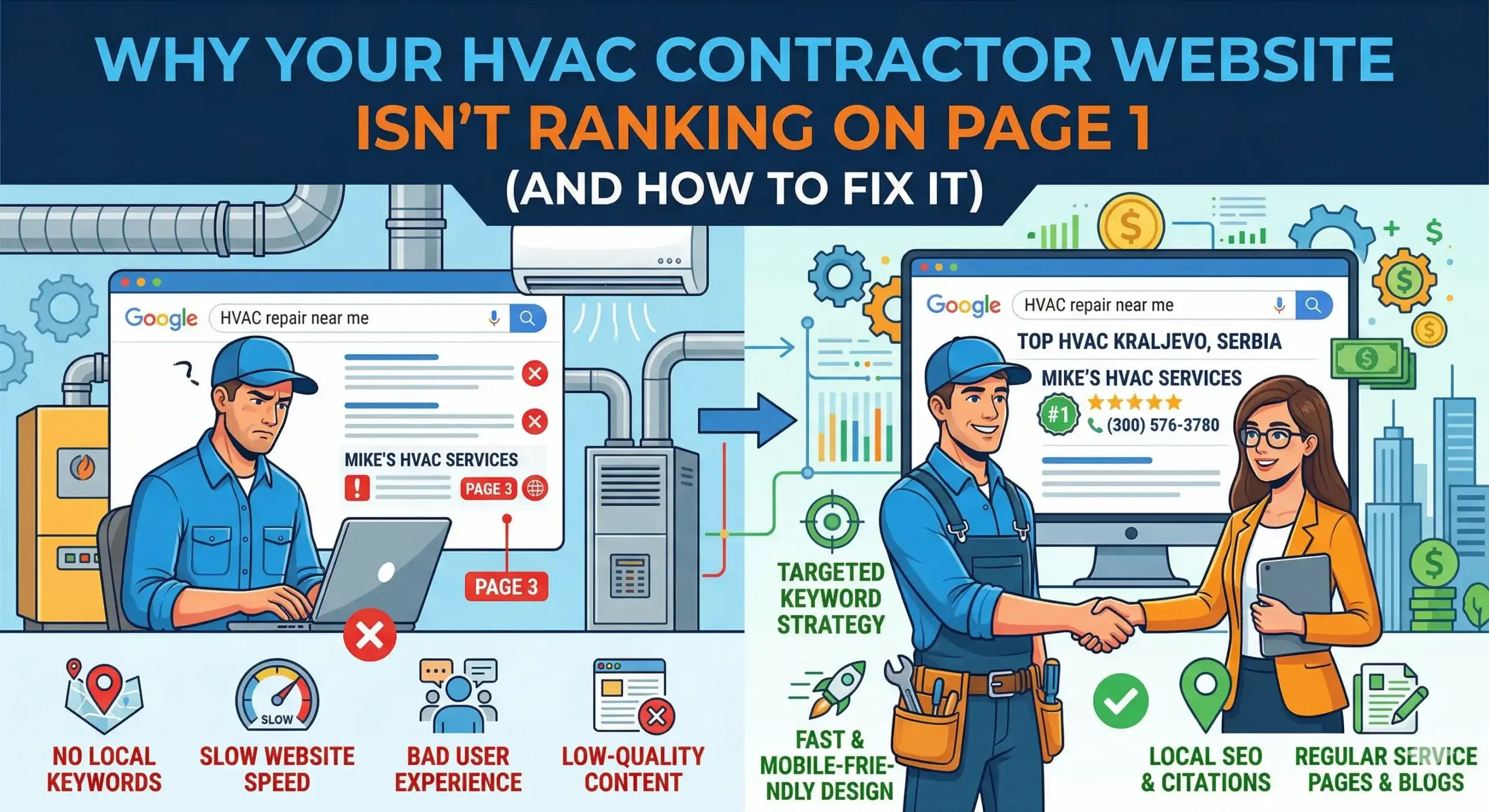
    Why Your HVAC Contractor Website Isn’t Ranking on Page 1 (And How to Fix It)

    In the HVAC industry, Page 2 of Google is a graveyard. When a homeowner’s AC fails in a heatwave or a furnace quits in mid-January, they don’t scroll through pages of search results. They click the first three companies that look professional, trustworthy, and ready to help.

    If your phone isn’t ringing, your “digital trace” is likely invisible to your target market. Having a basic hvac website is no longer enough; you need a high-performance sales engine. Most heating and cooling websites fail not because the owner lacks expertise, but because the site fails to meet the rigid technical and psychological standards required by Google and US consumers.

    Here is why your site is lagging and the strategic shifts needed to claim Page 1.

    1. Failure to Optimize for Mobile-First Indexing

    Google primarily uses the mobile version of your content for indexing and ranking. Many hvac company websites were built for desktops, with mobile being an afterthought.

    • The Problem: If your site takes more than three seconds to load on a 4G connection, or if buttons are too close together for a thumb to click, your bounce rate will skyrocket.
    • The Fix: Transition to a responsive framework. Ensure your “Emergency Service” button is “sticky” at the bottom of the mobile screen. Speed is a ranking factor; optimizing image delivery and leveraging browser caching is a prerequisite for any hvac web design agency worth its salt.

    2. Low “Trust Signals” and Poor User Experience (UX)

    The best hvac websites do more than list services; they build immediate authority. Homeowners are inviting a stranger into their homes; your website must bridge that trust gap.

    Technical Trust Markers

    • SSL Encryption: If your site says “Not Secure” in the browser bar, Google will penalize your ranking.
    • ADA Compliance: In the US market, ensuring your site is accessible to users with disabilities isn’t just a best practice—it’s a legal necessity that prevents costly lawsuits and improves overall SEO.

    Visual Trust Markers

    • Real Imagery: Stock photos of generic technicians hurt your brand. Use high-resolution photos of your actual branded vans and team.
    • Social Proof Integration: Don’t just link to Yelp. Embed live Google Reviews directly onto your ac repair website to show real-time reliability.

    3. Lack of Local Intent and Schema Markup

    You aren’t competing with HVAC companies nationwide; you’re competing with the guy three miles down the road. Generic hvac web design services often miss the “Local” in Local SEO.

    • Local Inventory: Your site needs dedicated landing pages for every city you service. A page optimized for “AC Repair in [City Name]” will always outrank a generic “Services” page.
    • Schema Markup: This is backend code that tells search engines exactly what your business is. It identifies your phone number, service area, and ratings so Google can display them as “Rich Snippets” in search results. Without this, you are invisible to the “Map Pack.”

    4. Content That Doesn’t Answer the “Emergency”

    Google rewards “Search Intent.” When someone searches for air conditioning website help, they usually have a specific problem (e.g., “AC blowing warm air”).

    If your content is thin or overly technical, you lose the lead. To rank among the top hvac websites, your content must:

    1. Identify the symptom.
    2. Explain the potential cause in simple terms.
    3. Provide a clear “Book Now” solution.

    5. The “Digital Trace” Advantage: Aesthetics vs. Performance

    Many hvac website design companies focus on making a site look “nice.” At Digital Trace, we know that a beautiful site that doesn’t rank is a liability, not an asset.

    High-end aesthetics must be balanced with technical performance. We focus on the “Core Web Vitals”—the specific metrics Google uses to measure a user’s experience. If your current site has high “Cumulative Layout Shift” (elements jumping around as they load), Google will suppress your ranking, regardless of how good your logo looks.


    Audit Your Digital Footprint

    Your website should be your hardest-working salesperson, generating leads while you’re out on service calls. If it’s not appearing on Page 1, you are actively handing market share to your competitors.

    Is your website working for you, or against you?

    Stop guessing why your rankings are stagnant. Visit Digital Trace today for a comprehensive website audit. We will analyze your current performance, identify the technical bottlenecks, and show you exactly how to optimize your digital trace for maximum ROI and growth.

    Get Your Free HVAC Website Audit at Digital Trace

  • HVAC Website Builder vs. Professional Agency: What’s the Real ROI?

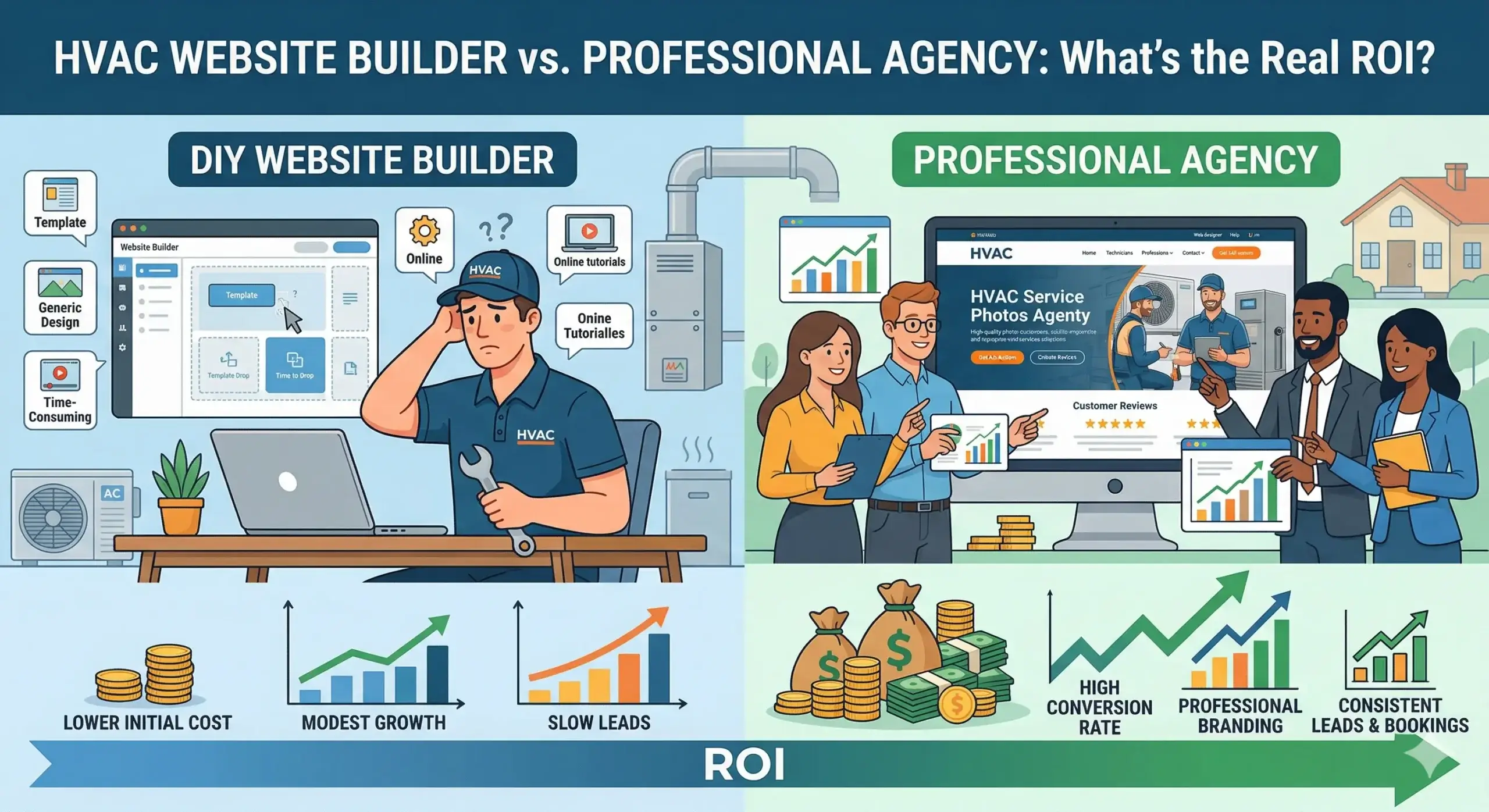
    HVAC Website Builder vs. Professional Agency: What’s the Real ROI?

    For many US-based HVAC business owners, the appeal of a “DIY” website builder like Wix, Squarespace, or GoDaddy is obvious: it’s cheap, fast, and looks “good enough.” You pick a template, drag in a few photos of your fleet, and launch.

    But six months later, the phone isn’t ringing. Your site is buried on page four of Google, and the few visitors you do get leave within seconds.

    In the high-stakes world of residential and commercial service, your website isn’t a digital brochure—it’s your 24/7 dispatcher. If that dispatcher is slow, confusing, or invisible, you aren’t saving money; you’re losing market share. To understand the real ROI of hvac website design, we have to look past the monthly subscription fee and into the mechanics of lead generation.

    The “Drag-and-Drop” Ceiling: Why Builders Stunt Growth

    Website builders are designed for generalists. They prioritize ease of use over technical performance. For a local service business, this creates three critical “performance ceilings”:

    1. Bloated Code and Slow Load Times

    Generic builders use heavy, “one-size-fits-all” code to make drag-and-drop possible. This results in slow page speeds. In the HVAC industry, speed is a conversion factor. If a homeowner’s AC dies in a 90-degree heatwave, they won’t wait five seconds for your “About Us” page to load. They will click the next result in the Google Map Pack.

    2. The SEO “Black Box”

    While builders offer basic SEO tools, they often lack the “technical depth” required for competitive hvac services. Professional agencies implement advanced Schema Markup (LocalBusiness data), which tells Google exactly which zip codes you service and what your average rating is. Without this, you’re fighting for visibility with one hand tied behind your back.

    3. Lack of True Mobile-First Architecture

    Most builders “respond” to mobile screens, but they aren’t built for them. Mobile-first indexing is the standard for Google in the US. A professional hvac web design agency builds for the thumb—placing “Click to Call” buttons and “Schedule Now” forms in high-conversion zones that templates simply can’t accommodate.

    Precision Engineering: The Digital Trace Approach

    At Digital Trace, we view hvac company websites as high-performance machinery. Just as you wouldn’t install a generic, unbranded furnace in a 5,000-square-foot home, you shouldn’t install a generic template for your business.

    Technical Performance as a Revenue Driver

    We focus on the “Core Web Vitals”—a set of metrics Google uses to measure user experience. High scores in these areas lead to higher rankings. When we provide hvac website design, we ensure:

    • LCP (Largest Contentful Paint): Ensuring your main offer is visible in under 2.5 seconds.
    • CLS (Cumulative Layout Shift): Preventing annoying shifts in content that cause users to click the wrong button.

    Local SEO and ADA Compliance

    The US market has specific legal and algorithmic requirements. ADA Compliance (Web Content Accessibility Guidelines) isn’t just about avoiding lawsuits; it’s about ensuring every potential customer, regardless of ability, can book your services. Furthermore, we optimize for Local SEO, ensuring your “AC repair website” appears exactly when a local user searches for “emergency cooling repair near me.”

    Calculating the ROI: The Math of Professional Design

    Let’s look at the numbers.

    • The DIY Route: Costs $30/month. If it generates 2 leads a month with a 10% closing rate, and your average job is $5,000, your monthly revenue from the site is $1,000.
    • The Professional Route: Requires a larger upfront investment. However, through expert hvac web design services, your site now ranks in the top 3 of the Map Pack. You generate 20 leads a month. With a professional UI/UX, your closing rate moves to 20%. Your monthly revenue is now $20,000.

    The “expensive” agency isn’t a cost; it’s a multiplier. The best hvac websites aren’t just pretty; they are engineered to reduce the cost per lead (CPL) and increase the lifetime value of a customer.

    Does Your Current “Digital Trace” Command Authority?

    A website that looks outdated or functions poorly tells a customer that your service might be outdated or poor, too. In an industry built on trust and technical expertise, your digital presence must mirror the quality of your field tech’s work.

    Top hvac website design companies don’t just give you a site; they give you a competitive advantage. If your current site is a liability rather than an asset, it’s time to shift from a “builder” mindset to an “authority” mindset.

    Optimize Your Growth

    Is your website helping you scale, or is it holding you back? Contact Digital Trace today for a free website audit. Let’s analyze your current performance and show you exactly how much revenue you’re leaving on the table.

  • HVAC Web Design: 7 Must-Have Features for High-Converting Service Pages

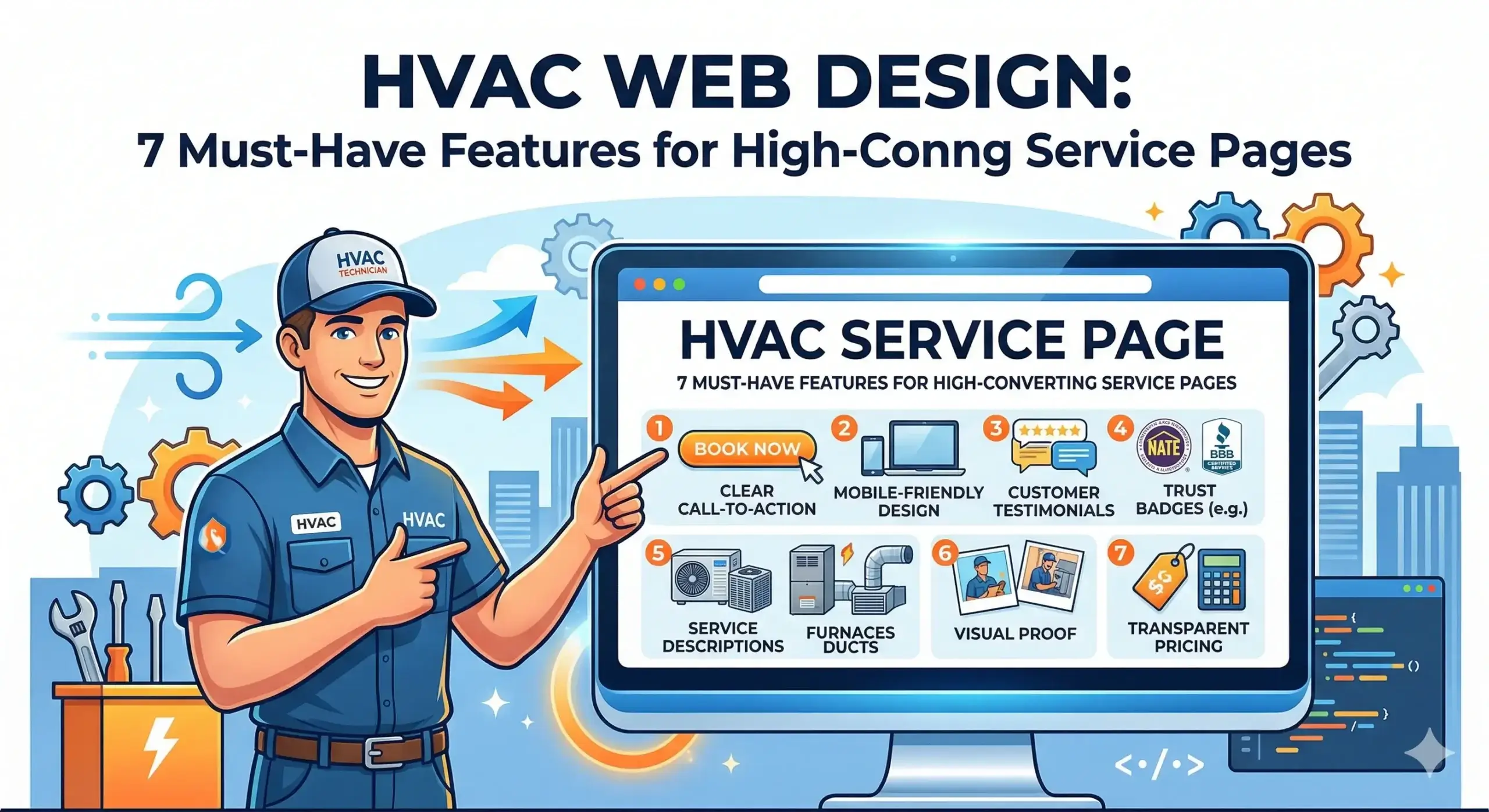
    HVAC Web Design: 7 Must-Have Features for High-Converting Service Pages

    In the competitive US residential services market, your website is no longer just a digital business card; it is your 24/7 sales representative. Most heating and cooling websites suffer from a “leaky bucket” syndrome—spending thousands on local ads only to send traffic to a site that fails to convert.

    If your hvac website design isn’t actively generating booked appointments, it’s a liability. To dominate your local territory in 2026, your site must balance high-end aesthetics with “trust architecture.”

    Here are the seven non-negotiable features every high-converting HVAC service page needs.


    1. Instant Booking & Low-Friction Lead Capture

    Modern homeowners expect Amazon-level convenience. If a customer has to search for a “Contact Us” page or fill out a 10-field form to get an ac repair website quote, they will bounce to a competitor.

    • The Fix: Integrate direct scheduling tools (like Housecall Pro or ServiceTitan) directly above the fold.
    • The Business Benefit: Reducing the steps to book an appointment directly correlates with a lower cost-per-acquisition (CPA).

    2. Localized SEO Architecture & Schema Markup

    For an hvac web design business, visibility is about more than just keywords. You need technical “Local Business” Schema markup so Google and AI search engines understand exactly which zip codes you service.

    • The Fix: Create dedicated landing pages for each service area (e.g., “Furnace Repair in Chicago”) rather than one generic service page.
    • Technical Depth: Use Geo-coordinates in your metadata to ensure your air conditioning website appears in the “Map Pack” and AI-generated local recommendations.

    3. Mobile-First Performance (Core Web Vitals)

    Over 70% of HVAC leads are generated on mobile devices, often during an emergency. If your hvac website takes more than 2.5 seconds to load (the LCP threshold), you’ve lost the lead.

    • The Digital Trace Angle: We don’t just build “pretty” sites; we optimize for performance. Fast load times are a ranking factor and a psychological trust signal. A slow site implies a slow service response.

    4. Trust Signals: Real-Time Social Proof

    Stock photos of “happy families” don’t sell HVAC services in 2026. US consumers are skeptical of generic branding.

    • The Fix: Embed live Google Review widgets and high-resolution, original photos of your branded trucks and uniformed technicians.
    • AEO Strategy: Use structured data for “AggregateRating” to ensure your 5-star rating appears directly in search results and AI snapshots.

    5. ADA Compliance & Accessible Design

    In the US, web accessibility is both a legal necessity and a conversion booster. Top hvac websites ensure that senior citizens or those with visual impairments can easily navigate their services.

    • The Fix: High-contrast buttons, screen-reader compatibility, and keyboard-navigable menus.
    • The Business Benefit: ADA compliance protects you from litigation while expanding your reachable audience.

    6. Visual Proof & Case Studies

    Heating and cooling is a “invisible” service until it fails. Use your hvac company websites to make the value visible.

    • The Fix: Include a “Before & After” gallery of complex installations. Documenting a messy attic-to-clean-install transition proves your team’s professionalism better than any marketing copy.

    7. The “Above the Fold” Value Proposition

    You have roughly three seconds to answer three questions for a visitor:

    1. What do you do?
    2. Where do you do it?
    3. How do I book you?
    • The Fix: Your H1 should be specific (e.g., “Professional AC Repair & Installation in Dallas”). Your CTA should be a high-contrast button like “Get Emergency Service Now.”

    Optimize Your Digital Trace

    Your website is either an engine for growth or a roadblock to your success. Is your current “digital trace” helping you win more local jobs, or is it handing them to your competitors?

    Visit Digital Trace today for a free HVAC website audit. Let’s turn your site into a high-performance lead machine.

  • The Essential Guide to Web Design and Development Integration

    The Essential Guide to Web Design and Development Integration

    For most US small business owners, a website is often viewed through a binary lens: it either looks good or it works. This separation is a costly mistake. If your “beautiful” site has a high bounce rate, or your “functional” site lacks brand authority, you aren’t just losing clicks—you’re losing market share to competitors who understand that web design and development must function as a single, integrated unit.

    At Digital Trace, we see the “digital trace” your business leaves behind. To convert modern consumers, your site must balance high-end aesthetics with rigorous technical performance. Here is how to integrate these disciplines to drive real business growth.

    The Myth of the “Pretty” Website

    Aesthetics attract, but infrastructure converts. You might have the most visually stunning website design and development project in your industry, but if the underlying code is bloated, your search engine rankings will suffer.

    In the US market, consumer patience is at an all-time low. If your site takes longer than 2.5 seconds to load, you lose 40% of your audience before they even see your logo. Integration means designing with performance in mind from day one, ensuring that high-resolution imagery doesn’t compromise your Core Web Vitals.

    Why Integration is the Key to ROI

    True web design and web development integration isn’t just about collaboration; it’s about cross-functional strategy.

    1. Mobile-First Indexing as a Standard

    Since Google’s shift to mobile-first indexing, your mobile site is your primary site for SEO. An integrated approach ensures that the design isn’t just “shrunk” for smaller screens, but re-engineered for thumb-friendly navigation and lightning-fast mobile rendering.

    2. Conversion Rate Optimization (CRO)

    A designer creates the “Buy Now” button; a developer ensures it triggers the pixel, tracks the data, and processes the transaction without friction. If these two aren’t aligned, your sales funnel will leak. Integration ensures that the user journey is seamless from the first visual hook to the final checkout.

    3. SEO-Driven Architecture

    Modern SEO is no longer just about keywords. It’s about site structure, schema markup, and internal linking. When web design and development work together, the site’s architecture is built to be crawled easily by search engines while remaining intuitive for human users.

    Navigating US Market Standards

    Operating in the US requires adherence to specific technical and legal standards that many generic templates ignore.

    • ADA Compliance: Accessibility is not optional. Ensuring your site is WCAG 2.1 compliant protects your business from litigation and expands your reach to the millions of Americans with disabilities.
    • Local SEO Integration: For small businesses, appearing in the “Local Map Pack” is vital. Integrated development ensures your NAP (Name, Address, Phone) data is consistent and wrapped in the correct local business schema.
    • Data Privacy: With the rise of state-specific regulations like CCPA, your development team must integrate robust data handling and cookie consent protocols into the design without ruining the UX.

    The Digital Trace Advantage: Performance Meets Artistry

    Generic agencies often outsource development or use rigid templates that stifle growth. At Digital Trace, we bridge the gap. We believe that your website should be your hardest-working employee.

    We focus on the intersection of technical performance (speed, security, and SEO) and human-centric design (brand storytelling and UX). This synergy ensures that your website doesn’t just sit there—it scales.


    Optimize Your Digital Trace Today

    Is your current website a liability or an asset? Don’t let a disconnected digital presence hold your business back.

    Contact Digital Trace for a Free Website Audit

    Discover exactly where your site is losing leads and how a professionally integrated approach to web design and development can transform your bottom line. Let’s make your digital trace unmistakable.

  • How to Choose the Right Web Design Company for Your Business

    How to Choose the Right Web Design Company for Your Business

    Most business websites are digital paperweights—visually “fine” but invisible to search engines and ignored by customers. You are likely spending thousands on traffic only to see a high bounce rate and stagnant conversion numbers. If your current site feels like an outdated brochure rather than a 24/7 sales machine, you aren’t just losing clicks; you’re ceding market share to competitors who treat their UI/UX as a strategic asset.

    To scale, you need more than a freelancer with a template. You need a web design company that aligns technical architecture with your business goals. At Digital Trace, we believe high-quality design is the primary growth lever for modern brands. This guide outlines how to vet a partner that delivers measurable ROI.


    1. Beyond Aesthetics: What the Best Web Design Agencies Actually Deliver

    Visual appeal is the baseline, not the goal. When evaluating the best web design agencies, look for a firm that prioritizes the “under the hood” mechanics. A beautiful site that takes five seconds to load is a failed investment.

    We focus on the intersection of three pillars:

    • User Intent Mapping: Every design element must guide the user toward a specific action (e.g., booking a demo or completing a purchase).
    • Scalable Architecture: Your site should be built to grow, utilizing modular components or a headless CMS approach to ensure longevity.
    • SEO-First Framework: Search visibility should be baked into the wireframes, not “bolted on” after the site goes live.

    2. Technical Infrastructure: Evaluating a Website Design Firm on Performance

    The gap between a standard website design firm and a high-end agency often lies in technical execution. In 2026, Google’s ranking algorithms are increasingly focused on Page Experience and real-world performance metrics.

    Technical Expert Insight: The Performance Stack

    Pro-Tip: Core Web Vitals & Schema Ensure your agency understands Interaction to Next Paint (INP). A site that feels sluggish during user interaction will suffer in rankings. Furthermore, demand JSON-LD Schema Markup integration. This structured data allows search engines to understand your business type, reviews, and services, directly increasing your click-through rate via rich snippets.

    If an agency cannot explain their strategy for minimizing Cumulative Layout Shift (CLS) or their approach to image optimization (e.g., WebP/AVIF delivery via CDN), they are likely selling you a template, not a professional solution.


    3. Vetting for Business Logic and Conversion UX

    A top-tier website design company functions as a business consultant. During your initial discovery call, observe if they ask about your color preferences or your customer’s pain points.

    The Digital Trace Vetting Checklist:

    • [ ] Portfolio Diversity: Do they have experience in your industry or with similar business models (B2B vs. D2C)?
    • [ ] Case Studies: Can they show a direct correlation between a redesign and an increase in conversion rate (CRO)?
    • [ ] Post-Launch Support: Do they offer performance monitoring and security updates, or do they disappear after the site goes live?
    • [ ] Accessibility (AODA/ADA): Is the design inclusive? Non-compliant sites are a legal liability and a missed market opportunity.

    4. The Value of Data-Driven Design

    We don’t guess; we validate. The right partner uses heatmapping and A/B testing data to inform design decisions. When you hire a web design company, you are paying for their ability to interpret user behavior and turn those insights into a friction-less interface. This “Data-First” approach ensures that your new site isn’t just a subjective improvement, but a statistically proven upgrade to your sales funnel.


    Elevate Your Digital Footprint

    Choosing a partner is the difference between a cost center and a revenue generator. Your website is the most important member of your sales team—it’s time to give it the tools it needs to succeed.

    Is your current website holding your business back? Let’s find out. We invite you to schedule a Digital Trace Audit. Our experts will analyze your current site’s Core Web Vitals, SEO health, and UX friction points to provide a roadmap for your next phase of growth.

    Book Your Free Audit Today

  • Why Most WooCommerce Stores Fail (And How to Avoid It)

    Why Most WooCommerce Stores Fail (And How to Avoid It)

    Common Pitfalls of WooCommerce Stores

    Many WooCommerce store owners encounter a range of challenges that can lead to their ultimate failure. Understanding these common pitfalls is crucial for any entrepreneur looking to build a successful online retail business. One of the primary mistakes is poor product selection. Oftentimes, store owners either choose products without sufficient market research or fail to update their inventory based on consumer demand. This misalignment can lead to dissatisfaction among consumers and result in dwindling sales.

    Inadequate marketing strategies also pose a significant threat to the sustainability of WooCommerce stores. Many owners underestimate the importance of a comprehensive marketing plan that includes search engine optimization (SEO), social media engagement, and email marketing. Relying solely on organic traffic without a structured promotional strategy can severely limit visibility and brand growth.

    High competition within the eCommerce landscape further complicates the situation. New WooCommerce stores often arise in saturated niches, making it difficult for new entrants to differentiate themselves. Failing to identify a unique selling proposition can result in being overlooked by potential customers who have numerous alternatives at their disposal. Additionally, an insufficient understanding of the target audience can lead to wasted resources on ineffective marketing and product offerings.

    Many store owners neglect to conduct customer research, missing vital insights that would guide their product selection and marketing efforts. Addressing these common pitfalls—by ensuring careful product selection, implementing a robust marketing strategy, distinguishing oneself in a competitive market, and understanding the target audience—can significantly enhance the prospects of success for WooCommerce stores. By being aware of these challenges, entrepreneurs can pivot their strategies towards more effective approaches, ultimately steering their stores away from failure.

    Importance of Proper Planning and Strategy

    Establishing a successful WooCommerce store requires more than just setting up an online shop and adding products. One of the most crucial aspects of a successful e-commerce venture is having a comprehensive business plan and a well-thought-out marketing strategy. Without these foundational elements, many stores find themselves struggling to gain traction, leading to potential failure.

    Before launching a WooCommerce store, it is imperative to conduct thorough market research. This involves understanding your target audience, analyzing competitors, and identifying current market trends. Knowledge gleaned from market research enables entrepreneurs to tailor their offerings and services, ensuring that they meet the demands and preferences of their potential customers. Furthermore, it lays the groundwork for informed decision-making throughout the lifespan of the business.

    In addition to market research, financial forecasting is another essential component of proper planning. By estimating startup costs, operational expenses, and projected revenues, business owners can create a realistic budget that helps navigate the financial aspects of running an online store. Financial forecasts also assist in setting measurable goals, which can motivate the team and provide direction for the business as a whole.

    Moreover, setting clear, specific goals is vital for maintaining focus and alignment within the WooCommerce store. These goals should be periodically reviewed and adjusted as needed to reflect changes in the market or business performance. Having a strategic plan not only guides the day-to-day operations but also prepares the business owner to address challenges and leverage opportunities that arise.

    Ultimately, proper planning and strategy are fundamental in reducing the risk of failure for WooCommerce stores. By investing time and resources into planning, entrepreneurs can establish a solid foundation for growth, paving the way for success in the competitive online marketplace.

    Optimizing Your WooCommerce Store for Success

    To enhance the efficiency of your WooCommerce store and mitigate the risk of failure, it is critical to focus on optimization strategies that improve both user experience and operational performance. Prioritizing customer satisfaction begins with a streamlined user interface. Ensure that your store is easy to navigate by organizing products into well-defined categories and providing clear filters that allow users to find what they need quickly. Simplifying the checkout process can significantly reduce cart abandonment rates, so consider minimizing the number of steps required to complete a purchase.

    An increasingly important factor is mobile responsiveness. With a significant portion of online shopping conducted via mobile devices, your WooCommerce store must offer a seamless experience across all platforms. This includes ensuring that images and links are easily clickable and that text is readable without excessive zooming. Utilize responsive design principles to adapt layouts for various screen sizes.

    Site speed is another critical element; a slow-loading site can deter potential customers and hurt your search engine rankings. Optimize images and use caching plugins to enhance performance. Regularly testing and monitoring your website’s loading time will help identify areas for improvement, contributing to a better overall shopping experience.

    Lastly, implementing effective SEO techniques is vital for directing traffic to your WooCommerce store. Use relevant keywords thoughtfully throughout your product descriptions, blogs, and meta tags. Developing high-quality content that answers potential customers’ questions can also improve your site’s visibility in search results. To enhance your store’s reputation, encourage satisfied customers to leave reviews and ratings, reinforcing social proof.

    By incorporating these strategies, WooCommerce store owners can significantly increase their chances of success, resulting in higher conversion rates and overall customer satisfaction.

    Continuous Improvement and Adaptation

    In the ever-evolving world of e-commerce, particularly with platforms like WooCommerce, the significance of continuous improvement and adaptation cannot be overstated. As consumer habits shift and technology advances, online shop owners must remain vigilant and responsive to changes within the market. This entails not only staying informed about the latest industry trends but also being aware of evolving customer preferences. E-commerce is dynamic; thus, the ability to adapt is a key component of success.

    One effective strategy for achieving this adaptability is through the collection and analysis of customer feedback. This feedback serves as a valuable resource for store owners, providing insights into what customers appreciate as well as areas that need enhancement. With WooCommerce, store owners have access to various plugins and tools that can facilitate the gathering of customer opinions. By analyzing this data, shop owners can pinpoint specific products or services that may be underperforming and take actionable steps to improve them.

    Moreover, it is essential for WooCommerce store owners to invest time in education and training. Online courses, webinars, and articles can provide deeper insights into not only improving product offerings but also optimizing the overall shopping experience. Keeping abreast of technological advancements, such as new payment gateways or shipping solutions, can make a significant difference in customer retention and satisfaction.

    Ultimately, the willingness to embrace change, coupled with a keen understanding of customer needs, can empower WooCommerce store owners to refine their approach continually. This proactive stance not only enhances the shopping experience but is also crucial for long-term success in a competitive e-commerce landscape.