Category: Roofing

  • 10 Reasons Your Roofing Website Isn’t Generating Leads (And How to Fix It)

    10 Reasons Your Roofing Website Isn’t Generating Leads (And How to Fix It)

    You’ve got a website. You’ve been in the roofing business for years. But the phone isn’t ringing the way it should — and you’re watching your competitor’s trucks roll past your house every morning on the way to another job.

    Here’s the hard truth most roofing contractors don’t hear: a website that exists is not the same as a website that works. The roofing website design decisions made when your site was built — or left unmade — determine whether Google sends customers to you or your competition. Most roofing business owners assume they need more advertising when the real problem is a website that’s quietly killing every lead before it even starts.

    Below are the 10 most common reasons your roofing website isn’t converting — and what actually fixes them.


    1. Your Site Loads Too Slowly and Visitors Leave Before Seeing Your Phone Number

    Think about how a homeowner searches for a roofer after a storm. They’re on a phone, in a panic, clicking through search results fast. If your site takes more than 3 seconds to load, most of them are already gone — they never even saw your number.

    The reason this happens is usually oversized images, bloated code, or cheap shared hosting that crawls under traffic. None of that is visible to you — it just silently drains leads.

    The fix: Optimize every image, host on a fast server, and run regular speed tests. Websites built for roofing businesses should load in under 2 seconds on mobile — full stop.


    2. Your Website Isn’t Built for Mobile — and 70%+ of Your Customers Are On One

    When a homeowner notices a missing shingle or ceiling stain, they don’t sit down at a desktop. They pull out their phone. If your site squishes text, hides your call button, or makes visitors pinch-and-zoom just to read your services, they’re calling someone else.

    A site that looks fine on your office computer can be completely broken on a phone. It’s one of the most common roofing website design problems — and one of the most invisible to the business owner.

    The fix: Test your site on an iPhone and an Android before trusting it. Better yet, have it rebuilt mobile-first so that phone users get a clean, fast experience designed for them.


    3. There’s No Clear Reason to Call You Over the Next Guy

    Scan your homepage. Does it say something like “Quality roofing services at competitive prices”? That’s the same line on every roofer’s website in your market. If a homeowner can’t tell in 5 seconds why they should call you instead of anyone else, they won’t.

    This isn’t a writing problem — it’s a strategy problem. Your website needs to lead with what makes you different: years of local experience, fast response time after storms, specific warranties, real reviews from real neighborhoods.

    The fix: Replace generic claims with specific proof. Name the cities you serve, show photos of your actual work, feature reviews that mention specific neighborhoods or job types.


    4. Google Doesn’t Know Enough About Your Business to Show It in Search Results

    You might offer roof repair, full replacements, gutter work, and storm damage inspections — but if your website doesn’t clearly communicate that to Google, it won’t rank for any of it. There’s a behind-the-scenes layer of information (called structured data or schema markup) that helps Google understand exactly who you are, where you serve, and what you do.

    Without it, Google treats your site with uncertainty. And Google doesn’t send traffic to sites it’s uncertain about.

    The fix: Add proper local business schema to your site so Google can confidently surface you for the searches that matter.


    5. Your Website Has No Local SEO Foundation — So You’re Invisible in Your Own Market

    A homeowner in Columbus, Ohio searching “roof repair near me” won’t find you if your website never actually mentions Columbus — or the neighborhoods around it. Roofing is a hyper-local business, and your website needs to reflect that.

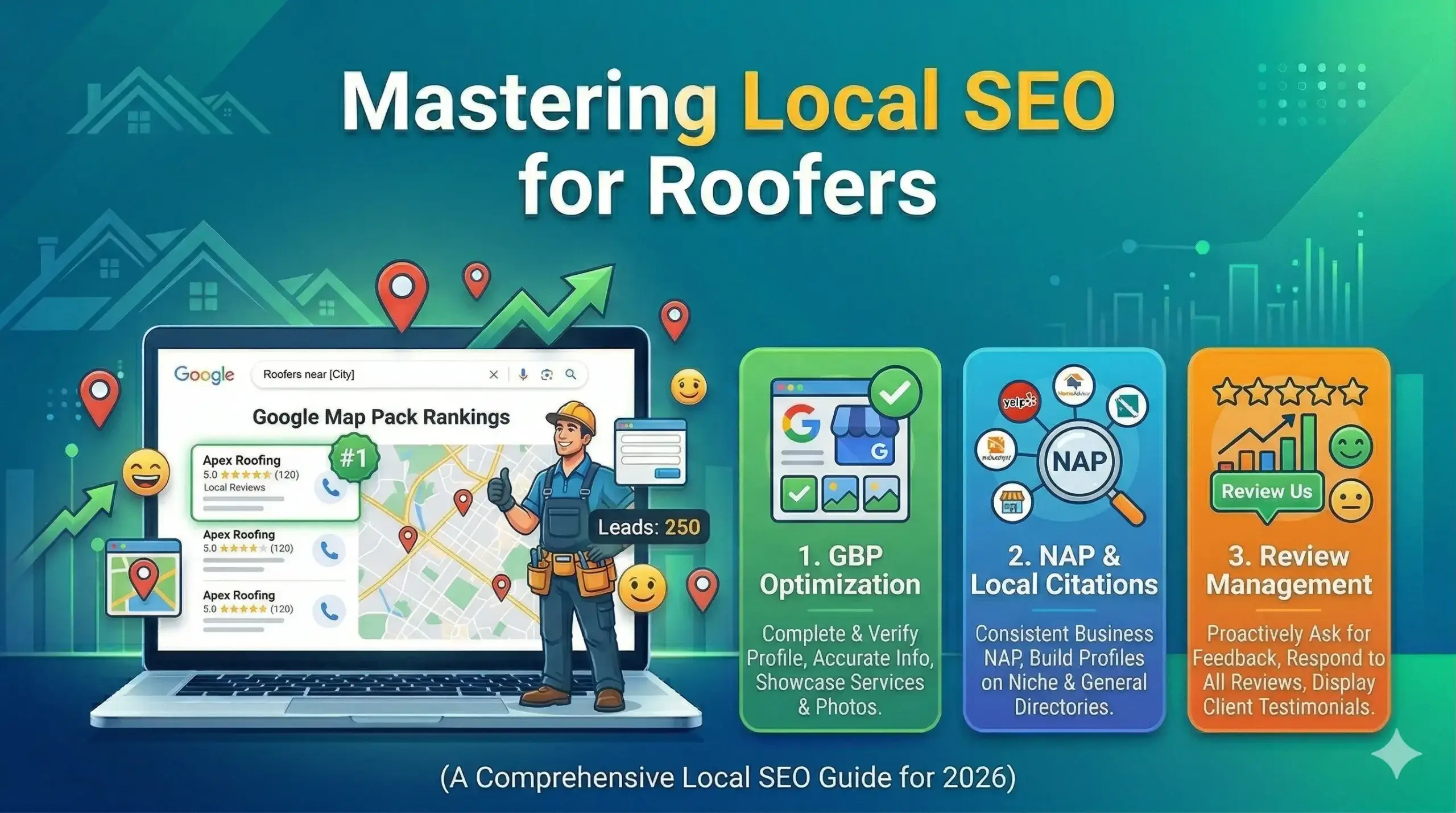
    This is what separates a generic web presence from a true roofing lead generation website. Local SEO for roofing companies means building location-specific pages, optimizing your Google Business Profile, and earning local citations that tell Google you’re an established, trusted business in a specific area.

    The fix: Build dedicated service area pages for every city or county you serve. Each page should speak to that community — not just swap out the city name in a template.


    6. Your Calls to Action Are Weak (Or Buried Where No One Sees Them)

    A prospective customer lands on your site ready to call. Where’s your phone number? Halfway down the page? In the footer? Not click-to-call on mobile? Every extra second it takes someone to find your contact info is a lead you’re losing.

    The same goes for forms. Long, complicated contact forms kill conversions. If you’re asking for more information than a roofer needs to schedule a free estimate, you’re asking for too much.

    The fix: Put a click-to-call phone number at the top of every page. Keep contact forms to 3 fields max: name, phone, and what they need. Make the next step obvious, instant, and frictionless.


    💡 Pro Tip

    One of the most common mistakes roofing business owners make is assuming their homepage is what most visitors see first. In reality, many people land on an inner page — a service page, a blog post, or a location page — from Google. If those pages don’t have their own clear calls to action and local details, you’re losing leads from traffic you don’t even know you have. Every page on your site should work as a standalone entry point, not just a supporting character.


    7. You’re Not Showing Up in the Map Pack — Where the Real Clicks Are

    When someone searches “roofing contractor [your city],” they usually see a map with three local businesses before any regular website results. That map pack gets the lion’s share of clicks. If you’re not in it, you’re competing for the scraps.

    Getting into the local map pack isn’t about luck. It requires a fully optimized Google Business Profile, consistent Name/Address/Phone information across the web, and a steady flow of genuine customer reviews.

    The fix: Claim and fully complete your Google Business Profile. Add photos, service areas, and business hours. Then actively ask every happy customer to leave a review — it’s one of the highest-impact things you can do.


    8. Your Website Has No Way to Build Trust With Someone Who’s Never Met You

    A homeowner handing you access to their property and writing a check for thousands of dollars needs to trust you first. Your website is often the first place that trust either gets built — or doesn’t.

    A site with no reviews, no photos of real work, no bios, and no credentials is a website that says “you’re taking a risk.” Meanwhile, competitors with before-and-after galleries, manufacturer certifications, and a dozen five-star reviews look like the obvious safe choice.

    The fix: Add real photos of your team and completed jobs. Feature your certifications (GAF, Owens Corning, etc.) prominently. Embed Google reviews directly on your homepage. Social proof is your most powerful sales tool — and it costs nothing to display.


    9. You’re Not Tracking What’s Working — So You Keep Paying for What Isn’t

    Most roofing business owners have no idea which of their marketing efforts actually drives calls. Is it the yard signs? Google Ads? The website? Without tracking, you’re flying blind — and often dumping money into things that aren’t working while ignoring the things that are.

    A properly set-up roofing website connects to Google Analytics and call tracking tools so you can see exactly how many people visited, where they came from, and whether they called.

    The fix: Set up Google Analytics 4 and a call tracking number tied to your website. Even basic data tells you more than gut instinct — and it shows you where to invest next.


    10. Your Website Was Built Once and Never Touched Again

    A roofing website isn’t a set-it-and-forget-it billboard. Google’s algorithm changes constantly. Competitors update their sites. New neighborhoods get built. If your site hasn’t been updated in two years, it’s falling behind — quietly, invisibly, and expensively.

    Search engine optimization for roofing companies is an ongoing process, not a one-time purchase. Fresh content, updated service area pages, new photos, and regular technical checks keep your site competitive.

    The fix: Treat your website like equipment — it needs regular maintenance. Publish new content (project highlights, seasonal tips, local updates) at least once a month. Keep your service pages current with what you actually offer.


    What a Roofing Website Overhaul Actually Looks Like

    A roofing contractor in the Atlanta metro area was spending over $2,000 a month on Google Ads but getting fewer than five qualified calls a week. Their site was five years old, loaded in over six seconds on mobile, had no local pages, and buried the phone number in the footer.

    After rebuilding their roofing website design from the ground up — prioritizing mobile speed, adding location pages for 12 surrounding suburbs, and restructuring every call to action — they went from five calls a week to averaging over 25. Within four months, their organic rankings brought in enough traffic that they cut their ad spend by 40% and still saw more leads. The site paid for itself in under 90 days.

    That’s what how Digital Trace builds roofing websites differently — every decision is built around what actually drives calls, not what looks good in a portfolio screenshot.


    Not sure if your roofing website has these problems? Get a free website audit — no obligation, just a clear picture of what’s costing you leads.


    Your Path to More Leads: 5 Steps That Actually Move the Needle

    Step 1: Audit what you have. Before spending anything, know what’s broken. Speed, mobile experience, local SEO, and calls to action are the four areas to check first.

    Step 2: Fix the foundation. A fast, mobile-friendly site with clear CTAs is the baseline. Nothing else works well without it.

    Step 3: Build out your local presence. Create service area pages for every city you actually work in. Optimize your Google Business Profile. Get your citations consistent.

    Step 4: Make trust visible. Add real photos, real reviews, and your certifications to every page that a potential customer might land on.

    Step 5: Measure and improve. Set up tracking so you know what’s working. Review it monthly. Double down on what drives calls, cut what doesn’t.


    Frequently Asked Questions

    Why am I not getting calls from my website even though it looks professional?

    A good-looking website and a lead-generating website are two different things. Most sites that don’t produce calls are missing the fundamentals: they load too slowly on mobile, they don’t rank for local search terms, or they bury the phone number where no one finds it. A professional design is table stakes — the real work is everything underneath it.

    How do I know if my roofing website is actually working?

    If you don’t have call tracking and Google Analytics connected, you genuinely don’t know. You should be able to see how many people visit your site each month, where they came from, and how many called. If that data isn’t available to you, that’s the first thing to fix. A free website audit will show you exactly where your site stands.

    How long does it take to see results from a new roofing website?

    A properly built site with fast load times and correct local SEO setup can see ranking improvements within 60–90 days. Organic rankings that drive consistent calls typically take 3–6 months. That’s why the site’s technical foundation matters so much — shortcuts on day one set you back by months.

    What makes a roofing website different from a regular business website?

    Roofing is a local, trust-heavy, high-ticket purchase. Your website needs to answer three questions fast: Are you local? Are you trustworthy? How do I reach you right now? A generic business website template doesn’t solve those three problems the way a site built specifically for a roofing contractor does — with local area pages, trust signals like certifications and reviews, and a frictionless path to call.

    Do I really need a fast website if my customers are already local and word-of-mouth sends me work?

    Word-of-mouth is the best lead source you have — until it’s not enough. But here’s the catch: even referral customers Google you before they call. If your site loads slowly or looks outdated on their phone, you lose the referral you already earned. A fast, credible site doesn’t replace word-of-mouth; it converts it.

    Can I just run Google Ads instead of fixing my website?

    You can, but you’ll pay more for worse results. Google Ads send traffic to your website — and if that site doesn’t convert visitors into calls, you’re paying for clicks that go nowhere. The roofing contractors getting the best return from ads have a high-converting site underneath the campaign. The ad is the fuel; the website is the engine.


    Ready to Find Out What’s Costing You Leads?

    Most roofing businesses don’t know what their website is actually costing them — not in monthly fees, but in calls that never came in, leads that bounced, and jobs that went to the competitor down the street.

    A free website audit from Digital Trace gives you a clear, no-jargon picture of what’s working, what isn’t, and what to prioritize first. No sales pitch. No obligation. Just straight answers about your site’s performance.

    Book your free website audit — and find out exactly where your leads are going.
  • Why Every Roofing Company Needs SEO to Survive in 2026

    Why Every Roofing Company Needs SEO to Survive in 2026

    You finished a strong job last week. The homeowner was thrilled. You asked them how they found you — and they said, “Google.”

    The problem? That call almost didn’t happen. A competitor showed up first. The homeowner clicked on them, got a fast, clean website with clear pricing and real reviews — then kept scrolling until they found you buried halfway down the page. They gave you a shot. Next time, they might not.

    This is exactly what’s happening to roofing companies across the country every single day. Not because they do bad work — but because their online presence doesn’t match the quality of their crews. This article breaks down why roofing SEO has gone from a “nice to have” to a survival tool, and what the best roofing companies are doing differently right now.


    Your Competitor’s Phone Is Ringing. Here’s Why Yours Isn’t.

    When a homeowner spots a damaged shingle or suspects they need a full replacement, they don’t ask around. They open Google and type something like “roofing company near me” or “roof repair [city].” Then they call whoever shows up first.

    That’s it. The entire buying decision starts and ends on that results page.

    If your roofing company isn’t ranking in the top 3 results — or worse, not showing up at all — those leads are going straight to whoever is. Roofing SEO is the process of making sure Google knows your business exists, trusts it, and shows it to the right people at exactly the right moment.

    Here’s the frustrating part: most roofing companies have a website. They’ve just never done anything to make it work as a lead machine. A website with no SEO is like a billboard facing the wrong direction — it exists, but nobody driving past ever sees it.


    Your Website Might Be Losing You Jobs Before Anyone Picks Up the Phone

    Think about the last time you pulled up a slow website on your phone. You waited two seconds, maybe three — then hit the back button without even reading it.

    Your customers do the exact same thing.

    Google tracks how fast your site loads, and if it’s slow, Google pushes it down in the rankings before your customer even gets the chance to leave. A site that takes more than 3 seconds to load loses the majority of mobile visitors — and most homeowners are searching on their phones, often right after noticing a problem with their roof.

    Speed is just one piece. Google also looks at:

    • Whether your site is easy to navigate on a phone screen
    • Whether it has clear calls to action (a phone number, a contact form, a “Get a Free Quote” button)
    • Whether the content on the page is relevant and trustworthy

    A roofing contractor website that checks all those boxes doesn’t just rank higher — it converts more visitors into actual calls. That’s the difference between a site that looks good and one that actually works.

    At Digital Trace, every roofing website we build is optimized from the ground up for speed, mobile performance, and conversions — not just aesthetics.


    Google Doesn’t Know Enough About Your Business to Trust It

    Here’s something most roofing business owners never hear from web agencies: Google isn’t just ranking websites — it’s ranking trustworthy, locally relevant businesses.

    If your Google Business Profile is incomplete, your business name and address aren’t consistent across the web, or your site has no reviews tied to it — Google gets nervous. It doesn’t want to recommend a business it can’t verify.

    This is what’s actually behind the phrase “local SEO for roofing companies.” It means:

    • Your Google Business Profile is fully filled out, verified, and actively getting reviews
    • Your name, address, and phone number are identical across every directory on the web (Google, Yelp, Angi, etc.)
    • Your website tells Google exactly which cities and neighborhoods you serve
    • You have structured data (called “schema”) on your site — invisible to visitors, but it signals to Google: “This is a roofing contractor in [city], here’s their license number, here are their service areas”

    When all of that is in place, Google starts showing your business confidently in local searches. When any of it is missing or inconsistent, you leak rankings to competitors who have it sorted out.


    💡 Pro Tip: The Duplicate Listing Problem That’s Quietly Tanking Your Rankings

    One of the most common — and invisible — issues we find in roofing company audits: duplicate Google Business listings. This happens when a profile gets created twice (once by the owner, once automatically by Google), and neither one is fully claimed or optimized.

    Google penalizes duplicate listings by splitting your credibility and reviews across two profiles. The fix is straightforward — claim, merge, and clean up — but it has to be done correctly or you risk losing your existing reviews. Before you assume your local SEO is fine, search your exact business name on Google Maps and verify there’s only one listing, fully in your control.


    What Happens When a Roofing Company Gets This Right

    Before: A roofing contractor in the Dallas–Fort Worth area had been in business for nine years. Solid reputation, mostly word-of-mouth. Their website was a basic five-page site built in 2018 — slow, not mobile-friendly, and buried on page 3 of Google for every relevant search. They were spending $2,000/month on pay-per-click ads just to keep the phone ringing.

    After: After a full website rebuild and a structured roofing SEO campaign — fixing their local citations, optimizing their Google Business Profile, building out location-specific service pages, and improving site speed — the results shifted within 4 months. The company started ranking in the local 3-pack for 12 high-intent search terms across 3 cities. Organic leads tripled. They cut their ad spend by more than half and were still booking more jobs than before.

    The site didn’t just look better. It started doing the work their ads used to do — except it didn’t cost them every time someone clicked.


    Not sure if your roofing website has these issues? Get a free website audit — no obligation, just a clear picture of what’s costing you leads.


    The Design Problem Nobody Talks About

    There’s a pattern that shows up in almost every roofing company website audit: the site was built by someone who understood design, but not roofing — or understood the internet, but not how homeowners actually make buying decisions.

    The result is a website that looks like it was built to impress the business owner, not to convert a worried homeowner who just spotted a leak.

    The best roofing websites do a few things that most roofing sites don’t:

    • Lead with trust signals immediately — licensing, insurance badges, certifications, and reviews appear above the fold, before the visitor has to scroll
    • Make the phone number unmissable — large, clickable, and visible on every single page
    • Use real photos — stock images of roofs signal generic; photos of your own crews, your own work, and your own vehicles signal real and local
    • Have specific service pages — one page for “roof repair,” a separate one for “roof replacement,” another for “storm damage claims” — because Google (and homeowners) want specifics

    Generic websites lose jobs to specific ones. If your site looks like it could belong to any roofing company in any city, it probably isn’t ranking for your city.

    Explore how Digital Trace builds roofing websites that are built to convert, not just to exist.


    Your Path to More Roofing Leads: A Simple Breakdown

    If you want your website to start generating consistent, qualified leads, here’s what needs to happen — in plain terms:

    1. Fix your website’s foundation. Speed, mobile performance, and clear calls to action come first. None of the other stuff works if the base is broken.
    2. Get your Google Business Profile working properly. Fill out every field, add real photos, and start actively collecting reviews from satisfied customers. This is your single highest-leverage local SEO move.
    3. Create pages that match what people are actually searching. If homeowners in your city search “roof replacement [city name],” you need a page specifically for that — not just a general homepage.
    4. Build credibility signals that Google and customers both trust. Consistent citations, structured data, and real reviews tell both Google and homeowners that you’re a legitimate, established local business.
    5. Track what’s actually working. Traffic is vanity; calls are the goal. Set up call tracking and basic analytics so you know which pages are generating leads — and which ones aren’t doing anything.

    This isn’t a one-week fix. But roofing companies that go through this process systematically stop depending on referrals and paid ads alone — and start owning the market in their area.


    FAQ: Real Questions Roofing Contractors Ask Before Hiring an SEO Agency

    Why am I not getting calls from my website even though people are visiting it?

    Traffic without calls usually means the site isn’t built to convert. If your phone number isn’t prominent, your trust signals are weak, or your site is asking visitors to work too hard to contact you, they’ll leave. A site that gets 500 visitors a month but generates 2 calls is a conversion problem, not a traffic problem.

    How do I know if my roofing website is actually working or just sitting there?

    The honest answer: most roofing companies don’t know. If you’ve never set up call tracking or reviewed your Google Analytics, you’re essentially running your marketing blind. A free website audit from Digital Trace will show you exactly which pages are doing work and which ones are invisible to Google.

    How long does it take to see results from roofing SEO?

    Local SEO for roofing typically starts showing meaningful movement within 3–5 months, with stronger results building over 6–12 months. It’s not instant — but unlike paid ads, the results compound. Once you’re ranking, you keep generating leads without paying for every click.

    What makes a roofing website different from any other business website?

    Homeowners making roofing decisions are often stressed — storm damage, a leak, an insurance claim — and they want to feel reassured quickly. A roofing site needs to project competence and calm within the first 5 seconds. That means specific credentials, local proof points, and a clear path to getting a quote. A generic “nice” website doesn’t achieve that.

    Do I really need SEO if most of my customers are local?

    Local customers are exactly who roofing SEO targets. Local SEO specifically helps you rank for searches happening in your city and service area — not nationally. If your customers are local, local SEO is the most direct tool for reaching them before your competitors do.

    I’ve paid for SEO before and saw nothing. Why would this be different?

    This is the most common concern — and a fair one. Most bad SEO experiences come from agencies selling reports and activity, not results. What matters is whether your rankings improved, whether your calls increased, and whether the agency can explain clearly what they did and why. Before hiring anyone, ask to see examples of roofing companies they’ve ranked, not just general portfolios.


    Stop Leaving Leads on the Table

    Every week your website sits unoptimized is another week of jobs going to a competitor who figured this out ahead of you.

    Roofing is local, competitive, and driven by trust — and the companies that show up first on Google aren’t always the best in their market. They’re just the most visible. The good news is that visibility is fixable, and fixing it doesn’t require a massive budget — it requires doing the right things in the right order.

    Digital Trace specializes in roofing SEO and website design built specifically for roofing contractors. We’ll show you exactly what’s holding your site back, what it’s costing you in missed leads, and what a clear path forward looks like.

    Get your free website audit →

    No hard sell. No obligation. Just a straight answer about what’s working, what isn’t, and what it would take to fix it.

  • Local SEO for Roofers: Why Your Roofing Website Isn’t Bringing in Calls (And How to Fix It)

    Local SEO for Roofers: Why Your Roofing Website Isn’t Bringing in Calls (And How to Fix It)

    You’ve got a solid crew, good reviews, and years of experience under your belt. But when someone in your city searches for a roofer, your competitor shows up — and you don’t. Or maybe you do show up, but the phone still isn’t ringing.

    Most roofing business owners assume the problem is their Google ranking. But that’s usually not the whole story. The real issue is often the website itself — how it loads, what it says, and whether it’s built to turn visitors into calls.

    Working with the right roofing web design agency isn’t just about getting a pretty site. It’s about getting a site that actually works as your best salesperson — one that’s online 24/7, loading fast, and built to convince homeowners to pick up the phone.

    By the end of this guide, you’ll know exactly what’s costing your roofing business leads, what a high-performing roofing website actually looks like, and how to fix it.


    Why Your Phone Isn’t Ringing — Even If You’re on Page One

    Here’s something most agencies won’t tell you: ranking on Google and actually getting calls are two different things.

    You can show up on the first page and still lose the customer in the first 10 seconds. Why? Because if your website loads slowly, looks outdated on a phone, or doesn’t immediately tell visitors you serve their area — they hit the back button and call your competitor.

    Think of it like handing out your business card with a smudged phone number. You got in front of them. You just couldn’t close it.

    A roofing website needs to do three things the moment someone lands on it:

    • Load in under 3 seconds
    • Show your phone number immediately (not buried below a slideshow)
    • Make clear you serve their city or neighborhood

    If any one of those is missing, you’re paying for visibility you can’t cash in on.


    Your Website Is Probably Invisible in the Neighborhoods That Matter

    Ranking in your city is one thing. Ranking in the specific zip codes and suburbs where your customers actually live is another.

    Here’s the reality: when a homeowner in a suburb 15 miles outside your city searches “roofing contractor near me,” Google shows them businesses that have content, pages, and signals specifically tied to that area. If your site only mentions your main city once in the footer, Google isn’t confident enough to show you.

    This is called local geographic relevance, and it’s the most overlooked part of roofing SEO.

    What actually works:

    • Dedicated service area pages for each city or suburb you work in
    • Your full address, phone number, and service area mentioned clearly on every page
    • A verified and fully optimized Google Business Profile that matches your website exactly

    Without this, you’re essentially invisible to a huge chunk of the homeowners who are ready to hire someone right now.


    💡 Pro Tip: Stop Treating Your Roofing Website Like a Business Card

    The most common mistake roofing companies make online is building a site that looks nice but doesn’t do anything. It shows your logo, a few photos, and a “Contact Us” button — and then waits.

    A roofing website that actually generates leads needs to tell visitors exactly what to do the moment they arrive. That means a clickable phone number at the top, a short form for free estimates above the fold, and trust signals (like reviews and certifications) visible before anyone scrolls.

    The technical term is “conversion rate optimization,” but the business reality is simpler: if your site doesn’t give people a reason to call in the first 10 seconds, most of them won’t.


    Your Competitor’s Website Loads Faster Than Yours — And That’s Costing You Jobs

    Speed isn’t a tech problem — it’s a revenue problem.

    Studies consistently show that more than half of mobile users leave a website that takes longer than 3 seconds to load. For roofing, most searches happen on phones, often right after a storm when a homeowner is stressed and wants answers fast. If your site is slow, they’re gone before they see your number.

    Why does this happen? Usually it’s a combination of uncompressed photos (roofing sites are loaded with images), cheap shared hosting, and a website theme that wasn’t built for performance.

    What Digital Trace does differently: every roofing website design we build goes through speed optimization before it ever goes live — compressed images, fast hosting, and clean code that loads the phone number before anything else.


    Google Doesn’t Know Enough About Your Business to Rank You With Confidence

    This one is quiet but expensive.

    There’s a layer of information that helps Google understand your roofing business — your service areas, the type of work you do (residential vs. commercial, repairs vs. full replacements), your reviews, and how your business is described across the web. When that information is missing or inconsistent, Google holds back. It ranks businesses it understands more clearly.

    The fix is straightforward, but most roofing websites don’t have it:

    • Consistent NAP data (your Name, Address, Phone number) across your website, Google Business Profile, and directory listings
    • Structured data markup — code that tells Google exactly what your business does (you never see it; Google does)
    • A steady flow of genuine reviews that mention the type of work and location

    When these are in place, Google stops guessing and starts recommending you.


    What a Real Roofing Business Transformation Looks Like

    Take a roofing company out of the Dallas-Fort Worth area — a family-owned operation with 11 years in the business, strong word-of-mouth, but almost zero leads coming from their website. They were ranking on page two for their main city keyword, but their site was loading in over 6 seconds on mobile, had no suburb-specific pages, and their phone number wasn’t visible without scrolling.

    After a full rebuild focused on speed, local SEO structure, and conversion — with 8 service area pages for surrounding suburbs, a mobile-first design, and a Google Business Profile overhaul — their website traffic from local searches increased significantly within 90 days. More importantly, their inbound call volume roughly doubled compared to the same period the year before.

    The work didn’t change. The crew didn’t change. The website did.

    Not sure if your roofing website has these same issues? Get a free website audit — no obligation, just a clear picture of what’s costing you leads.


    Your Path to More Roofing Leads: 5 Steps That Actually Work

    If you’re ready to stop leaving jobs on the table, here’s what the path forward looks like:

    1. Audit what you have. Know exactly what’s broken before you try to fix it. Speed, mobile experience, local visibility, and conversion rate all need to be checked separately.
    2. Fix your Google Business Profile. This is often the fastest win. Make sure every field is filled out, your service areas are listed, and your photos are current.
    3. Build service area pages. One page per suburb or city you serve. Each one should be written for that specific location — not copied and pasted.
    4. Upgrade your website for speed and mobile. If your site takes more than 3 seconds to load on a phone, this is the single most important fix.
    5. Turn your website into a lead machine. Clear phone number at the top, a simple estimate request form, and trust signals visible before anyone scrolls.

    This is exactly what Digital Trace builds for roofing companies. See how we approach websites built specifically for roofing businesses.


    Frequently Asked Questions

    Why am I not getting calls from my website even though I have one?

    Most roofing websites are built to look good, not to convert. If your phone number isn’t immediately visible, your site loads slowly on mobile, or visitors can’t quickly tell you serve their area — they leave. Getting calls requires a site designed around those three things, not just one that looks professional.

    How do I know if my roofing website is actually working?

    If you don’t know how many calls or form submissions came directly from your website last month, it’s almost certainly not working hard enough. A working roofing site should be traceable — you should be able to see where visitors came from, how long they stayed, and whether they took action. A free website audit will show you exactly where yours stands.

    How long does it take to see results from a new roofing website?

    For speed and conversion improvements, results can show up within weeks — more calls from the same number of visitors. For local SEO rankings and organic traffic growth, expect meaningful results within 60–90 days, with continued improvement over 6 months. There’s no instant fix, but a properly built site compounds over time.

    What makes a roofing website different from a regular business website?

    Roofing customers are often in a reactive state — they’ve just spotted damage, had a storm come through, or got a surprise inspection result. A roofing website needs to meet that urgency. That means your phone number front and center, trust signals visible immediately, and fast load times on mobile. Generic website templates aren’t built for this specific buyer psychology.

    Do I really need a fast website if my customers are local?

    Especially if your customers are local. Most homeowners search for roofers on their phone — often right after checking damage on their roof. If your site takes more than a few seconds to load, they don’t wait. They hit back and call whoever loads first. Speed is one of the highest-return improvements you can make to a local roofing website.

    I’ve been burned by marketing agencies before. How is this different?

    That’s a fair concern — the industry is full of agencies that sell rankings but can’t show you a dollar of return. Digital Trace focuses specifically on roofing businesses, and every engagement starts with an honest audit of what’s actually happening on your site. No vague promises, no 12-month lock-in before you see anything. If your site has fixable problems, we’ll show you exactly what they are.


    Ready to Find Out What Your Website Is Costing You?

    Most roofing companies we talk to are losing leads they don’t even know they had. Someone searched, found your site, and left — because it loaded too slowly, didn’t show your number fast enough, or didn’t have a page for their neighborhood.

    That’s revenue you worked hard to be in position to earn — and a fixable problem.

    Get your free roofing website audit →

    No sales pitch. No obligation. Just a clear, honest look at what’s costing your roofing business leads — and what it would take to fix it.

  • Best Roofing Website Features That Generate Leads

    Best Roofing Website Features That Generate Leads

    You’re getting traffic to your roofing website. People are finding you. But the phone isn’t ringing the way it should be — and you can’t figure out why.

    Most roofing contractors assume the problem is marketing. They run more ads, post more on Facebook, or bump up their Google budget. But the real leak isn’t in your marketing. It’s in your website.

    A poorly built roofing website is like showing up to a job with a rusted-out truck and no ladder. You might get there, but you’re not closing anything. Homeowners visit your site, make a split-second decision, and either call — or click away to your competitor.

    This post breaks down the specific website features that actually generate roofing leads. Not generic design tips. The real stuff that determines whether a homeowner picks up the phone or moves on.


    Why Your Roofing Website Isn’t Generating Calls

    Here’s the honest truth most agencies won’t say: most roofing websites are built to look good in a presentation — not to win jobs.

    They have nice photos, a logo, maybe a contact form buried on page three. What they don’t have is a clear path that takes a stressed-out homeowner (who just discovered a leak after last night’s storm) and turns that urgency into a phone call or booked estimate.

    Every hour a panicked homeowner spends confused on your site is an hour they spend on a competitor’s site instead.


    Feature #1: A Phone Number That’s Always in Sight

    When a homeowner needs a roofer, they’re not browsing leisurely. They want a number. Fast.

    If your phone number isn’t visible at the top of every single page — especially on mobile — you’re losing calls before the conversation even starts. This isn’t a design opinion. It’s the single highest-impact change most roofing websites can make.

    What a strong roofing company website does instead:

    • Pins a clickable phone number to the top of the screen on mobile so it scrolls with the user
    • Uses a high-contrast color (orange, red, or bright green) so the number pops
    • Includes a “Call Now” button that one tap connects directly — no copying, no memorizing

    The goal is zero friction between “I need a roofer” and “I’m talking to one.”


    Feature #2: A Site That Loads Before They Get Impatient

    Most people give a slow website about three seconds before they leave. On mobile — which is where most of your traffic comes from — that window is even shorter.

    Think about that. You could be spending money on Google Ads, showing up in search results, and losing every single visitor because your site takes six seconds to load an image gallery from 2019.

    The business impact isn’t just annoying users. Google’s ranking algorithm now factors in speed directly. A slow site ranks lower AND converts worse — a double loss.

    What this looks like in practice:

    • Images that are properly compressed (big photos are the #1 speed killer on roofing sites)
    • A hosting plan that can actually handle traffic
    • Code that’s clean and doesn’t load unnecessary bloat

    Digital Trace builds every roofing contractor website with performance baked in from the start — not bolted on as an afterthought.


    Feature #3: A Homepage That Speaks to Stressed Homeowners — Not Search Engines

    Walk into any roofing website and you’ll see the same thing: “Quality Roofing You Can Trust.” “Serving [City] for 20 Years.” A stock photo of someone in a hard hat.

    That copy doesn’t make anyone pick up the phone. It doesn’t address what the homeowner is actually feeling: Is this company reliable? Will they show up? Are they going to rip me off?

    Your homepage needs to answer those questions in the first 10 seconds. That means:

    • A headline that names the specific problem you solve (“Storm damage? We respond same-day.”)
    • Social proof immediately visible — reviews, years in business, number of jobs completed
    • A clear, single call to action above the fold (“Get a Free Estimate” — not four different buttons)

    Every word on your homepage is either earning a call or costing you one.


    Feature #4: Reviews That Show Up Where Homeowners Are Looking

    You probably have great Google reviews. But if they’re not showing up in the right places — or not showing up at all — you’re leaving money on the table.

    Google uses review signals to decide how prominently to show your business in local search. More importantly, homeowners use reviews to decide whether to trust you before they’ve ever spoken to you.

    A high-performing roofing website pulls in live Google reviews so homeowners see them on your site — not just on your Google Business profile where competitors are also listed. It also uses structured data (the technical term is “schema markup”) so Google understands your business is a local roofing contractor with real customer feedback. In plain terms: it helps Google confidently recommend you over someone with no reviews or a thin profile.


    💡 Pro Tip: Your Contact Form Might Be Killing Conversions

    Most roofing websites have a contact form with six or more fields: name, email, phone, address, type of roof, message, preferred callback time… By field three, most homeowners have already closed the tab.

    The fix is simple: reduce your form to three fields maximum — name, phone number, and one line about their issue. Fewer fields = more submissions. A shorter form feels less like a commitment and more like a quick conversation starter. The roofing companies that make this one change alone often see a dramatic jump in form completions.


    Feature #5: Local SEO Built Into Every Page — Not Just the Homepage

    Here’s where most roofing websites fall completely flat. They optimize the homepage for “[City] Roofing” and call it done. But homeowners search for roofers in their specific neighborhood, zip code, or suburb — not just the city.

    If your site doesn’t have dedicated pages for the specific areas you serve, you’re invisible to a huge portion of your potential customers.

    Effective roofing web design services build out location-specific pages for every major service area. Each page targets the real search phrases homeowners use — “roof repair in [Neighborhood],” “emergency roofer near [Zip Code]” — and gives Google enough local context to rank you confidently.

    This is one of the biggest separators between roofing websites that generate a steady stream of leads and ones that just sit there.


    Before & After: What Happens When a Roofing Website Actually Works

    The Situation: A roofing contractor in the Midwest — 12 years in business, strong reputation, solid reviews — was getting roughly 400 website visitors a month but averaging only 6–8 contact form submissions. Their site was built by a nephew in 2017, loaded slowly on mobile, and had a contact form with nine fields.

    What Changed: A new site was built with a pinned mobile call button, fast load times, a three-field contact form, and location pages for the eight towns they actively served. Reviews were pulled in live from Google. The homepage headline was rewritten to address storm damage response directly.

    The Result: Within 90 days, form submissions jumped from 6–8 per month to over 35. Phone calls from the website more than doubled. Their cost-per-lead from Google Ads dropped because the site was converting the traffic they were already paying for.

    The leads didn’t change. The traffic didn’t change. The website changed — and the phone started ringing.


    Not sure if your roofing website has these problems? Get a free website audit — no obligation, just a clear picture of what’s costing you leads.


    Your Path to More Leads: 5 Steps to a Roofing Website That Works

    Step 1: Audit what you have. Look at your site the way a panicked homeowner would — on your phone, in 10 seconds. Can you find the phone number immediately? Is there a clear reason to call you over anyone else?

    Step 2: Fix the speed. Run your site through Google’s free PageSpeed Insights tool. If you’re scoring below 70 on mobile, your site is losing visitors before they see anything.

    Step 3: Simplify the conversion path. One headline. One call to action. One phone number. One short form. Complexity kills conversions.

    Step 4: Build out your local presence. Create dedicated pages for every area you serve. This is where the long-term lead flow comes from.

    Step 5: Let an expert handle the heavy lifting. The websites Digital Trace builds for roofing businesses are engineered from day one to generate calls — not just look professional. Speed, local SEO, conversion structure, and review integration are all built in, not added as extras.


    FAQ: Real Questions Roofing Contractors Ask Before Hiring a Web Agency

    Why am I not getting calls from my website even though people are visiting it?

    Traffic without calls almost always means a conversion problem, not a visibility problem. Your site might load slowly, have an unclear headline, bury the phone number, or make it hard to take the next step. The good news is these are fixable — usually without rebuilding the entire site.

    How do I know if my roofing website is actually working?

    If your website is working, you should be able to trace a clear percentage of your monthly calls and form submissions back to it. If you can’t — or if that number is near zero — your site is a placeholder, not a business asset. A free audit can show you exactly where visitors are dropping off.

    How long does it take to see results from a new roofing website?

    Conversion improvements (more calls from existing traffic) can show results within the first 30–60 days. Local SEO and organic ranking improvements typically build over 3–6 months. Most roofing contractors see meaningful lead increases within the first quarter after launch.

    What makes a roofing website different from a regular business website?

    Roofing customers are often in a stressful situation — they’ve just had storm damage, a leak, or a roof failure. They need to move fast and trust quickly. A roofing website has to communicate speed, credibility, and local expertise within seconds. Generic business website templates don’t account for any of that urgency.

    Do I really need a fast website if my customers are mostly local?

    Especially if they’re local. Local homeowners are searching on their phones, often while standing in a wet room or looking at a damaged roof. If your site takes more than three seconds to load on mobile, they’re already calling the next roofer. Site speed is also a direct Google ranking factor — a slow site ranks lower in local search results, which means fewer people even find you.

    I’ve been burned by agencies before. How is this different?

    That’s a fair concern — and it’s one Digital Trace hears often. The difference is accountability and specificity. A free audit shows you exactly what’s broken and what it’s costing you in concrete terms — before any money changes hands. There’s no pressure and no vague promises. Just a clear picture of where your website stands and what fixing it would actually mean for your business.


    Ready to Find Out What Your Roofing Website Is Costing You?

    Most roofing contractors don’t realize how much revenue is slipping through the cracks of a slow, confusing, or outdated website. The leads are out there — homeowners in your area searching for exactly what you do. The question is whether your website is capturing them or sending them to your competitor.

    A free website audit from Digital Trace takes a close look at your site’s speed, structure, local SEO, and conversion flow — and gives you a plain-English breakdown of what’s working, what isn’t, and what it would take to fix it.

    No hard sell. No long contracts. Just a clear, honest look at what you’re working with.

    Book your free roofing website audit →

  • Why Your Roofing Website Isn’t Getting Leads

    Why Your Roofing Website Isn’t Getting Leads

    You’re running a solid roofing business. You do good work, your customers refer you, and you’ve been in the game long enough to know your craft. But your website? It’s sitting there doing nothing — no calls coming in, no contact forms filling up, just a digital placeholder that cost you money and delivers zero return.

    Here’s what most roofing contractors get wrong: they think the problem is that not enough people are visiting their site. Usually, that’s not the issue. People are finding your site — they’re just leaving without calling. Something is breaking the connection between “I found this roofer” and “I’m going to pick up the phone.”

    This post breaks down exactly why that happens and what a real roofing web design agency does to fix it — not with buzzwords, but with changes that put actual leads in your pipeline.


    Your Site Loads Slowly — And That’s Already Cost You Calls This Week

    Think of your website like your crew showing up to a job site. If they roll up 45 minutes late, the homeowner has already started calling your competitor. Your website works the same way.

    Most roofing websites load in 5–8 seconds. The average visitor decides to stay or leave in under 3 seconds. That means a huge chunk of people who found your business — people already looking for a roofer — bounced before they ever saw your phone number or your work.

    The technical reason this happens is usually oversized images, bloated page builders, or cheap shared hosting. But you don’t need to understand the technical side — you just need to know that slow sites silently kill your lead flow every single day.

    At Digital Trace, every website we build is optimized for speed from the ground up. We test load times across mobile and desktop before a site ever goes live, because a fast site isn’t a “nice to have” — it’s the baseline for getting calls.


    Your Site Wasn’t Built for Mobile — But That’s Where Your Customers Are

    When a homeowner notices a missing shingle or a leak after a storm, they don’t walk to their desktop. They pull out their phone and search “roofing contractor near me” right then and there.

    More than 60% of local service searches happen on a mobile device. If your roofing website is hard to read on a phone — tiny text, buttons that are hard to tap, menus that don’t work right — those visitors are gone in seconds. And they’re calling someone else.

    This isn’t just about looks. A mobile-unfriendly site also gets penalized by Google, which means you rank lower in search results before a potential customer even has the chance to visit.

    The fix is a site built mobile-first — where the phone experience is designed first, not crammed in as an afterthought. That’s the standard we hold every roofing company website to.


    You’re Invisible on Google Because Your Site Doesn’t Speak Google’s Language

    Here’s a frustrating truth: you can have a perfectly decent-looking website and still be invisible in search results. That’s because Google needs signals to understand what your business is, where you operate, and why it should show you to someone searching for a roofer.

    Most roofing websites are missing those signals. No service pages targeting specific cities. No local keywords woven into the content. No structured data telling Google “this is a roofing contractor serving Dallas.” Without those signals, Google shrugs and shows your competitor instead.

    This isn’t about tricking Google — it’s about giving search engines the clear, organized information they need to confidently recommend your business. When your site has the right foundation, showing up becomes the natural result.

    💡 Pro Tip: One of the most common — and invisible — problems roofing websites have is missing location-specific service pages. If you serve five cities but your site only says “serving the surrounding area,” Google has no idea where to rank you. A page dedicated to each city you actually work in, with real content about your services there, can dramatically change who finds you and when.


    Your Site Looks Like Every Other Roofer — So No One Has a Reason to Choose You

    Walk through any neighborhood after a hailstorm. Every roofer is knocking doors, handing out the same business card, saying the same thing. Your website is doing the same thing digitally — stock photos of roofs, generic text about “quality workmanship” and “serving the community,” a phone number, and a contact form.

    That’s not a website that earns trust. That’s a website that makes your business look identical to every competitor on the page — and when you look the same, price becomes the only differentiator. That’s a race to the bottom.

    What converts visitors into callers is specificity. Real photos of your crew and your actual jobs. Reviews that mention real neighborhoods. Content that shows you understand the specific roofing challenges in your area — whether that’s hail in the Midwest, humidity in the South, or heavy snow loads in the Northeast. These details don’t just make your site look better; they make it feel like the obvious choice.


    Your Contact Options Are Making It Too Hard to Reach You

    Imagine a homeowner is ready to call. They’re on your site, they like what they see, and then — they can’t find your number without scrolling. Or your contact form has eight fields to fill out. Or there’s no option to request a quick quote.

    That friction is silently killing conversions. Most people won’t push through it. They’ll back up and click the next result.

    The best roofing contractor websites make contact frictionless:

    • Phone number visible at the top of every single page — and clickable on mobile
    • A simple form asking only what’s needed (name, service type, zip code, message)
    • A clear call-to-action on every page, not just the contact page
    • Optional text or chat options for customers who prefer not to call

    Every one of these details matters. The easier you make it to reach you, the more people actually will.


    Before & After: What Changes When a Roofing Website Is Built Right

    The situation: A family-owned roofing company in Ohio had been in business for 11 years. Strong reputation locally, solid Google reviews, and a website they’d paid a freelancer to build in 2019. The site looked “fine” — but the owner was getting almost no leads from it. Most new work still came through word of mouth.

    The problems: The site loaded in over 7 seconds. It had no mobile-optimized layout. There were no city-specific pages — just one generic “service area” paragraph. And the phone number was buried at the bottom of the page.

    What changed: Digital Trace rebuilt the site with a mobile-first design, cut load time to under 2 seconds, created individual service pages for their six target cities, and added a click-to-call button visible on every page.

    The result: Within 90 days, inbound calls from the website went from near-zero to roughly 15–20 qualified calls per month. The owner reported that several callers specifically mentioned finding them “on Google” — something that had never happened before.

    That’s not magic. It’s a website that was actually built to work.


    Not sure whether your roofing website has any of these issues? Get a free website audit — no obligation, just a clear picture of what’s costing you leads.


    Your Path to More Leads: What to Do Next

    You don’t need to understand web design to take the right steps. Here’s what the process looks like when a roofing business gets serious about their website:

    1. Audit what you have. Find out what’s actually broken — load speed, mobile experience, missing pages, contact friction. You can’t fix what you don’t know is broken.
    2. Fix the foundation first. Speed and mobile experience come before anything else. If those aren’t right, nothing else works.
    3. Build for the right keywords. Create dedicated pages for the specific cities and services you want to rank for. Generic is invisible.
    4. Make contact easy. Put your number at the top. Simplify your form. Add a strong call-to-action on every page.
    5. Let the results guide the next step. A good roofing website isn’t a one-time project — it’s a lead-generating asset that improves over time as you track what’s working.

    Frequently Asked Questions

    Why am I not getting calls from my website even though I have one?

    Having a website and having a working website are two different things. Most roofing sites that don’t generate calls are missing one or more of the basics: they load too slowly, they’re hard to use on a phone, or they don’t rank in Google for the searches that matter. Any one of those issues is enough to dry up leads completely.

    How do I know if my roofing website is actually working?

    If you’re not tracking where your calls and leads are coming from, you genuinely don’t know. A working roofing website consistently drives calls from people who found you through Google — not just from people who already knew your name. If that’s not happening, something is broken. A free website audit will show you exactly where the problem is.

    How long does it take to see results from a new roofing website?

    It depends on your market and how competitive local search is, but most roofing businesses start seeing meaningful improvement within 60–90 days of launching a properly built site. Some changes — like fixing load speed or adding a clickable phone number — produce faster results. Ranking improvements from new location pages take a little longer to build.

    What makes a roofing website different from a regular business website?

    Roofing is a local, high-ticket, trust-dependent business — and the website has to reflect that. Customers are making a significant decision about their home. They need to see real proof of your work, read reviews from people in their area, and find it easy to reach you fast. A generic business website template doesn’t do any of that well.

    Do I really need a fast website if my customers are local and not tech-savvy?

    Yes — more than ever. The speed requirement isn’t about tech-savvy customers. It’s about Google. Slow sites rank lower in local search results, which means fewer people even find you. And on mobile, a slow site feels broken to anyone, regardless of how tech-savvy they are.

    I already paid someone to build my roofing website. Is it worth rebuilding?

    Sometimes the existing site just needs targeted fixes — speed, mobile layout, contact improvements. Other times the foundation is too weak to save. The honest answer is: it depends on what’s actually wrong, which is why an audit is the right first step before spending anything.


    Ready to Find Out What Your Website Is Really Costing You?

    Every week your roofing website isn’t working, leads are landing on your competitor’s site instead. Not because they’re better at roofing — because their website is doing the job yours isn’t.

    Digital Trace specializes in building high-converting websites for roofing businesses across the US. We don’t do cookie-cutter templates or generic agency packages. We build sites that are fast, mobile-optimized, locally targeted, and built specifically to turn visitors into callers.

    The first step costs you nothing. Book your free roofing website audit and find out exactly what’s holding your site back — with a clear picture of what it would take to fix it.

    No pressure. No sales pitch. Just a straight answer about what your website is doing and what it could be doing instead.

    Get My Free Website Audit →

  • Best Roofing Web Design Companies in 2026

    Best Roofing Web Design Companies in 2026

    You’ve got a website. You’re paying for it every month. And your phone still isn’t ringing the way it should.

    That’s the situation most roofing business owners find themselves in — not because they don’t have an online presence, but because their website is doing the roofing equivalent of having a beautifully wrapped bid packet… that nobody ever sees. It’s sitting there. Looking fine. Doing nothing.

    Most roofing contractors assume their website “just needs more traffic.” But the real problem runs deeper. The site loads too slow. It doesn’t rank where local homeowners are actually searching. The phone number is buried. There’s no reason for a visitor to trust you in the first 10 seconds.

    By the end of this guide, you’ll know exactly what separates a roofing website that generates consistent leads from one that silently bleeds revenue — and what the best roofing web design companies are doing differently in 2026.


    Why Most Roofing Websites Don’t Get Calls

    Here’s a hard truth: most roofing websites weren’t built to get leads. They were built to exist.

    A web designer who doesn’t understand roofing will give you something that looks clean, passes the eye test, and does almost nothing for your business. The problem isn’t the look — it’s that the site doesn’t speak to the person who just had a storm roll through their neighborhood and is frantically searching for someone trustworthy to call right now.

    When that homeowner lands on your site and it takes more than three seconds to load, they’re gone. When they can’t find your phone number immediately, they’re gone. When the site looks identical to every other roofing contractor in town, you’ve given them zero reason to choose you.

    Every one of those moments is a lead your competitor is picking up instead.

    The best roofing web design companies understand that a roofing website isn’t a digital flyer — it’s a 24/7 sales rep who needs to know how to close. If it’s not built that way from the ground up, it’s costing you money every single day.


    Your Site Loads Too Slow — and You’re Bleeding Leads Because of It

    Most people searching for a roofer are not patient. They’re dealing with a leak, storm damage, or a deadline from an insurance adjuster. They need answers fast.

    If your website takes four, five, or six seconds to load, the majority of visitors leave before they ever see your name, your work, or your phone number. This isn’t a theory — this is how people use their phones. They tap, they wait half a second, and if nothing happens, they hit the back button.

    The technical reason this happens is usually oversized images, cheap shared hosting, or a bloated website template that wasn’t built for speed. None of that is your fault — it’s what most generalist web designers deliver without thinking about it.

    What Digital Trace does instead is build roofing websites on fast, lean infrastructure — compressed images, optimized code, performance-tested hosting — so that when a homeowner taps your site after a hailstorm, it loads instantly. That speed is often the difference between a call and a missed opportunity.


    Google Doesn’t Know Your Business Well Enough to Show It

    You might assume that because you have a website, Google knows you exist. But there’s a big difference between Google knowing you exist and Google being confident enough to show you to someone searching for a roofer in your area.

    When your website is missing certain technical signals — things like location-specific service pages, structured data that tells Google what you do and where, and consistent contact information — Google treats your business like a question mark. It won’t put a question mark in front of someone who needs a roofer right now.

    Think of it this way: Google is like a cautious homeowner’s neighbor giving referrals. If they don’t know your name, what you do, your service area, and that you’re legit, they’re not going to recommend you. They’re going to recommend the contractor whose reputation they’re confident in.

    A strong roofing website design agency fixes this by building pages that are structured specifically for local search — making it easy for Google to understand exactly what you offer, where you serve, and why you’re trustworthy. That’s what gets you visible when it counts.


    Visitors Arrive — and Leave Without Calling

    Getting someone to your website is only half the battle. The other half is what happens when they get there.

    Most roofing websites share the same fatal flaw: they make the homeowner work too hard. The phone number is in the footer. There’s no clear “free estimate” button above the fold. The homepage talks about the company’s history instead of speaking directly to the visitor’s problem. There’s no social proof — no reviews, no photos of real local jobs, no reason to trust you over the next guy.

    A homeowner looking for a roofer is already stressed. Your website’s job is to make the decision feel easy and safe. That means:

    • Phone number visible immediately on every page
    • A clear, prominent call-to-action (free estimate, free inspection)
    • Photos of real work — not stock images of people shaking hands
    • Reviews and trust signals front and center
    • A simple contact form that takes 30 seconds to fill out

    When websites built for roofing businesses are designed with conversion in mind — not just aesthetics — the difference in calls per month is dramatic.


    💡 Pro Tip

    The #1 mistake roofing contractors make with their website: using their business name as the headline.

    If someone lands on your homepage and the first thing they read is “Johnson Roofing LLC — Serving the Tri-State Area Since 2004,” you’ve already lost them.

    They don’t care about your name yet. They care about their problem. Swap that headline for something that speaks directly to them: “Fast, Reliable Roof Repairs for [City] Homeowners — Free Estimates, No Pressure.”

    That single change — leading with the customer’s need instead of your company bio — can meaningfully increase the number of people who stick around long enough to call. Technically, this is called conversion-optimized copy. Practically, it’s just knowing who you’re talking to.


    What a Real Roofing Website Transformation Looks Like

    Before: A roofing contractor in the Dallas–Fort Worth area had a website built by a local print shop a few years back. It looked dated, loaded slowly on mobile, and had no individual pages for their service areas. They were getting traffic from people searching nearby but losing them immediately — the site took over five seconds to load on a phone, the homepage had no clear call-to-action, and Google was ranking them on page two or three for most local searches. They were spending money on ads but seeing minimal return because the site wasn’t converting the clicks.

    After: After a full rebuild focused on speed, local SEO structure, and conversion design — including fast mobile load times, dedicated city-specific service pages, a prominent “Free Roof Inspection” button, and real job photos — results shifted within 60 days. Organic rankings moved to page one for key local terms. The bounce rate dropped by more than half. Calls from the website more than doubled compared to the same period the prior year. The owner reinvested what had been going to ads into additional service area pages — each one a new channel for inbound leads.

    Not sure if your roofing website has these issues? Get a free website audit — no obligation, just a clear picture of what’s costing you leads.


    Your Path to More Roofing Leads Online

    Getting your website to work for you doesn’t require a technical background. Here’s what the process actually looks like:

    1. Audit what you have. Before changing anything, understand what’s broken. Speed, rankings, contact flow, mobile experience — these are the four things that matter most. A good audit tells you exactly where leads are slipping through the cracks.
    2. Fix the foundation first. Speed and mobile experience aren’t optional extras — they’re baseline requirements in 2026. A slow site on mobile is an invisible sign that says “go elsewhere.”
    3. Build for local search. Generic pages don’t rank locally. You need service pages that are specific to your area, structured so Google understands exactly where you work and what you do.
    4. Make it easy to say yes. Every page should have one clear next step — call, request an inspection, fill out a form. Remove every obstacle between a visitor’s interest and their action.
    5. Track what’s working. A website is not a one-time project. Knowing which pages drive calls, where visitors drop off, and what’s converting lets you keep improving over time.

    Digital Trace handles all of this for roofing businesses across the US — from the initial audit through to a site that’s actively bringing in leads.


    Frequently Asked Questions

    Why am I not getting calls from my website even though I have traffic?

    Traffic without conversion is like handing out flyers with your phone number missing. If your website loads slowly, buries your call-to-action, or doesn’t immediately build trust, visitors leave before they ever contact you. The issue is almost always the site’s structure and speed — not the number of visitors.

    How do I know if my roofing website is actually working?

    If you can’t answer “how many calls came from my website last month,” your site isn’t working — or at least you have no way to know if it is. A working roofing website has trackable calls, visible rankings for local search terms, and a conversion rate you can measure. Get a free audit and we’ll show you exactly where yours stands.

    How long does it take to see results from a new roofing website?

    In most cases, technical improvements — speed, mobile experience, contact flow — produce changes in lead volume within the first 30 to 60 days. SEO results from new or restructured pages typically build over 60 to 90 days as Google re-crawls and re-ranks your content. The businesses that see the fastest results are usually the ones where the old site had the most obvious problems to fix.

    What makes a roofing website different from a regular business website?

    Roofing customers are usually searching under stress and on a short timeline — storm damage, leaks, insurance deadlines. A roofing website has to load fast, build trust immediately, and make it effortless to call or request an inspection. It also needs to rank for hyper-local searches, not just broad terms. A general business website template doesn’t account for any of that.

    Do I really need a fast website if my customers are local and mostly come from referrals?

    Referrals are valuable — but even referred customers look you up online before they call. If your site loads slowly or looks outdated on a phone, it creates doubt right at the moment they’re deciding whether to trust you. Speed and mobile performance are table stakes now, not bonuses. And for every customer who finds you through referral, there are others in your service area searching for a roofer right now who have no idea you exist.

    How much does a roofing website redesign cost, and is it worth it?

    Costs vary depending on the scope of work, but the better question is: what is your current website costing you in missed leads every month? If your site is generating two or three calls per month when it should be generating fifteen, the math on a professional rebuild pays for itself quickly. A free audit is the best starting point — it shows you what’s actually happening before you commit to anything.


    Stop Leaving Money on the Table — Get a Free Audit

    Your roofing website should be your hardest-working employee — out there 24 hours a day, finding homeowners who need your services and making it easy for them to call.

    Right now, there’s a good chance it has hidden problems that are quietly costing you leads every single week. Slow load times. Missing local signals. A contact flow that’s losing people at the last step. These are fixable — but only once you know they’re there.

    Book your free website audit and get a clear, no-jargon breakdown of exactly what’s working, what isn’t, and what it would take to turn your site into a consistent source of roofing leads. No pressure, no obligation — just the information you need to make a smart decision for your business.

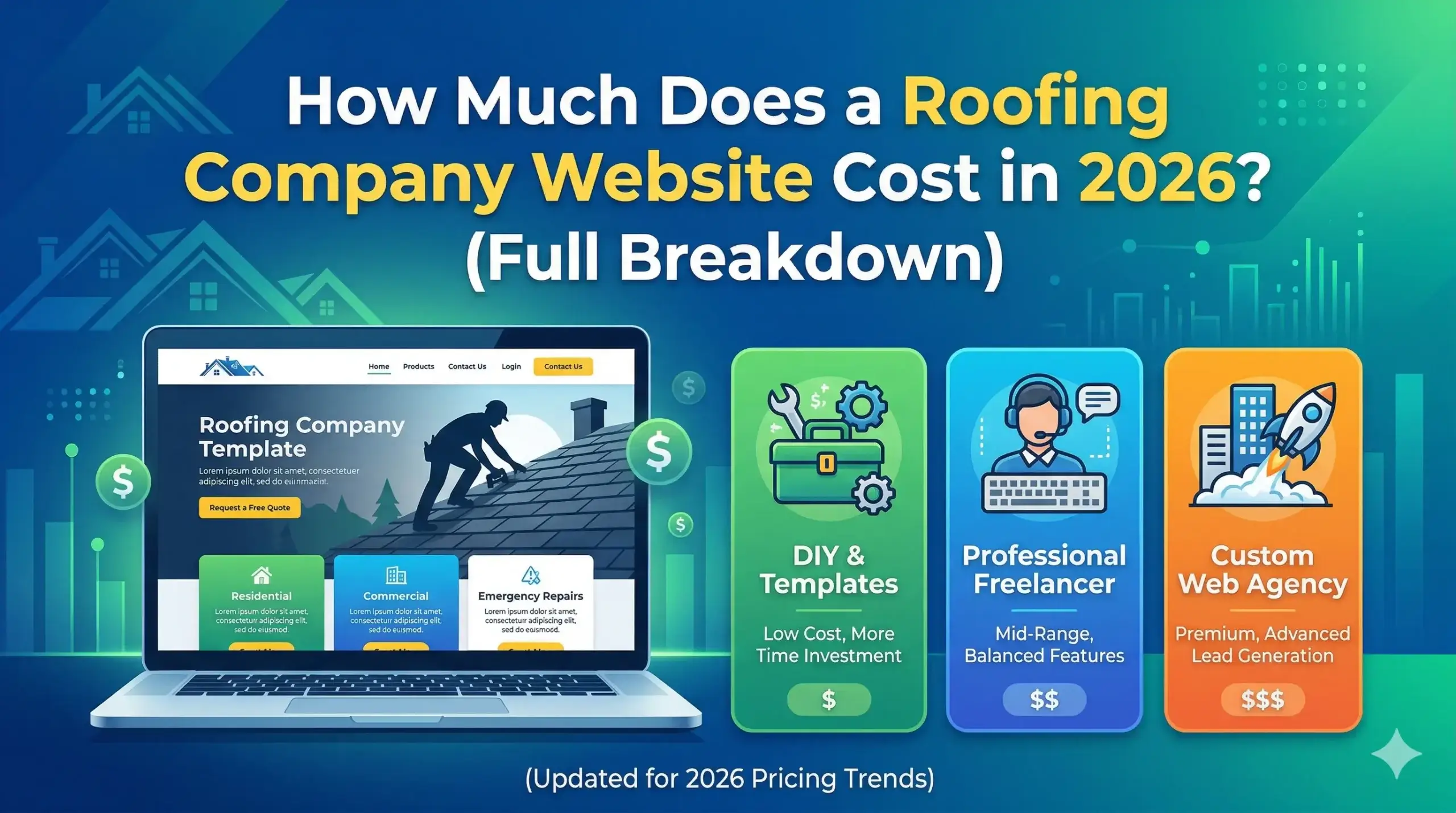
  • How Much Does a Roofing Company Website Cost in 2026? (Full Breakdown)

    How Much Does a Roofing Company Website Cost in 2026? (Full Breakdown)

    You spent real money on a website. Maybe a few thousand dollars a couple of years ago, maybe more recently. And yet — the phone isn’t ringing the way it should. You check your site, it looks fine to you, so you assume the problem is somewhere else.

    Here’s the truth most roofing business owners don’t hear until it’s costing them: a website that looks decent is not the same as a website that gets you jobs. For a roofing company, where the average ticket runs $8,000 to $25,000, even one missed lead per month adds up fast.

    This guide breaks down exactly what a roofing company website costs in 2026 — not just in dollars, but in what you get (or don’t get) for that money. By the end, you’ll know what separates a site that sits there from a site that actually brings in work.


    Why Most Roofing Websites Cost Money Twice

    The first cost is obvious — what you pay to build it. The second cost is invisible — the leads that walk away because the site wasn’t built to convert them.

    Think of it like a truck wrap. You pay once for the vinyl. But if the phone number is too small to read from the road, or the design is cluttered and nobody knows what service you offer in three seconds, you’ve paid for something that isn’t working. A roofing website is the same: what it costs to build matters a lot less than whether it’s built to do the job.

    Most roofing owners end up with a site that was cheap to launch and expensive to keep — because every month it’s online without converting visitors is a month of lost estimates.


    What You’re Actually Paying For: The Real Cost Breakdown

    Here’s an honest look at what roofing website projects cost in 2026, and more importantly, what you get at each level.

    Budget Tier: $500 – $2,500

    At this range, you’re typically getting a templated build — a generic design that wasn’t made for the roofing industry. It might have your logo and some photos, but it won’t be structured to answer the specific questions a homeowner in your market types into Google before they call someone.

    These sites often load slowly on mobile (and most of your customers find you on their phones, not a desktop). They’re missing the trust signals — licensing info, local service areas, photo galleries of real work — that make a homeowner pick up the phone instead of hitting the back button.

    The hidden cost: If your site converts 1 in 100 visitors instead of 3 in 100, and you get 200 visits a month, that’s 4 estimates per month you’re losing before you even bid.

    Mid-Range: $2,500 – $6,000

    This is where most roofing companies land after their first bad experience. You get a more custom design, usually from a generalist web designer or small agency. The site looks better. It might even have some SEO basics in place.

    The gap here is industry specificity. A generalist builds websites. A roofing web design company builds websites that understand your buyer’s decision process — storm damage urgency, insurance claim guidance, local trust signals, before/after galleries, and service-area pages that show up in the towns where you actually work.

    Professional Tier: $6,000 – $15,000+

    At this level, you’re investing in a site built around your actual business goals: more booked estimates, more phone calls, more form submissions. This includes custom design, conversion strategy, technical performance, and local SEO structure baked in from day one.

    For most roofing companies doing $500K or more in annual revenue, this range represents a fraction of one job — and a site built right can generate that return in the first month.


    What Makes a Roofing Website Actually Work (vs. Just Look Good)

    A roofing website has a specific job: turn a curious homeowner into a booked estimate. Every element should serve that goal. Most don’t.

    Speed — Because Homeowners Don’t Wait

    If your site takes more than three seconds to load on a phone, the majority of visitors leave before they ever see your phone number. Not because they weren’t interested — because they ran out of patience. This is especially brutal after a storm, when a homeowner is trying to find someone fast.

    A professionally built roofing website loads in under two seconds on mobile. That’s not a luxury — it’s the baseline for competing in your market today.

    Local Signals — Because Google Has to Know Where You Work

    If you serve ten different towns but your website only mentions your business name and a general phone number, Google doesn’t have enough information to show your site when someone searches “roofing contractor near me” in those towns. There’s a straightforward fix: properly structured service-area pages and behind-the-scenes signals that tell Google exactly where you operate and what you do.

    Roofing companies who add these see measurable increases in calls from neighborhoods they’ve been servicing for years — just never ranking for.

    Trust — Because Nobody Calls a Roofer They Don’t Trust

    Homeowners handing over $10,000–$20,000 for a new roof need to believe you’re the right company. Your website either builds that confidence quickly or it doesn’t. The elements that matter most:

    • Real photos of your team and completed jobs (not stock images)
    • Visible license numbers and insurance info
    • Genuine customer reviews, not just a Google rating badge
    • A clear, local phone number above the fold — not buried at the bottom

    💡 Pro Tip: Your “Contact” Page Is Probably Killing Conversions

    Most roofing websites bury their contact form on a separate page and leave it at that. But your visitor is often a homeowner who’s stressed about damage, comparing three roofers at once, and deciding in under a minute.

    The fix: put a click-to-call button and a short, friction-free form (“Get a Free Estimate”) on every page — especially your homepage and service pages. When someone’s already decided they want a quote, don’t make them hunt for how to ask for one. This single change has helped roofing companies see significant jumps in inbound calls without changing anything else about their site.


    Real-World Example: How One Roofing Company Turned Their Site Around

    Consider a roofing company operating in a mid-sized Midwest market — 12 years in business, strong reputation, decent word-of-mouth. Their website had been up for four years and looked fine on a desktop. On mobile, it was a different story: slow to load, no click-to-call, and a service page that listed everything they did in one long paragraph.

    They were getting around 400 monthly visitors and booking maybe 6–8 estimates from the web each month.

    After a full rebuild focused on roofing-specific conversion structure — fast mobile loading, service-area pages for 14 zip codes, a visible call button on every page, before/after galleries, and proper local signals — their inbound web leads climbed to 22–28 per month within 90 days. Same market, same reputation, same ad spend. The website finally did the job it was supposed to do.


    Not sure if your roofing website has these issues? Get a free website audit — no obligation, just a clear picture of what’s costing you leads.


    Your Path to More Leads: What to Do Next

    You don’t need to overhaul everything at once. Here’s where to start:

    1. Test your site on your phone — load it fresh on mobile data (not WiFi). If it’s slow or the phone number isn’t immediately visible, that’s costing you calls right now.
    2. Check your service pages — do you have a separate page for each service you offer (roof replacement, storm damage, gutters, commercial roofing)? If everything is on one page, Google can’t send the right visitors to the right content.
    3. Count your trust signals — open your homepage and count the number of things that tell a stranger you’re a legitimate, local, experienced company. If you can count fewer than five, there’s work to do.
    4. Review your local footprint — search “[your service] + [town you work in]” and see where you appear. If competitors show up and you don’t, your site isn’t sending the right local signals.
    5. Talk to a roofing web design specialist — not a generalist agency. A team that builds websites specifically for roofing businesses will know what converts in your industry and what doesn’t.

    FAQ: Questions Roofing Owners Actually Ask Before Hiring a Web Agency

    Why am I not getting calls from my website even though I’m getting traffic?

    Traffic and conversions are two different things. If visitors are landing on your site and not calling, the site isn’t giving them a fast, clear reason to reach out — no prominent phone number, no compelling reason to choose you over the next roofer, or a design that feels untrustworthy on mobile. Traffic without conversion is just a number.

    How do I know if my roofing website is actually working?

    Look at one metric: how many calls or form submissions did you receive last month that came from your website? If you don’t know the answer, your site isn’t set up to track it — and that’s the first problem to fix. A properly built site tells you exactly where every lead came from.

    How long does it take to see results from a new website?

    For conversion improvements — more calls, more form fills — many roofing companies see results within the first 30–60 days, because the changes happen immediately. For search ranking improvements, expect 60–120 days for meaningful movement, depending on your market and how competitive your area is.

    What makes a roofing website different from a regular business website?

    Roofing buyers are often anxious (they’ve just had storm damage), making a large financial decision, and comparing multiple options simultaneously. A roofing website needs to build trust fast, answer insurance and pricing questions before the visitor asks them, and make requesting an estimate as easy as tapping a button. A generic business website template doesn’t account for any of that.

    Do I really need a fast website if my customers are mostly local?

    Especially if your customers are local. Most people searching for a roofer after a storm or noticing damage do it on their phone while standing in their driveway. If your site takes five seconds to load, they’ve already moved on to the next result. Speed matters more for mobile-first, local searches than almost any other type.

    How do I know if a web agency actually understands roofing — or is just saying they do?

    Ask them: what’s on a roofing service page that converts, versus one that doesn’t? What local SEO signals matter for a contractor serving multiple zip codes? If they can’t answer specifically, they’re a generalist. Get a free website audit from Digital Trace and see what a team that knows roofing actually looks at.


    Ready to See What Your Website Is Really Costing You?

    Most roofing websites are losing leads every single day — not because the owner isn’t good at their trade, but because the site was never built to do the job.

    A free website audit from Digital Trace gives you a clear picture of exactly where your site is falling short: what’s slowing it down, what’s driving visitors away, and what’s stopping Google from sending you more of the customers who are already searching for what you do.

    There’s no pitch, no contract, no obligation — just a direct, honest look at your site from a team that builds websites specifically for roofing companies.

    Get your free roofing website audit →