Category: Automotive

  • What Every Automotive Website Must Have to Generate Leads

    What Every Automotive Website Must Have to Generate Leads

    Your shop is busy. Your techs are good. Your reviews are solid. So why isn’t your phone ringing from people who found you online?

    Most automotive business owners assume their website is “good enough” — it has their address, their hours, maybe a few photos. But good enough doesn’t generate leads. Visitors land on your site, look around for three seconds, and leave to call your competitor instead. Not because they preferred your competitor. Because your competitor’s site made it easier.

    This isn’t about fancy design. It’s about building a website that works like a sales tool — one that turns strangers searching “auto repair near me” or “oil change in [your city]” into booked appointments. Below are the things every automotive website must get right to actually generate leads, and what’s silently costing you business if they’re missing.


    Your Site Loads Too Slowly — And You’re Losing Calls Because of It

    Picture a customer with a slow leak in their tire. They pull over, grab their phone, search for a tire shop, and your site comes up. They tap on it. It takes five seconds to load. They go back and tap the next result.

    That scenario plays out dozens of times a day for most automotive businesses with slow websites. Most visitors leave within three seconds if a page hasn’t loaded — and they never come back.

    The technical reason is usually bloated images, outdated hosting, or code that wasn’t built for mobile. But the business impact is simple: every second of load time is a call you didn’t get.

    When Digital Trace builds automotive websites, speed is non-negotiable. Pages are optimized for mobile-first loading because that’s where your customers are searching — usually from a parking lot or the side of the road.


    Visitors Can’t Find Your Phone Number Fast Enough

    Think of your website like your front counter. If a customer walks in and can’t immediately find someone to help them, they walk out. Your phone number is the equivalent of that front counter — and most automotive websites bury it.

    Your number needs to be:

    • Visible at the very top of every single page
    • A clickable “tap to call” link on mobile (not just text)
    • Repeated in the footer and on every service page

    If someone has to scroll or hunt to find how to reach you, most won’t bother. They’ll call the shop whose number was right there.

    This sounds obvious, but it’s one of the most common problems we find during website audits for automotive businesses. The number is there — just not where it needs to be.


    Google Doesn’t Know Enough About Your Business to Show It Confidently

    Here’s something most automotive shop owners don’t realize: Google isn’t just reading your website — it’s trying to understand what your business does, where it is, and whether it should trust you enough to recommend you to a searcher.

    When your site is missing the right signals — your city, your specific services, consistent contact information — Google hedges its bets and shows you lower in results, or not at all. Meanwhile, a competitor with a clearer, better-structured site gets the call.

    The fix involves things like:

    • Dedicated pages for each core service (oil changes, brakes, tires, etc.)
    • Your city and region mentioned naturally throughout the content
    • Consistent business name, address, and phone number across your site
    • Structured data that tells Google exactly what type of business you are

    This isn’t black-hat SEO trickery. It’s just making your website legible to Google — the same way you’d make your shop easy to find by putting a clear sign out front.


    💡 Pro Tip

    One of the most common mistakes automotive websites make: having a single “Services” page that lists everything in one place. Google wants to rank specific pages for specific searches. If someone searches “brake repair in [city],” a page dedicated to brake repair will outrank a generic list every time. Break your services into individual pages — each one a clear signal to Google about what you offer and where.


    Your Website Doesn’t Build Trust Fast Enough

    When someone lands on an automotive website for the first time, they’re asking themselves one question before anything else: Can I trust these people with my car?

    A website that looks outdated, has stock photos of random mechanics, or has no reviews visible anywhere answers that question the wrong way — fast. Trust signals are the difference between a visitor who calls and one who bounces.

    Strong trust signals for automotive sites include:

    • Real photos of your shop, your team, and your actual work
    • Google reviews embedded or linked prominently
    • Certifications and affiliations (ASE, AAA-approved, etc.) shown clearly
    • A specific “About Us” section that tells the real story of your shop

    Customers are handing over their vehicle — often their most important daily asset. They want to see a real place with real people before they call. Give them that, and your conversion rate climbs.


    Your Site Has No Clear Path for the Visitor to Follow

    Most automotive websites are built like a brochure: here’s who we are, here’s what we do, goodbye. But a lead-generating website is built like a good service advisor — it guides the customer toward the next step at every turn.

    Without a clear path, visitors wander. They read a little, shrug, and leave. With the right structure, they read, they trust, and they book.

    Every page on your site should answer three questions clearly:

    1. What can you do for me? (The specific service, explained plainly)
    2. Why should I trust you? (Reviews, credentials, experience)
    3. How do I reach you right now? (A prominent CTA — call, book, or contact)

    When those three elements are present and easy to find, the phone rings more. It’s not complicated — it’s just intentional design.


    Before & After: What a Better Website Actually Changes

    A family-owned auto repair shop in the Midwest had been in business for 14 years. Strong reputation locally. Regular customers. But their website was built in 2017, loaded slowly on mobile, had no individual service pages, and buried the phone number at the bottom of the page.

    They were getting traffic — people were finding them — but almost none of it was converting to calls from new customers.

    After rebuilding the site with dedicated service pages, a mobile-first speed overhaul, prominent click-to-call buttons, and embedded Google reviews, the picture changed:

    • Organic website traffic increased by roughly 60% over four months
    • New customer calls from the website more than doubled
    • The shop’s Google ranking for key local search terms moved from page two to the top five results

    The shop didn’t change their prices, didn’t run ads, and didn’t change their hours. The website finally started doing its job.


    Not sure if your automotive website has these issues? Get a free website audit — no obligation, just a clear picture of what’s costing you leads.


    Your Path to More Leads: 5 Steps That Actually Work

    You don’t need to overhaul everything at once. Start here:

    1. Check your site speed on a phone. Pull out your personal cell, go to your website, and count how long it takes to fully load. If it’s more than three seconds, it’s costing you calls.
    2. Make your phone number impossible to miss. It should be at the top of every page, clickable on mobile, and repeated in the footer.
    3. Create individual pages for each of your main services. One page per service — brake repair, oil change, transmission, etc. Each one should mention your city naturally.
    4. Add real photos and visible reviews. Pull your best Google reviews onto your homepage. Replace stock images with real shots of your team and shop.
    5. Work with a team that understands automotive. Generic web agencies build generic websites. Digital Trace builds websites specifically for automotive businesses — designed to rank, load fast, and turn visitors into booked appointments.

    Frequently Asked Questions

    Why isn’t my automotive website getting me any calls?

    Usually it comes down to one of three things: the site loads too slowly and people leave before they see your number, the site doesn’t rank for local searches because it’s missing the right signals, or the site doesn’t make it easy enough to take the next step. Most of the time, all three are happening at once.

    How do I know if my website is actually working or just sitting there?

    If you can’t tell how many people are visiting your site, where they’re coming from, or how many are clicking your phone number — your website isn’t being tracked properly. A properly set-up site gives you those numbers clearly. A free website audit will show you exactly what’s happening and what’s being missed.

    What makes an automotive website different from a regular business website?

    Automotive customers search differently. They search by specific service (“brake repair near me”), they search urgently (broken-down cars, flat tires), and they make fast decisions. Your website needs to load immediately on mobile, show the right services for local searches, and make calling you effortless — none of which a generic template handles well.

    How long does it take to see results from a new website?

    For local search rankings, most businesses see meaningful movement within 60 to 90 days of launching a properly built site. Speed and conversion improvements — more calls per visitor — are typically visible within the first few weeks. It’s not overnight, but it’s also not a year-long wait.

    Do I really need a fast website if my customers are mostly local?

    Especially if your customers are local. Local searchers are almost always on their phones, often in their cars or on the go. They’re not sitting at a desktop with fast WiFi — they’re on a mobile connection, and they’ll leave in seconds if your page doesn’t load. Speed matters more for local automotive businesses, not less.

    I’ve been burned by agencies before. What makes this different?

    That’s a fair concern, and it’s worth asking. The difference is specificity — a general-purpose agency builds general-purpose websites. Digital Trace focuses specifically on automotive businesses, which means the design, the structure, and the SEO approach are built around how automotive customers actually search and decide. No guesswork, no one-size-fits-all templates.


    Ready to See What Your Website Is Missing?

    Your website should be your hardest-working employee — generating calls and appointments 24 hours a day, even when you’re closed. If it’s not doing that, there’s a reason. And most of the time, it’s fixable.

    Digital Trace offers a free, no-obligation website audit for automotive businesses across the US. We’ll show you exactly what’s slowing you down, what Google can’t find, and what’s causing visitors to leave without calling — in plain language, with no pressure.

    Book your free website audit today and find out what your site is quietly costing you.
  • How to Get More Local Customers for Your Auto Business Without Ads

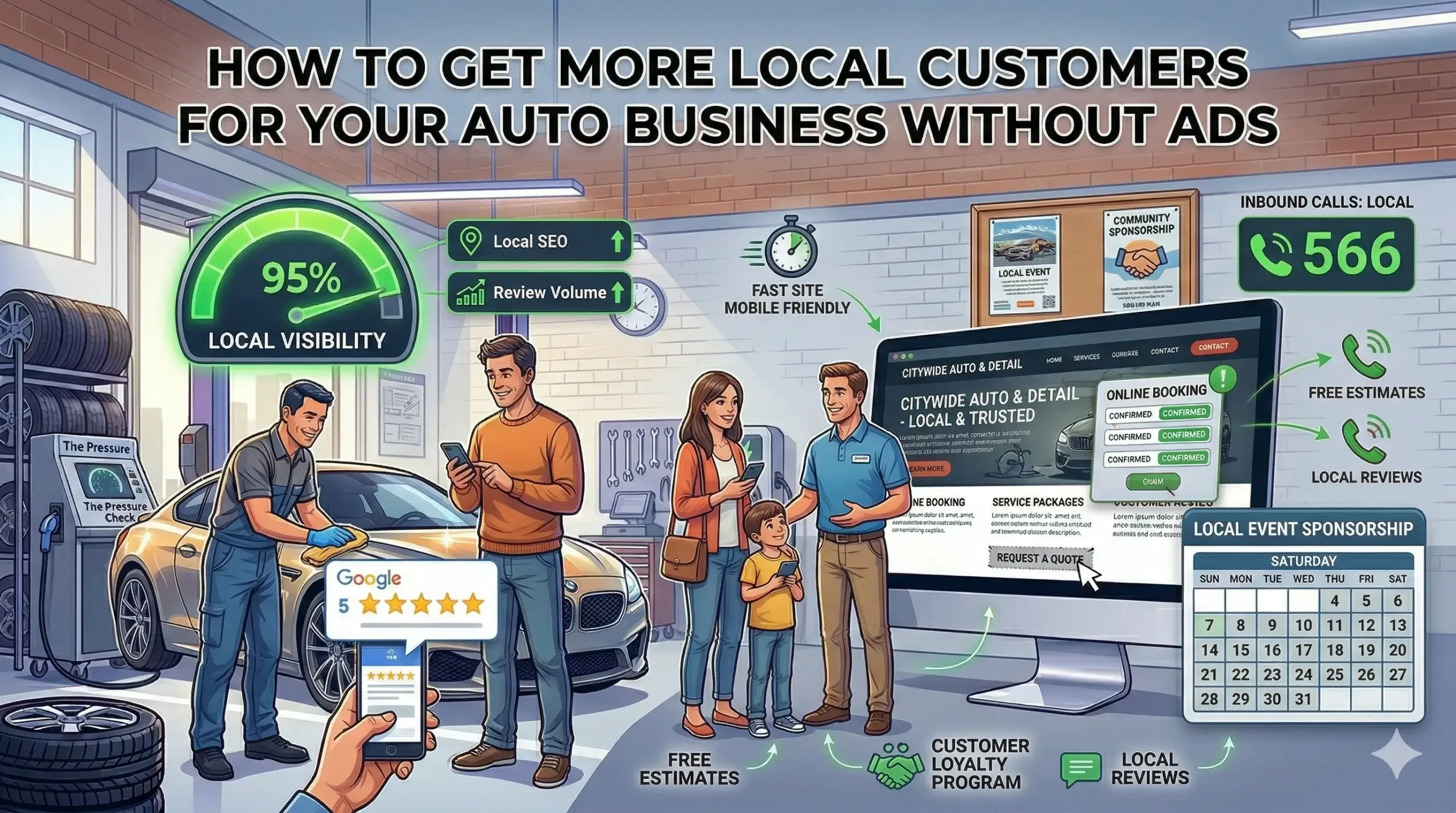
    How to Get More Local Customers for Your Auto Business Without Ads

    You’re running a solid auto business. You’ve got the skills, the crew, and the reputation. But your phone isn’t ringing the way it should — and when you look at your website, it looks fine to you.

    That’s the problem.

    Most auto business owners assume their website is just a place to park their address and phone number. Something to point people to. But right now, your website is either actively winning you customers — or quietly sending them to your competitor down the street. There’s very little middle ground.

    The good news: you don’t need to spend a dollar on ads to fix this. What you need is a website that’s been built to do one job — convert local searchers into paying customers. That’s exactly what smart automotive website design is designed to do.

    By the end of this article, you’ll know exactly where your website is losing you business and what to do about it.


    Your Competitor Is Showing Up. You’re Not. Here’s Why.

    Picture this: someone’s car just broke down two miles from your shop. They pull out their phone and search “auto repair near me.” Your competitor’s name pops up first. Yours doesn’t appear until page two — or not at all.

    It’s not that Google doesn’t know about you. It’s that Google doesn’t trust your website enough to show it prominently.

    When your site loads slowly, has thin content, or lacks the right technical signals, Google treats it like a business that might not be worth recommending. It’s like a mechanic whose bay is dark, the sign is faded, and the door looks locked — even if the lights are on inside. Customers keep driving.

    What Digital Trace does differently: every automotive website design project starts with a full technical audit to find exactly why Google isn’t ranking your site — and fixes it from the ground up.


    The 3-Second Problem (And Why It’s Costing You Real Money)

    Here’s something most auto shop owners don’t realize: the majority of people searching for local auto services are on their phones, often in a stressful moment — their car just made a noise, the check engine light came on, or they need an oil change before a road trip.

    They will not wait for a slow website.

    If your site takes more than three seconds to load, a large portion of those visitors will hit the back button before your phone number even appears on their screen. They don’t call you. They call someone else.

    This isn’t a traffic problem. It’s a speed problem — and it’s entirely fixable.

    What to look for:

    • Images that haven’t been compressed or optimized
    • Old, bloated website themes that weren’t built for performance
    • Hosting plans that were cheap for a reason
    • Too many plugins slowing everything down

    A properly built automotive website loads fast on a 4G connection, shows your phone number and services above the fold, and gives someone a reason to call within the first few seconds of landing.


    💡 Pro Tip: Google Can’t Read a Confusing Website

    Here’s one of the most common issues we see on auto business websites: Google genuinely doesn’t know what your business does, where you’re located, or what services you offer — because the website never told it clearly.

    This isn’t about writing more content. It’s about a behind-the-scenes technical fix called structured data (sometimes called schema markup). Think of it like filling out a detailed form that tells Google: “We’re a full-service auto repair shop in [City], we do brake jobs, oil changes, and transmission work, and here’s our phone number.”

    Without it, Google has to guess — and when Google guesses, it often plays it safe by not ranking your site at all.

    The fix takes a few hours for a developer. The benefit can be showing up in local search results with your hours, reviews, and services displayed right on the results page.


    Why Most Auto Websites Don’t Convert (Even When They Rank)

    Getting someone to your site is only half the battle. Once they land, your website has about 8 seconds to give them a reason to call you instead of going back to Google.

    Most automotive websites fail here in the same ways:

    • No clear headline — visitors don’t immediately know what you do, where you are, or why you’re the right choice
    • Phone number buried — it’s in the footer, or you have to click “Contact” to find it
    • No social proof above the fold — reviews, ratings, and trust signals are hidden or missing entirely
    • Generic copy — “We provide quality automotive services” tells no one anything
    • No clear next step — what do you want them to do? Call? Book online? Request a quote?

    Your website should work like your best salesperson — one who greets every visitor, answers their questions upfront, shows them proof you’re trustworthy, and makes it obvious what to do next.


    What a Real Automotive Website Audit Revealed

    A real-world scenario from our work:

    A family-owned transmission repair shop in the Midwest had been in business for over 20 years. Strong reputation, loyal customers, word-of-mouth referrals. But over three years, they’d noticed new customer calls dropping off — even as the neighborhood grew.

    Their website had been built by a nephew years earlier. It looked decent enough on a desktop. But on mobile, the text was tiny, the phone number wasn’t clickable, and the site took nearly 8 seconds to load on a phone.

    After a full rebuild with proper mobile optimization, page speed improvements, and local SEO structure:

    • Mobile load time dropped from 8.1 seconds to under 2 seconds
    • The shop started appearing in the Google local map pack for targeted local searches
    • Inbound calls from new customers increased significantly within 90 days — without a single dollar spent on ads

    The shop didn’t change what they do. They just stopped losing people who were already looking for them.


    Not sure if your website has the same issues? Get a free website audit — no obligation, just a clear picture of what’s costing you leads.


    What Makes an Automotive Website Different From a Generic Business Site

    A website built for a law firm or a restaurant isn’t built for an auto business. The customer behavior is different. The search intent is different. The trust signals are different.

    Someone looking for an auto shop is often in reactive mode — their car needs something, they need it soon, and they need to know you can handle it. That means your website needs to:

    Lead with service specificity. Don’t just say “auto repair.” List the services clearly — brakes, diagnostics, transmission, AC service, tires. People search for specific problems, not general categories.

    Show local credibility fast. Your city or service area should be visible immediately. A generic website with no location signals tells Google (and your visitors) nothing about where you work.

    Make booking or calling frictionless. One tap to call on mobile. No forms with ten fields. No waiting. The easier you make it to reach you, the more people will.

    Display real reviews prominently. Auto service is a trust-heavy purchase. Showing Google or Facebook reviews near the top of the page — not hidden in a footer carousel — changes how quickly visitors decide to call.


    Your Path to More Leads (Without Spending on Ads)

    You don’t need a massive marketing budget to get more local customers. You need a website that’s been built to earn them. Here’s the straightforward path:

    Step 1: Find out what’s broken. Start with a professional website audit. You need to know your actual load speed on mobile, whether Google is indexing you correctly, and where visitors are dropping off.

    Step 2: Fix your mobile experience. More than half of local searches happen on phones. If your site isn’t fast and easy to use on a phone, you’re losing the majority of potential callers before they ever reach out.

    Step 3: Nail your local SEO basics. Your business name, address, and phone number need to be consistent across your website, Google Business Profile, and any directories you’re listed on. Inconsistencies quietly hurt your rankings.

    Step 4: Build trust signals into the design. Reviews, certifications, photos of your actual shop and team — these belong near the top of your homepage, not buried in a tab.

    Step 5: Make it embarrassingly easy to contact you. Your phone number should be at the top of every page. On mobile, it should be tappable. Add a simple “Book a Service” or “Get a Quote” button that leads somewhere real.


    Frequently Asked Questions

    Why am I not getting calls from my website?

    The most common reasons are slow load speed, a poor mobile experience, or missing local SEO signals that help Google connect your site to nearby searchers. Visitors may be landing on your site but leaving before they see your contact info. A website audit will show you exactly where the drop-off is happening.

    How do I know if my automotive website is actually working?

    If you’re not tracking where your phone calls and form submissions are coming from, you have no way to know. A properly set up automotive website includes basic analytics and call tracking so you can see, in plain numbers, how many leads your site generates each month.

    How long does it take to see results from a new website?

    Most businesses see measurable improvement in local search visibility within 60 to 90 days of launching a properly optimized site. Speed and mobile improvements tend to show results faster. Organic SEO gains build over time, but they compound — meaning they keep working without ongoing ad spend.

    What makes an automotive website different from a regular business website?

    Auto customers search differently. They’re often in urgent or near-urgent situations, searching on mobile, and making quick trust decisions. An automotive website needs fast mobile load times, service-specific pages, prominent reviews, and clear calls-to-action — all designed around how a car owner actually searches and decides. A generic website template doesn’t account for any of that.

    Do I really need a fast website if my customers are mostly local?

    Yes — especially because they’re local. Local searchers are almost always on their phones, often in the moment of need. Google also uses page speed as a ranking factor for local search results. A slow site doesn’t just frustrate visitors — it actively pushes you down in rankings compared to competitors whose sites load quickly.

    How do I know if Digital Trace is the right fit for my shop?

    Start with a free website audit. You’ll get a clear, honest picture of what’s working on your site, what’s costing you leads, and what a better version of your website would look like — no pressure, no commitment required.


    Stop Losing Customers Who Are Already Looking for You

    Every week your website underperforms, someone in your area searches for exactly what you offer — and finds your competitor instead.

    You’ve already done the hard part: building a real business with real expertise. The website should be the easy part. It should work for you around the clock, turning searches into calls and calls into customers.

    Digital Trace builds websites specifically for automotive businesses — fast, optimized for local search, and designed to convert visitors into paying customers without relying on ads.

    Find out what your website is costing you — get a free audit today.

    No sales pitch. No obligation. Just a clear, honest look at your site and a straight answer on what to fix.

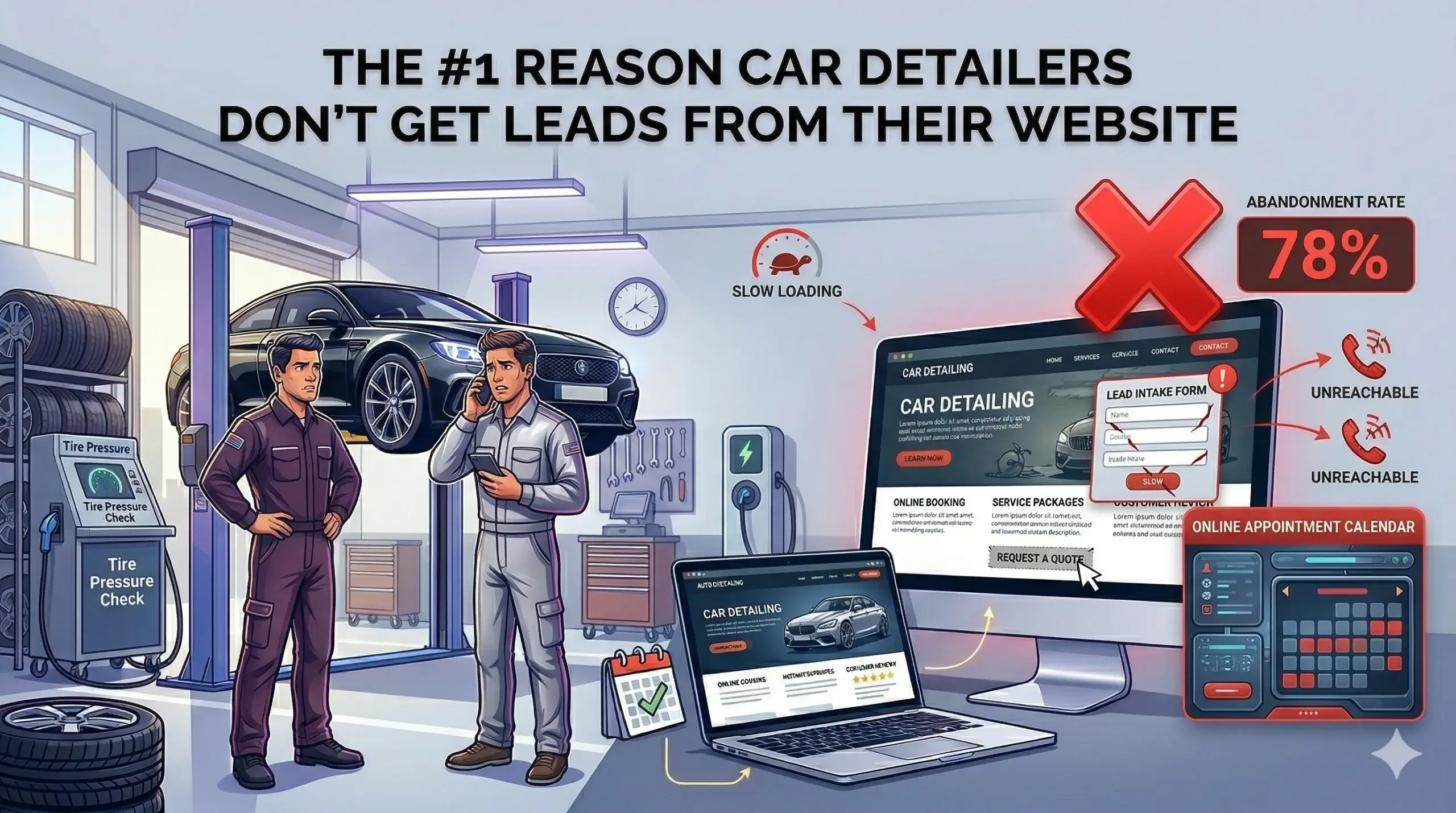
  • The #1 Reason Car Detailers Don’t Get Leads From Their Website

    The #1 Reason Car Detailers Don’t Get Leads From Their Website

    You spent money on a website. You might have even paid someone to “do SEO.” But the phone still isn’t ringing the way it should — and you’re not sure why.

    Here’s the uncomfortable truth most car detailers never hear: your website isn’t broken because it’s ugly. It’s broken because it was built to look like a website, not to work like one.

    Most automotive websites are digital waiting rooms — they sit there, look decent enough, and do absolutely nothing to push a visitor toward calling you or booking a job. Meanwhile, a competitor down the street with half your experience is showing up on Google and filling their schedule.

    By the end of this post, you’ll know exactly why that’s happening — and what a proper automotive website design actually looks like when it’s built to generate real leads.


    Your Website Loads Too Slowly — And Your Leads Leave Before They Even See Your Phone Number

    Think about how you browse on your phone. If a page takes more than three seconds to load, you’re gone. Your potential customers are no different.

    Most car detailing websites — especially those built on cheap page builders or outdated templates — load slowly on mobile. Large uncompressed photos of your work, bloated code, no performance optimization. It all adds up.

    The real cost: a customer searches “car detailing near me,” clicks your site, waits, gets impatient, hits the back button, and books with whoever loads faster. You never even knew they were there.

    What Digital Trace does instead: Every site built for automotive businesses is optimized for speed from day one — compressed images, clean code, fast hosting. The goal is to load in under two seconds on mobile, because that’s where most of your customers are searching from.


    Google Doesn’t Know Enough About Your Business to Show It Confidently

    Here’s a simple way to think about it: Google is like a customer who’s never heard of you and needs to be convinced you’re legitimate before recommending you to anyone else.

    If your website doesn’t clearly communicate what you do, where you do it, and why you’re trustworthy, Google won’t rank it confidently. There’s a behind-the-scenes layer of information — called structured data — that tells Google exactly who you are, what services you offer, and where you’re located.

    Most detailing websites skip this entirely. So Google hedges its bets and shows your competitor instead.

    What Digital Trace does instead: Proper technical signals are built into every site so Google has everything it needs to understand your business and show it to the right local customers at the right time.


    Your Site Was Built for First Impressions — Not for Getting People to Call

    A lot of web designers think their job ends when the site looks good. But a good-looking site that doesn’t convert is like a showroom with no sales team. People walk in, look around, and leave without buying.

    Car detailers lose leads every day because their site:

    • Has no clear call-to-action above the fold (before scrolling)
    • Buries the phone number at the bottom of the page
    • Doesn’t answer the questions customers actually ask before booking
    • Has no trust signals — reviews, before/after photos, guarantees — visible right away

    Visitors aren’t spending five minutes reading your homepage. They’re spending about eight seconds deciding whether to call you or go back to Google.

    What Digital Trace does instead: Sites are structured so the most important things — your phone number, your services, your proof — are visible immediately. The layout is designed around the decision a visitor needs to make, not around what looks nice in a portfolio.


    💡 Pro Tip

    One of the most common mistakes car detailers make is listing services like “Interior Detail” and “Exterior Detail” with no further description. From a customer’s perspective, that’s vague — they don’t know what’s included or whether it’s worth the price. From Google’s perspective, it’s a missed opportunity. Each service should have its own dedicated section (ideally its own page) with a clear description, pricing range, and photos of the finished result. This tells both customers and Google exactly what you offer — and it’s one of the fastest ways to start showing up for specific searches like “ceramic coating [your city]” or “paint correction near me.”


    You’re Not Showing Up When It Actually Matters

    Search results aren’t random. Google serves results based on signals it picks up from your website and your overall online presence. If those signals are weak — or missing entirely — you won’t show up when a nearby customer is ready to book.

    The searches that actually bring in revenue aren’t always “car detailing.” They’re “mobile car detailing [city],” “ceramic coating near me,” “paint correction [neighborhood].” If your website doesn’t have pages, content, or signals built around these specific searches, you’re invisible to the customers who are closest to booking.

    What Digital Trace does instead: Automotive websites are built with location and service targeting baked in from the start. Not keyword stuffing — smart, natural content that matches what your best customers are actually searching for.


    Before vs. After: What Changes When the Website Actually Works

    The situation: A mobile car detailing business in Phoenix had been operating for four years with a solid reputation — mostly word of mouth and a few Google reviews. Their website had been built by a friend a few years back. It looked fine on a desktop but was nearly unusable on mobile, took over seven seconds to load, and had no clear call-to-action. Their Google Business profile was pulling in some views, but very few people were clicking through to book.

    What changed: A new site was built focused entirely on mobile performance, conversion, and local relevance. Service pages were created for their core offerings — paint correction, ceramic coating, interior detailing — each with real photos and descriptions. Their phone number and a “Book Now” button were placed prominently at the top of every page. Page load time dropped from over seven seconds to under two.

    The result: Within 90 days, organic traffic to the site more than doubled. More importantly, inbound calls from the website increased significantly — the owner estimated they were booking two to three additional jobs per week that previously would have gone to a competitor. For a business averaging $300–$500 per detail, that’s a meaningful difference in monthly revenue.


    Not sure whether your site has these issues? Get a free website audit — no obligation, just a clear picture of what’s costing you leads.


    Your Path to More Leads: What Actually Needs to Change

    Getting more leads from your website isn’t about a complete reinvention. It’s about fixing the right things in the right order.

    Step 1 — Speed first. If your site loads slowly on mobile, nothing else matters until that’s fixed. Every other improvement is built on top of this foundation.

    Step 2 — Make it obvious what you do and where. Your homepage should communicate your services, your service area, and how to book within the first few seconds of landing on it.

    Step 3 — Build pages around your actual services. “Detailing” is too broad. Ceramic coating, paint correction, interior detailing, fleet services — each one deserves its own page with real descriptions and photos.

    Step 4 — Add proof. Real before-and-after photos, genuine reviews, and a clear guarantee do more to convert visitors than any amount of copywriting.

    Step 5 — Get a professional to look at the technical side. Speed, structured data, mobile usability — these aren’t things you can eyeball. A proper audit will surface the issues that are silently costing you leads.


    Frequently Asked Questions

    Why am I not getting calls from my website even though I’m getting visitors?

    Traffic without calls almost always means a conversion problem, not a traffic problem. Your visitors aren’t finding a compelling reason to contact you quickly enough — either the page loads too slowly, the phone number isn’t visible, or there’s no clear next step. A site audit will show you exactly where people are dropping off.

    How do I know if my car detailing website is actually working for me?

    If your website is working, you should be able to point to real leads it generated — calls, form fills, bookings. If you can’t, it’s not working. Beyond that, you want to see that your site loads fast on mobile, shows up in local searches for your specific services, and has a clear path for visitors to contact you. A free website audit will give you a straight answer on all of these.

    How long does it take to see results after getting a new website?

    Most automotive businesses start seeing measurable improvements within 60–90 days of launching a properly built site. The biggest early wins usually come from speed improvements and better mobile usability — those impact both user behavior and Google rankings relatively quickly. Longer-term results from content and SEO build over three to six months.

    What makes an automotive website different from a regular business website?

    The buying decision for detailing services is highly local and often impulsive — someone notices their car is dirty and searches for a nearby service. Your website needs to load instantly, show up for hyper-local searches, display trust signals (reviews, before/afters) immediately, and make booking or calling as frictionless as possible. Generic website templates aren’t designed around any of that. Websites built for automotive businesses are built specifically to serve that intent.

    Do I really need a fast website if my customers are mostly local?

    Yes — especially because they’re local. Local customers are searching on their phones, often while they’re already out and about. Mobile users are the least patient of any audience online. A site that takes five seconds to load on a phone loses a significant portion of visitors before they even see your business name. Speed is one of the highest-leverage improvements a local detailing business can make.

    I’ve worked with a web agency before and didn’t see results. Why would this be different?

    Most agencies build websites that look good in a portfolio but aren’t built with business outcomes in mind. The difference is whether the site was designed around how your customers actually search, browse, and decide to book — or whether it was designed around what looks impressive in a screenshot. The right agency will show you a clear connection between the site and your leads, not just traffic numbers.


    Ready to Find Out What Your Website Is Costing You?

    Every week a car detailing website isn’t converting, it’s not a neutral outcome — it’s lost jobs. Lost revenue. Customers who found your competitor instead of you.

    A free website audit from Digital Trace will show you exactly what’s happening on your site right now: what’s working, what’s broken, and what’s costing you leads without you realizing it. No obligation. No sales pressure. Just a clear, honest look at your website from people who build high-converting websites for automotive businesses every day.

    Get your free website audit →

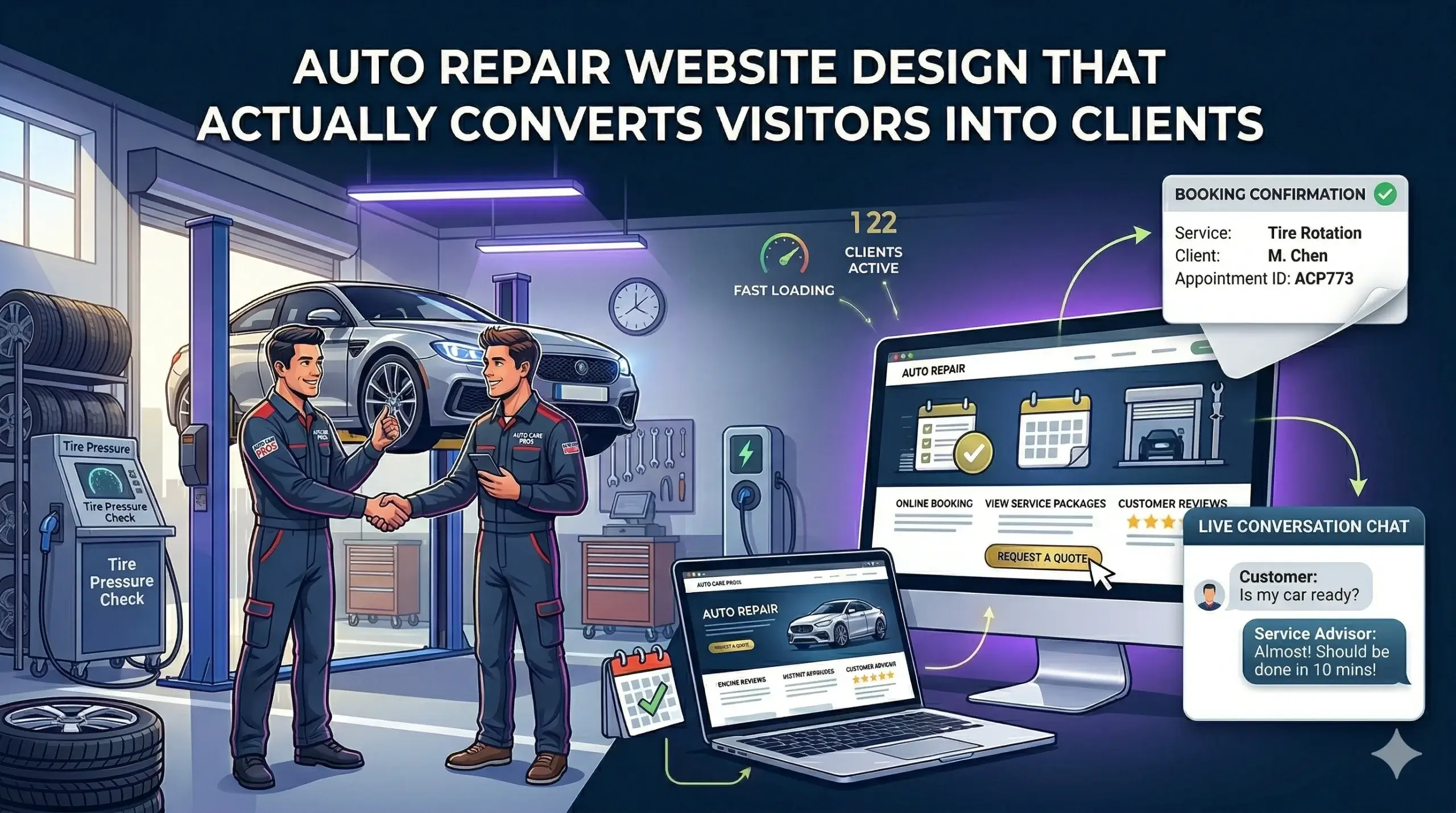
  • Auto Repair Website Design That Actually Converts Visitors Into Clients

    Auto Repair Website Design That Actually Converts Visitors Into Clients

    You’ve got a website. You paid someone to build it — maybe a few years ago, maybe recently. But the phone isn’t ringing the way it should. Customers walk in saying they “found you on Google,” but you’re not sure how, and you’re definitely not sure if it’s working.

    Here’s the uncomfortable truth most auto repair shop owners don’t hear: having a website and having a website that works are two completely different things. Thousands of automotive businesses across the US are sitting on digital dead weight — pages that look fine but quietly bleed leads every single day.

    This isn’t about chasing trends or spending more money on ads. It’s about understanding why the visitors you’re already getting don’t pick up the phone — and fixing it. By the end of this post, you’ll know exactly what’s breaking your site and what a real automotive website design solution looks like.


    Why Your Shop Shows Up — But Nobody Calls

    Picture this: someone’s check engine light comes on during their commute. They pull over, grab their phone, and search “auto repair near me.” Your shop appears in the results. They tap your link.

    And then… nothing happens fast enough. The page crawls. The layout looks wrong on their phone. They can’t find your phone number in the first five seconds. So they hit the back button and call your competitor instead.

    This happens dozens of times a week at most auto shops — and the owner never knows.

    The technical reason is almost always a combination of slow load time and poor mobile layout. Over 70% of local service searches happen on a smartphone. If your site isn’t built from the ground up for mobile users, you’re handing those leads to whoever is.

    What Digital Trace does differently: Every site built for automotive businesses is mobile-first by design — meaning your phone number is front and center, your services are easy to find, and the page loads before the customer loses patience.


    Your Website Is Sending the Wrong First Impression

    Think of your website like the front lot of your shop. If cars are parked haphazardly, the signage is faded, and there’s no clear indication of what you do or who you serve — customers drive past. Online, visitors make the same split-second judgment.

    Most automotive websites make three costly first-impression mistakes:

    • No clear headline — visitors can’t immediately tell what you fix, where you’re located, or why they should choose you
    • Buried contact info — the phone number is in the footer, not at the top where someone can tap it instantly
    • Generic stock photos — images of smiling mechanics in perfect lighting don’t build trust; photos of your actual shop and team do

    The result? Visitors bounce within seconds. They came looking for confidence and left because nothing on the page said we’re the right shop for you.

    A well-designed automotive website leads with trust signals immediately: your location, your specialties, real customer reviews, and a phone number that’s impossible to miss.


    Google Doesn’t Know Enough About Your Shop to Show It

    You might be doing everything right inside your shop and still losing to a competitor who’s nowhere near as good — just because their website is set up better for Google.

    Here’s why: Google needs specific signals to decide which businesses to surface when someone searches nearby. Things like your service area, your exact services, how your business is described, and whether your name, address, and phone number match across every listing online. When these signals are missing or inconsistent, Google gets cautious. It shows businesses it’s more confident about instead.

    This is often called local SEO — but ignore the term. What it really means is: Google doesn’t know enough about your shop to trust showing it to customers. And there’s a straightforward fix.

    A proper automotive website design includes what’s called structured data — basically a clear, behind-the-scenes label that tells Google exactly what your business is, what you do, and where you do it. Without it, you’re invisible to the very customers who are actively searching.

    💡 Pro Tip: One of the most common — and most fixable — problems for auto repair shops is inconsistent business information across the web. If your address on your website says “St.” but Google Maps says “Street,” that small mismatch sends a signal of uncertainty to search engines. Audit every place your business is listed and make sure the name, address, and phone number are identical everywhere.


    The “Fast Enough” Problem That’s Costing You Leads

    Most auto shop owners assume their site loads fine because it works on their own phone — usually over Wi-Fi, to a site their browser has already cached.

    Your customers aren’t in that situation. They’re on LTE in a parking lot, on an older Android phone, trying to get information right now.

    Studies consistently show that if a page takes more than 3 seconds to load, more than half of mobile visitors leave — without ever seeing your phone number, your reviews, or your services. You paid for the website. You might even be paying for ads to drive traffic to it. And that traffic is evaporating before the page finishes loading.

    The culprits are usually:

    • Oversized images that weren’t compressed for web
    • Outdated website platforms that load slowly by default
    • Unnecessary plugins and scripts running in the background

    Speed isn’t a luxury feature — it’s the difference between a lead and a missed call.


    The Before/After: What a Real Fix Looks Like

    Business: Eastside Auto & Tire — a four-bay independent auto repair shop in Columbus, Ohio. Family-owned, 14 years in business, solid reputation in the area.

    The problem: Their site was built in 2018 by a local freelancer. It looked decent on desktop, but on mobile it was nearly unusable — text was tiny, the phone number wasn’t clickable, and the page took over 6 seconds to load on an average connection. They were getting traffic from Google but almost no calls from it. Walk-ins came from word of mouth. The website was effectively invisible.

    What changed: A full rebuild using an automotive website design approach — mobile-first layout, click-to-call button above the fold, compressed images, fast hosting, local SEO structure, and real photos of the shop and team.

    The result: Within 60 days, inbound calls from the website increased by roughly 3x. Their Google Business profile clicks doubled. Two new fleet clients — who found them through search — now account for a significant portion of monthly revenue. The owner’s exact words: “We thought our website was fine. Turns out it was the thing holding us back.”


    Not sure if your site has these same issues? Get a free website audit — no obligation, just a clear picture of what’s costing you leads.


    Your Path to More Leads: What the Fix Actually Looks Like

    Getting your website to actually work for your shop isn’t complicated — but it does require doing the right things in the right order.

    1. Audit what’s broken first. Before changing anything, understand where leads are dropping off. Is it load speed? Mobile layout? Missing contact info? Each problem has a different fix.
    2. Make your phone number impossible to miss. Every page, at the top, clickable on mobile. This single change can move the needle immediately.
    3. Build for mobile, not desktop. Your customers are on their phones. Your website needs to be built for that reality from the ground up.
    4. Tell Google who you are. Add structured data, keep your business info consistent everywhere online, and make sure your site clearly describes your specific services and location.
    5. Use real photos and real proof. Authentic images of your shop, your team, and customer reviews convert better than anything a stock photo library offers.
    6. Track what’s actually working. Know how many people call from your website, which pages they visit, and where they leave. Guessing isn’t a strategy.

    FAQ: What Auto Shop Owners Actually Ask Before Redesigning Their Site

    Why am I not getting calls from my website even though I have one?

    Having a website doesn’t automatically mean it’s working. The most common culprits are slow load times, a layout that doesn’t work well on mobile, and a missing or hard-to-find phone number. If visitors can’t find how to contact you within a few seconds on their phone, they leave. A website audit will tell you exactly where you’re losing them.

    How do I know if my automotive website is actually doing anything?

    If you can’t answer “how many people called us from the website this month,” your site isn’t set up to be measured. A properly configured site tracks calls, form submissions, and traffic sources — so you know what’s working and what’s wasted. Get a free audit to see where your site currently stands.

    How long does it take to see results after a website redesign?

    For most auto repair shops, improvements in lead volume from organic search typically start showing within 60–90 days. Changes like a mobile-friendly layout and a click-to-call button can produce results much faster — sometimes within the first few weeks — because they directly improve what visitors see the moment they land.

    What makes an automotive website different from a regular business website?

    Auto repair customers are often in a stressful situation — something broke unexpectedly, and they need help fast. A site built for that reality prioritizes speed, trust, and action: clear services, real credentials, customer reviews, and a phone number that’s always one tap away. A generic website template doesn’t account for any of that.

    Do I really need a fast website if most of my customers are local?

    Yes — especially if they’re local. Local customers searching on their phones expect instant results. A slow site doesn’t just frustrate them; it signals that your business might not be up to date. Google also ranks faster sites higher in local search results, which means a slow site is actively pushing you down in the list.

    I’ve hired web agencies before and didn’t see results. Why would this be different?

    That’s a fair concern. The difference is whether the agency understands what an auto repair customer actually needs when they land on your site — and whether they measure results in leads and calls, not just traffic and clicks. Before committing to anything, ask to see their work with automotive businesses specifically, and ask how they track whether the site is actually driving revenue.


    Ready to See What Your Website Is Actually Costing You?

    Most auto repair shop owners are surprised when they see a real audit of their site — not because the problems are complicated, but because they’re fixable. Load speed. Mobile layout. A phone number buried where nobody finds it. Structured data missing entirely. Small things that add up to real lost revenue every single week.

    Digital Trace specializes in building websites for automotive businesses that do one thing above everything else: convert visitors into customers. No fluff. No generic templates. Just a fast, professional site that works as hard as you do.

    Get your free website audit →

    No cost. No commitment. Just a clear look at what’s working, what’s broken, and what it would take to start turning your website traffic into booked appointments.

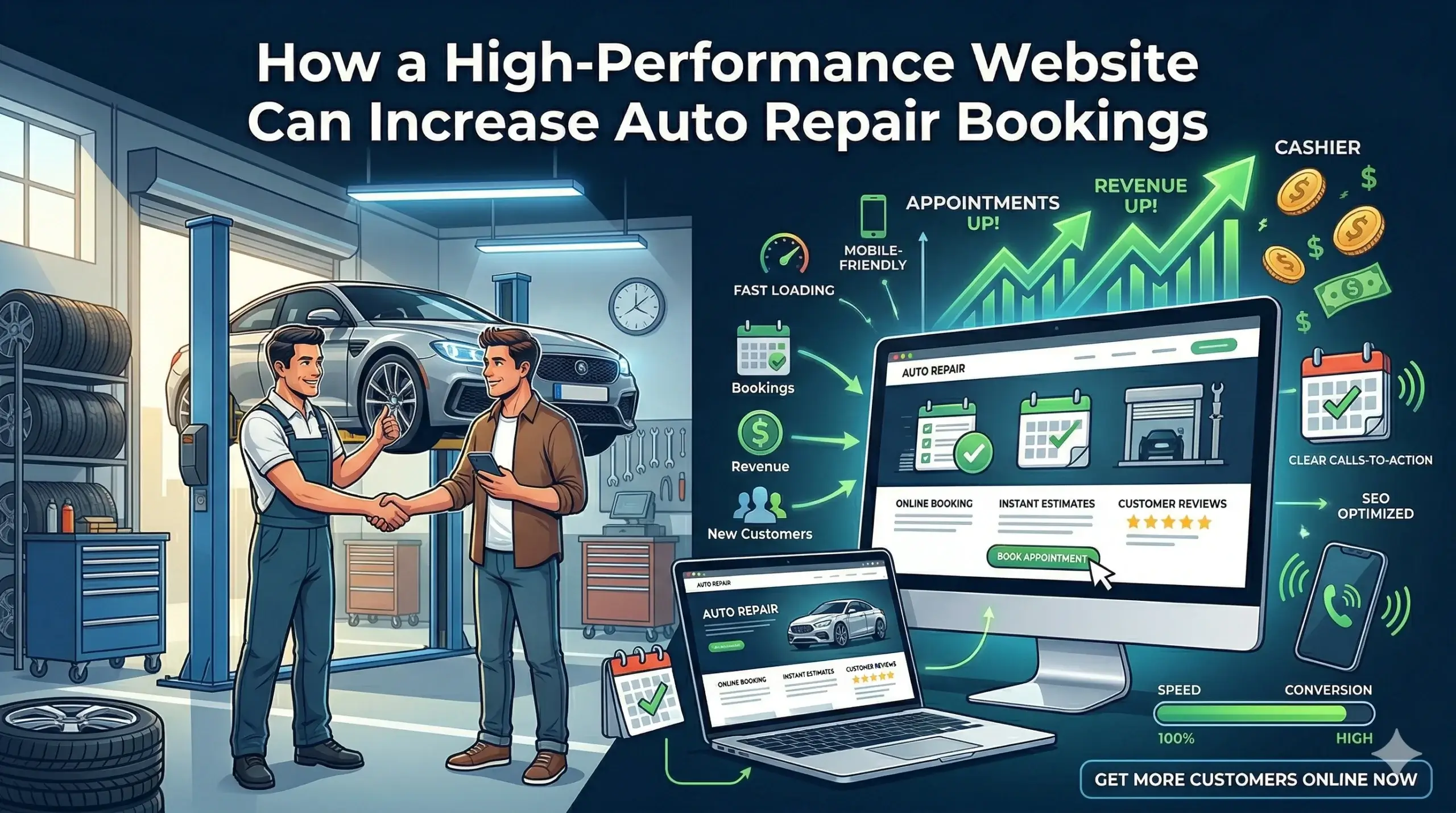
  • How a High-Performance Website Can Increase Auto Repair Bookings

    How a High-Performance Website Can Increase Auto Repair Bookings

    Your bays are ready. Your techs are skilled. But your phone isn’t ringing the way it should — and your gut tells you something is off with your website.

    Here’s the truth most auto shop owners don’t hear until it’s too late: your website isn’t just a digital business card. It’s either your best salesperson or your worst front-desk employee. And right now, if customers are landing on your site and leaving without calling, booking, or even reading past the first line — you’re losing revenue every single day without a trace.

    This post breaks down exactly what a high-performance automotive website design actually looks like, what’s most likely killing your bookings right now, and what a purpose-built shop site should do instead. No tech jargon. No fluff. Just what matters for getting more cars in your bays.


    Your Website Loads Slowly — And Your Customers Are Already Gone

    Think about how a customer finds you. They’re sitting in a parking lot, their check engine light just came on, and they’re on their phone searching for a nearby shop. They tap your link. They wait. They wait a little longer. And then they tap the back button and call your competitor.

    That’s not a hypothetical. That’s what happens when a website takes more than three seconds to load on mobile — and most auto shop websites load in six, eight, even ten seconds.

    The technical reason comes down to how the site was built: oversized images, bloated code, cheap hosting, no performance optimization. But the business reason is simpler: slow sites don’t get calls.

    What a properly built automotive website does instead:

    • Loads in under 2 seconds on any phone
    • Shows your phone number and “Book Now” button immediately — no scrolling required
    • Works flawlessly on every screen size (most auto repair searches happen on mobile)

    Digital Trace builds websites for automotive businesses that pass Google’s Core Web Vitals benchmarks — because a fast site isn’t just good UX, it’s a ranking signal that puts you above slower competitors in search results.


    Google Doesn’t Know Enough About Your Shop to Show It Confidently

    You might assume that having a website means Google knows you exist. It does — but “existing” and “ranking” are completely different things.

    Here’s a plain-English way to think about it: Google is like a new service writer at a dealership who needs to write up a customer’s car. If the file is incomplete — no VIN, no service history, no notes — they can’t do their job confidently. Your website works the same way. If Google can’t quickly understand what you do, where you are, and why you’re credible, it won’t confidently show your shop to someone searching nearby.

    The things most auto shop websites are missing:

    • Location signals: Your city and service area clearly named throughout the site — not just buried in a contact page
    • Structured data: Behind-the-scenes code that tells Google “this is an auto repair shop, here are their hours, here’s their rating” — without it, Google guesses
    • Service-specific pages: One catch-all “Services” page doesn’t rank. A dedicated page for “brake repair in [city]” does.

    This is exactly the kind of gap that a specialized automotive design agency addresses during a proper build — not as an afterthought, but baked into the foundation.


    Visitors Land On Your Site But Leave Without Calling

    Getting someone to your website is only half the battle. What happens when they get there?

    Most auto shop websites fail the same way a waiting room with no front desk would: customers show up, look around, don’t see anyone to help them, and walk out. Your website visitor does the same thing — if they can’t immediately find your phone number, your location, and a clear reason to trust you, they’re gone.

    This is called “conversion” — turning a visitor into a caller or booking. And it’s where most auto shop websites completely fall apart.

    The most common conversion killers:

    • Phone number hidden in the footer or on a separate contact page
    • No clear call-to-action above the fold (what you see before scrolling)
    • Generic stock photos instead of real shop photos that build trust
    • No reviews, ratings, or trust signals visible on the homepage
    • A contact form as the only booking option (customers want to call or book online instantly)

    A high-performing automotive website puts your phone number and “Schedule Service” button in the header — visible on every page, on every device, always. That one change alone can meaningfully increase inbound calls.


    💡 Pro Tip

    The #1 mistake auto shops make: one generic homepage trying to do everything.

    If someone searches “oil change near me” and lands on a homepage that talks about everything from tires to transmissions, they don’t see what they need fast enough — and they leave. The fix is creating targeted landing pages for your highest-value services (brake repair, transmission service, AC recharge) that speak directly to what the customer was searching for. Each page should have its own headline, its own local keywords, and its own call-to-action. It’s more pages to maintain — but each one works harder for you.


    What Happens When You Fix the Foundation: A Real-World Scenario

    The Shop: A family-owned auto repair business in the Southwest with three bays, five years in business, strong word-of-mouth — but a website built by a nephew in 2019 that hadn’t been touched since.

    The Problem: The site loaded in over eight seconds on mobile. There was no booking option — just a contact form that went to an inbox nobody checked daily. The homepage had no reviews, no service-specific pages, and the phone number was only in the footer. They were showing up on page three for their main local search terms.

    What Changed: A full rebuild focused on speed, mobile-first design, and local SEO structure. Dedicated pages for their top five services. Real shop photos. A prominent click-to-call button on every page. A simple online booking widget connected to their scheduling software.

    The Result: Within 90 days, inbound calls from the website increased by over 60%. They moved to page one for three of their core local search terms. The owner estimated they were recovering at least 8–10 lost leads per week that had previously found their site and left.

    That’s not a marketing miracle — it’s what happens when a website is actually built to convert.


    Not sure if your shop’s website has these same issues? Get a free website audit — no obligation, just a clear picture of what’s costing you leads right now.


    Your Competitor Is Showing Up — And You’re Not. Here’s Why.

    If you’ve Googled your own services and noticed a competitor ranking above you — especially one you know isn’t better than you — this section is for you.

    Local search rankings aren’t random. Google ranks sites based on dozens of signals, and most of them come down to three things: relevance (does this site clearly match what the searcher wants?), proximity (is the business actually local?), and authority (does Google trust this site?).

    The shop outranking you has probably done a few things you haven’t:

    • More reviews, more often: Businesses with a steady stream of recent Google reviews rank higher. Not just more reviews — recent ones, because Google treats review recency as a freshness signal.
    • Consistent business information everywhere: Name, address, and phone number matching exactly across Google Business Profile, Yelp, your website, and every directory. Even small inconsistencies hurt rankings.
    • A faster, better-structured website: Google uses site performance as a ranking factor. The competitor with the faster site has an edge — even if your service is better.

    None of these are impossible to fix. But they take intentional effort — and usually a partner who understands how local search actually works for automotive businesses specifically.


    Your Path to More Bookings

    Here are five things that move the needle — in plain English:

    1. Fix your site speed. If your site takes more than three seconds to load on a phone, you’re losing customers before they ever see your number. This is fixable with the right rebuild.
    2. Make your phone number impossible to miss. It should be in your header, clickable on mobile, and visible without scrolling on every single page.
    3. Create service-specific pages. Stop trying to rank for everything on one page. Build individual pages for your top services, each targeting a local keyword.
    4. Get your Google Business Profile dialed in. Make sure your hours, photos, services, and responses to reviews are complete and current. This directly affects your map pack ranking.
    5. Add an online booking option. A lot of customers — especially younger ones — won’t call. They want to book online. Give them that option and you’ll capture leads you’re currently losing.

    Frequently Asked Questions

    Why am I not getting calls from my website even though I have one?

    Having a website and having a working website are two different things. If your site is slow, hard to navigate on mobile, or doesn’t have a visible phone number and clear call-to-action, visitors will leave before they ever contact you. The site exists — but it’s not doing its job.

    How do I know if my auto shop website is actually working or costing me leads?

    The honest answer: most shop owners have no idea, because nobody’s told them what to look for. A basic check is this — Google your own top service plus your city, see where you rank, then open your site on your phone and time how long it takes to load. If you rank below page one or the site takes more than three seconds, you’re losing leads. A free website audit gives you a full picture without any guesswork.

    How long does it take to see results from a new website?

    For traffic and rankings, most shops start seeing meaningful movement within 60–90 days of launching a properly optimized site. Conversion improvements — more calls and bookings from existing traffic — can happen almost immediately after a rebuild, because you’re making it easier for people who already find you to actually contact you.

    What makes an automotive website different from a regular business website?

    Auto repair customers search differently than almost any other service business. They’re often in a stressful situation, searching on mobile, and making a decision fast. Your website needs to load instantly, show trust signals (reviews, credentials, real photos) at a glance, and make it dead simple to call or book. Generic website templates aren’t designed for that specific moment — automotive-specific design is.

    Do I really need a fast website if all my customers are local?

    Yes — especially because they’re local. Local customers are almost always searching on their phones, often while they’re already out. Mobile connections are slower than WiFi, which makes site speed even more critical. And Google uses site speed as a ranking factor for local search results, so a slow site directly hurts how often you show up when someone nearby searches for what you offer.

    I’ve paid for a website before and it didn’t help. Why would this be different?

    Most shop owners who’ve been burned before paid for a site that looked fine but was never built to rank or convert. Design and performance are different disciplines. A site can look professional and still load slowly, miss local SEO signals, and bury your phone number. The difference is a build process that starts with “how do we get this shop more calls” — not “how do we make this look nice.”


    Ready to See What Your Website Is Actually Costing You?

    Every week you have a slow, underperforming website, you’re handing leads to the shop down the street. Not because they’re better — because their website works and yours doesn’t.

    Digital Trace specializes in building high-performance websites for auto repair businesses across the US — sites that load fast, rank locally, and turn visitors into booked appointments.

    There’s no pitch, no pressure, and no obligation. Just a clear, honest look at what’s working, what isn’t, and what it would take to fix it.

    Get your free website audit →

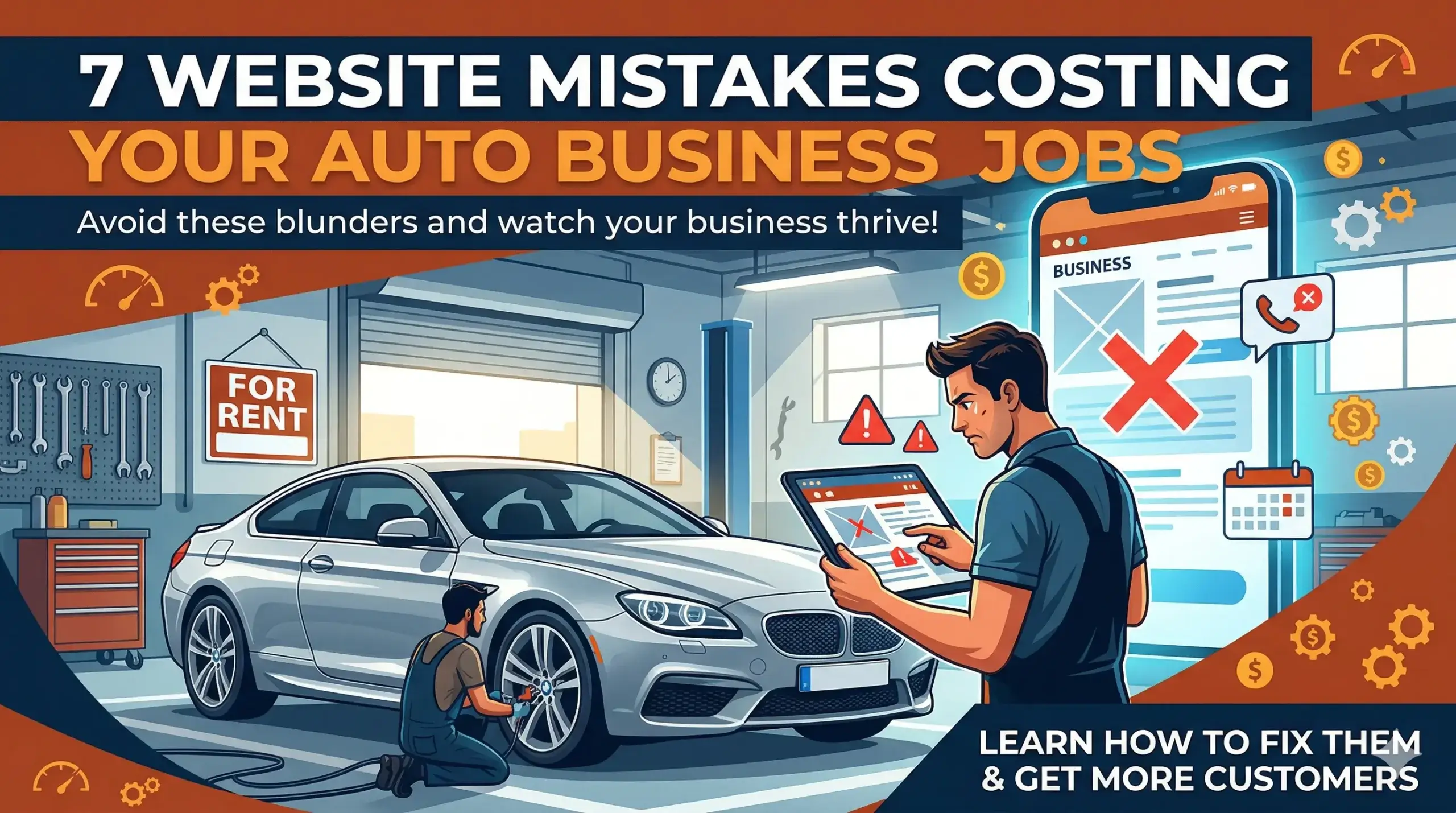
  • 7 Website Mistakes Costing Your Auto Business Jobs

    7 Website Mistakes Costing Your Auto Business Jobs

    Your phone should be ringing more than it is. You’ve got the skills, the crew, the equipment — maybe even solid reviews on Google. But the jobs aren’t coming in the way they should. You’re watching competitors stay busy while you’re refreshing your inbox.

    Here’s what most auto business owners don’t realize: your website isn’t just a place people visit. It’s the moment someone decides whether to call you or keep scrolling. And if your automotive website design is making any of the mistakes below, you’re quietly bleeding leads every single day — without knowing it.

    This isn’t about fancy design trends or technical buzzwords. It’s about the real reasons customers land on your site and leave without picking up the phone.


    Mistake #1: Your Site Takes Too Long to Load — And Customers Leave Before They See Your Number

    Think about the last time you waited more than five seconds for a webpage to load. You clicked away. Your customers do exactly the same thing.

    Most auto shop websites are loaded down with oversized images, outdated themes, and cheap hosting that can’t keep up. The result? Slow load times that kill your first impression before it even starts.

    The real cost isn’t a “bad user experience” — it’s a lost oil change, a lost tire rotation, a lost engine job. Someone searched, found you, and left because your site was too slow. They called the shop two listings down.

    What Digital Trace does instead: Every site we build for auto businesses is optimized for speed from the ground up — compressed images, fast hosting, lean code. Because in the auto industry, every second your site takes to load is a second a competitor has to steal your customer.


    Mistake #2: Your Site Looks Fine on a Desktop — But Broken on the Phone Where Customers Are Searching

    Pull up your website on your phone right now. Can you read it without zooming? Is your phone number easy to tap? Can someone find your hours in under 10 seconds?

    If the answer to any of those is “not really” — you have a problem. More than 70% of local searches for auto services happen on a mobile phone. People are searching “oil change near me” or “transmission repair shop” while they’re sitting in their driveway.

    A site that’s awkward to use on mobile sends a silent message: this business doesn’t take their image seriously. Even if that’s not true, it’s what people feel — and they move on.

    What Digital Trace does instead: Every automotive website we build is mobile-first. That means your phone number is one tap away, your services are easy to find, and the whole experience feels clean and professional on any screen.


    Mistake #3: Google Doesn’t Know Enough About Your Business to Recommend It

    You might wonder why your competitor — who’s been in business half as long as you — shows up on Google when you don’t. There’s a technical reason, and it’s fixable.

    Google needs signals to feel confident recommending a business. Things like structured business data, clear service pages, proper location information, and consistent details across the web. When those signals are weak or missing, Google plays it safe and surfaces someone else.

    Think of it like this: if a customer walked into your shop and asked what you specialize in, and you just shrugged and handed them a blank card — they’d walk out. That’s what a poorly structured website does to Google.

    What Digital Trace does instead: We build automotive websites with the right technical foundation so Google understands exactly what you do, where you are, and who you serve. That’s how we help auto businesses climb local rankings without paying for every single click.


    💡 Pro Tip: One of the most common mistakes auto business owners make is having a single generic “Services” page instead of separate pages for each service — oil changes, brakes, transmission, tires, and so on. Google ranks individual pages for individual searches. If you want to show up when someone searches “brake repair in [your city],” you need a dedicated page for that service. It doesn’t have to be long — 300 focused words beats a bloated catch-all page every time.


    Mistake #4: Your Website Has No Clear Reason for Someone to Call Right Now

    Most auto shop websites describe what the business does. What they don’t do is give a visitor a reason to act today.

    There’s no offer. No urgency. No clear next step. Just a list of services and maybe a phone number buried in the footer. The visitor reads, nods, and then closes the tab to “come back later.” They don’t come back.

    Your website should function like a good service advisor — it should greet the visitor, understand their problem, and guide them toward booking an appointment. Not just inform them that you exist.

    What Digital Trace does instead: We build conversion-focused automotive websites that include clear calls to action, easy scheduling, and trust signals (like reviews, certifications, and warranties) placed exactly where hesitant customers need to see them.


    Mistake #5: Your Website Makes It Hard to Trust You — Even When You’re Great at What You Do

    Trust is everything in the auto industry. Customers hand over their keys and their money based on a gut feeling. Your website either builds that feeling or kills it.

    A website with no photos of your actual shop, no real team bios, no customer reviews, and a generic stock-photo look signals one thing: this shop hasn’t invested in their reputation online. Even if you have 200 five-star reviews on Google, if they’re not on your website, you’re missing a massive opportunity.

    A prospective customer who lands on your site at 10pm on a Saturday — when they can’t call you — needs enough to feel confident. If your site can’t close that gap, you’ve lost the job before you even knew about it.

    What Digital Trace does instead: We help auto businesses build credibility right into the website — real photos, embedded reviews, team introductions, and badges that show what you stand for. The site does the selling while you focus on the work.


    What a Real Auto Business Turnaround Looks Like

    Consider a mid-sized auto repair shop in a competitive suburban market. They had a website — technically — but it was built years ago, wasn’t mobile-friendly, took about 7 seconds to load, and had no individual service pages. Their Google Business Profile got some traction, but the website was losing leads the moment people clicked through.

    After rebuilding with a proper automotive website design — fast loading, mobile-optimized, separate pages for each service, customer reviews prominently displayed, and a clear “Book an Appointment” flow — the difference was measurable. Within three months, organic traffic from Google doubled. Phone calls from the website increased significantly. And the shop owner stopped depending entirely on word-of-mouth to fill their calendar.

    The work didn’t change. The skill didn’t change. The website did.


    Not sure if your automotive website has these issues? Get a free website audit — no obligation, just a clear picture of what’s costing you leads.


    Mistake #6: You’re Invisible to Customers Searching Right Now in Your Area

    There’s a box of potential customers in your market who are searching for exactly what you offer, right this minute. If your site isn’t showing up in that window — the Google map pack, the local search results, the “near me” queries — you’re invisible to them.

    Local SEO for auto businesses isn’t complicated, but it requires the right foundation. Your Google Business Profile, your website, your service pages, and your online mentions all need to work together. When they don’t, your competitor who built their site right gets the call.

    What Digital Trace does instead: We make sure the entire local SEO foundation is built into every automotive website we design — not added as an afterthought. Because showing up when someone searches “auto shop near me” is worth more than any ad you could run.


    Mistake #7: Your Website Was Built Once and Never Touched Again

    A website isn’t a billboard you bolt up and forget. The auto industry changes. Search behavior changes. Google’s expectations change. A site that was “good enough” two years ago may be actively hurting you today.

    Outdated plugins, broken forms, missing security certificates, or content that no longer reflects your services — these are quiet problems that erode trust and performance without anyone flagging them.

    What Digital Trace does instead: We build automotive websites designed for the long term, and we support our clients beyond launch. A site that keeps working, stays current, and keeps generating leads is the whole point.


    Your Path to More Leads

    Getting your website working for your auto business doesn’t have to be overwhelming. Here’s the straightforward version of what needs to happen:

    • Fix the speed. A site that loads in under 3 seconds keeps people on the page. Anything slower is losing you customers.
    • Make it work on mobile. Your phone number should be one tap away, every time.
    • Give Google what it needs. Separate service pages, proper business data, consistent information — these are how you get found.
    • Build trust on the page. Real photos, real reviews, real information about your team and your process.
    • Make it easy to take the next step. A clear, frictionless way to call, book, or reach you turns visitors into jobs.

    None of this requires a massive overhaul or a six-figure budget. It requires getting it right. That’s exactly what websites built for automotive businesses by Digital Trace are designed to do.


    Frequently Asked Questions

    Why am I not getting calls from my website even though people are visiting it?

    Traffic without calls usually means one of two things: your site isn’t making it easy enough to contact you, or visitors aren’t finding enough reason to trust you yet. A slow site, no visible reviews, and a buried phone number are the most common culprits. A website audit will show you exactly where you’re losing people.

    How do I know if my auto shop website is actually working?

    If you can’t point to calls, appointment requests, or contact form submissions that came from your site — it’s not working hard enough. Your website should be generating leads every week. If it’s not, something in the design, speed, or structure is breaking the chain.

    How long does it take to see results from a new automotive website?

    Most auto businesses start seeing measurable improvements within 60–90 days of launching a properly built site — especially in local search visibility and lead volume. The timeline depends on how competitive your market is and how strong your Google Business Profile already is, but a well-built site typically pays for itself quickly.

    What makes an automotive website different from a regular business website?

    Auto customers have specific trust barriers — they want to know you’re qualified, honest, and local. A generic business template doesn’t address any of that. A purpose-built automotive website includes service-specific pages, trust signals like certifications and reviews, fast mobile performance for in-driveway searches, and local SEO foundations that put you in front of the right customers.

    Do I really need a fast website if most of my customers are local?

    Especially if your customers are local. Local searches happen on phones, in the moment, with very little patience. If your site loads slowly or looks rough on mobile, the person searching from their car will call the next result. Speed and mobile performance are the baseline for local auto businesses, not a bonus feature.

    What should I ask a web agency before hiring them to build my auto shop website?

    Ask them to show you automotive websites they’ve built, not just general business sites. Ask what their process is for local SEO. Ask how they measure success after launch. And book a free website audit with Digital Trace first — you’ll know exactly what your current site is missing before you spend a dollar.


    Your Auto Business Deserves a Website That Works as Hard as You Do

    Every day your website has these problems is another day of jobs going to someone else. You don’t need a flashy redesign for the sake of it — you need a site that loads fast, ranks locally, builds trust, and makes it effortless for customers to choose you.

    Digital Trace specializes in automotive website design built specifically for shops like yours — not cookie-cutter templates, but conversion-focused sites grounded in how your customers actually search and decide.

    Get your free website audit today. No pitch, no pressure — just a clear, honest look at what your current site is costing you in leads and revenue. There’s no risk in knowing where you stand.

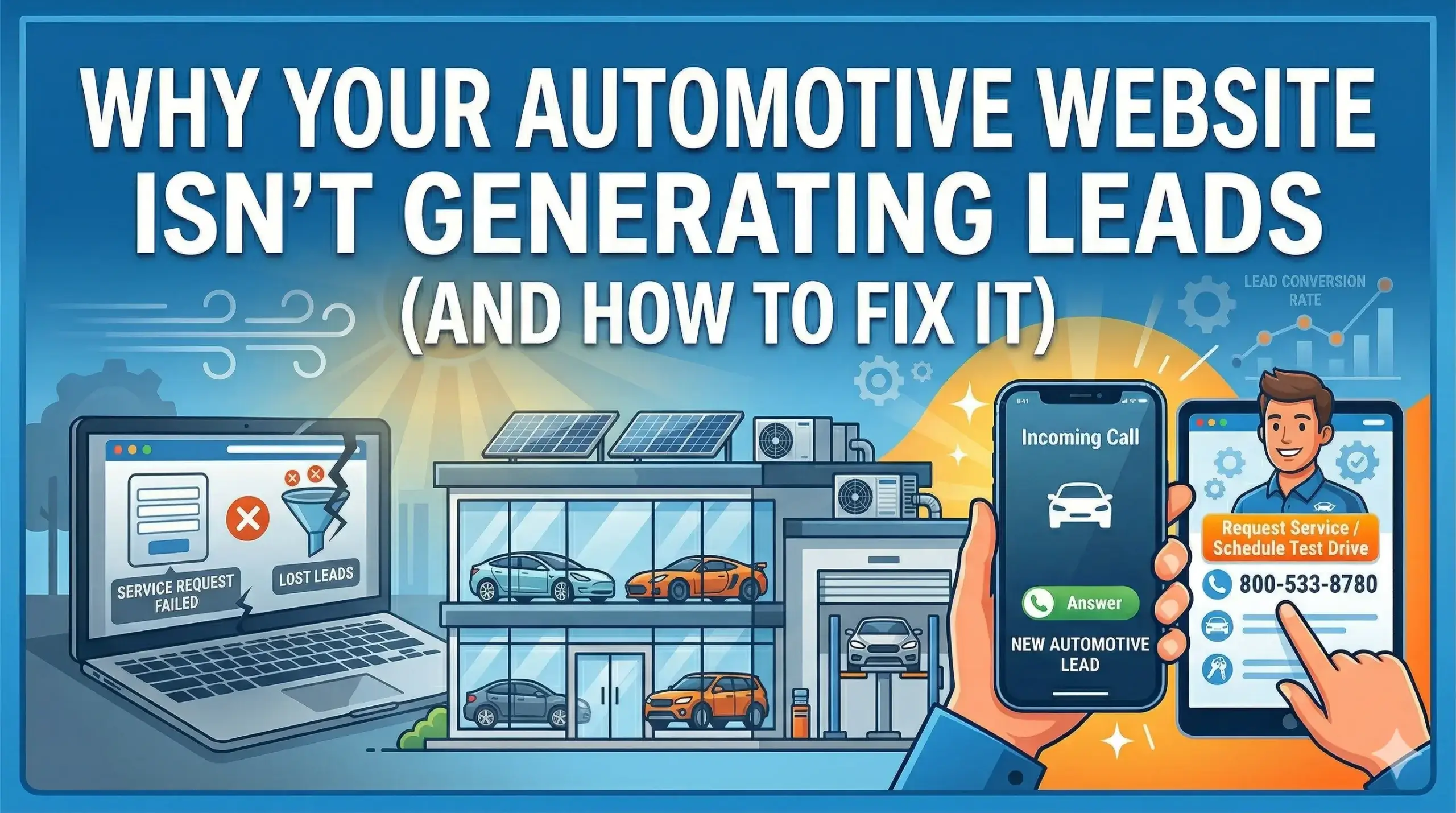
  • Why Your Automotive Website Isn’t Generating Leads (And How to Fix It)

    Why Your Automotive Website Isn’t Generating Leads (And How to Fix It)

    You’ve got a website. It’s been live for a couple of years. Maybe someone redid it, or maybe it came with your shop management software. Either way, the phone isn’t ringing the way it should — and you’re not sure why.

    Here’s the uncomfortable truth: most automotive websites look fine on the surface but are silently failing every single day. They’re not converting visitors into calls. They’re not showing up when local customers search. And they’re handing leads directly to your competitor down the street without you ever knowing.

    This isn’t about needing more traffic or spending more on ads. It’s about fixing the foundational problems in your automotive website design that are costing you real customers right now. By the end of this article, you’ll know exactly what’s broken — and what a high-performance fix looks like.


    Your Website Is Like a Waiting Room With No Receptionist

    Think about it this way: when a customer walks into your shop, someone greets them. They see your certifications on the wall. They know where to sit, what to ask, and that they’re in the right place.

    Most automotive websites do none of that. A customer lands on your site, can’t find your phone number, can’t tell what services you offer, and has no idea if you’re trustworthy. So they leave — and call the next shop in Google’s results.

    That moment of confusion costs you a customer every single time. And it’s happening dozens of times a day.


    Problem #1: Your Phone Number Is Hidden (Or Just Hard to Find)

    This sounds too simple to be a real issue. It is absolutely a real issue.

    On most automotive websites, the phone number lives in the footer, in small text, buried beneath a navigation menu. On mobile — where 70%+ of your customers are searching — that means they have to scroll past your entire homepage just to find out how to call you.

    The real cost: A potential customer searching “oil change near me” at 7pm has three tabs open. Whichever shop makes it easiest to call gets the booking. If that’s not you, it’s someone else.

    What a high-performance automotive website does instead: The phone number sits at the very top of every page as a clickable tap-to-call button. On mobile, it’s always visible. No scrolling. No hunting. One tap and they’re talking to you.


    Problem #2: Your Site Takes Forever to Load — and Nobody Waits

    Imagine a customer pulls into your parking lot, sits in your waiting area for 10 seconds, and then walks out. That’s what a slow website does, every single time.

    Most automotive websites load in 6 to 10 seconds. The research is clear: most people abandon a site after 3 seconds if it hasn’t loaded. That means a significant chunk of your visitors are leaving before they’ve even seen your name.

    Why it happens: Oversized images, cheap hosting, bloated code, too many plugins — all the technical stuff that gets ignored when a site is built on the cheap. None of it is visible to you. All of it is visible in your call volume.

    What Digital Trace does instead: Every automotive website we build is optimized to load in under 2 seconds — tested across real mobile devices, not just desktop. Speed isn’t an afterthought; it’s built into the foundation.


    Problem #3: Google Doesn’t Know Enough About Your Business to Trust It

    You might wonder why your competitor — with a worse-looking website — shows up before you in Google. The answer usually isn’t about their design. It’s about signals.

    Google needs specific information to confidently recommend a local business: your services, your location, your hours, your reviews, and structured data that tells Google’s systems exactly what your business does. Most automotive websites are missing most of this.

    The plain-English version: Google is like a cautious customer who only refers friends to businesses they know well. If your site doesn’t give Google enough to work with, it won’t take the risk of putting you in front of searchers — even if you’re the best shop in town.

    What this looks like in practice: Your site needs clear service pages (not just “Services” — think “Brake Repair in [City]”), a properly claimed and linked Google Business Profile, consistent contact information, and technical markup that tells Google’s crawlers what they’re reading.

    💡 Pro Tip: One of the most common mistakes automotive shops make is having a single “Services” page that lists everything in bullet points. Google rewards specificity. A dedicated page for each service — oil changes, brake repair, tire installation, AC service — not only helps Google understand your business, it also gives you a page that can rank for each individual search. It’s one of the fastest fixes that directly impacts how often you show up locally.


    Not Sure If Your Site Has These Problems?

    Digital Trace offers a free website audit for automotive businesses — no obligation, just a clear picture of what’s costing you leads. We’ll look at your speed, your mobile experience, your local SEO setup, and your conversion path, then show you exactly what’s working and what’s not.

    Claim Your Free Audit →


    Problem #4: Your Website Doesn’t Build Trust Fast Enough

    When someone’s choosing a shop to trust with their car, they’re making a judgment call in about 8 seconds. Your website either builds that trust or it doesn’t.

    Most automotive websites skip the basics: no visible reviews, no certifications displayed prominently, no photos of the actual team or shop, no guarantees. They look like a placeholder — not a professional operation.

    The real cost: Customers assume the worst. If your site looks like it hasn’t been updated since 2016, they assume your service might match.

    What builds trust fast:

    • Google and Yelp review counts displayed prominently (not buried)
    • ASE certifications or brand partnerships shown near the top
    • Real photos of your shop and team — not stock images
    • A clear service guarantee or warranty statement
    • Before/after or “what to expect” content that reduces anxiety

    These aren’t design extras. They’re conversion elements. Every one of them directly affects whether someone calls or clicks away.


    Problem #5: Your Site Wasn’t Built for the Customer Who’s Ready to Book Right Now

    There’s a big difference between someone browsing automotive content and someone who’s ready to book a service today. High-intent customers — the ones searching “brake repair near me” or “check engine light diagnosis [city]” — need a direct, frictionless path to contact.

    Most automotive websites treat every visitor the same: they show the same homepage, the same generic copy, the same buried contact form. There’s no urgency, no clear next step, no reason to act now instead of later.

    What a conversion-focused automotive website design looks like:

    • Service-specific landing pages with clear calls to action
    • Tap-to-call and online booking options visible immediately
    • Location-specific content that confirms “yes, we serve your area”
    • Trust signals (reviews, certifications) reinforced on every page, not just the homepage

    When a high-intent customer lands on a page built for them, conversion rates jump dramatically. That’s not marketing theory — that’s the practical difference between 3 calls a week and 15.


    The Real Numbers: Typical vs. High-Performance Automotive Website

    FactorTypical Automotive WebsiteHigh-Performance Automotive Website
    Calls per month3–6 (inconsistent)15–35+ (predictable)
    Page load speed6–10 secondsUnder 2 seconds
    Mobile experienceBuried phone number, hard to navigateTap-to-call, clean layout, fast booking
    Google visibilityPage 2–3, no map packPage 1, local map pack
    Trust signalsMissing or outdatedReviews, certifications, guarantees visible
    Service pagesOne generic “Services” pageIndividual pages per service, locally optimized
    Bounce rate70–85%35–50%

    The difference between these two columns isn’t a bigger marketing budget. It’s better automotive website design decisions made upfront.


    Real-World Before/After: Midwest Auto & Tire

    The situation: A family-owned tire and repair shop in Ohio had been operating for 11 years. They had a website — professionally designed three years earlier — and were running a modest Google Ads campaign. Calls were flat at 8–12 per week. The owner assumed the market was just slow.

    What the audit found: The site loaded in 8.4 seconds on mobile. The phone number was only in the footer. There were no individual service pages — just one page listing 14 services in paragraph form. Their Google Business Profile was incomplete and linked to a domain they no longer used. Reviews existed on Google but weren’t referenced anywhere on the site.

    What changed: Digital Trace rebuilt the site with speed as a priority (under 1.8 seconds load time), added tap-to-call functionality at the top of every page, created individual optimized pages for their eight core services, fixed the Google Business Profile link, and added a review widget pulling live Google ratings to the homepage.

    The result: Within 90 days, inbound calls increased from an average of 10 per week to 28 per week. The Google Ads budget stayed the same. The only difference was where those visitors landed — and what happened when they got there.


    Your Path to More Leads: 5 Steps to Start Now

    You don’t need to overhaul everything overnight. Start here:

    1. Check your site on your phone right now. Open your own website on your smartphone as if you’re a customer. Can you find the phone number in under 3 seconds? Can you tap to call? If not, that’s costing you bookings today.

    2. Google your own business. Search “[your service] near [your city].” Are you on page one? Are you in the map pack? If not, your customers aren’t finding you — they’re finding someone else.

    3. Count your service pages. If your entire service offering lives on one page, you’re invisible for most of the searches that matter. Each service deserves its own page.

    4. Check your site speed. Go to Google PageSpeed Insights and run your site. A score below 50 on mobile means you’re losing a significant percentage of visitors before they even see your content.

    5. Get a professional audit. Most of the problems listed in this article are invisible to the naked eye. They live in your site’s code, its structure, and its relationship with Google. A proper audit finds them in hours — not months.


    Ready to Find Out What’s Costing You Calls?

    Digital Trace works specifically with small business owners in the automotive industry to build websites that don’t just look good — they generate consistent, qualified inbound calls.

    The free audit covers your load speed, mobile usability, local SEO setup, conversion path, and trust signals. You’ll get a plain-English breakdown of exactly what’s working and what’s actively costing you leads.

    There’s no pitch, no pressure, and no obligation. Just a clear picture of where your website stands — and what it would take to fix it.

    Get Your Free Automotive Website Audit →

  • Virtual Showrooms: How 3D Walkthroughs are Replacing the Traditional Test Drive

    Virtual Showrooms: How 3D Walkthroughs are Replacing the Traditional Test Drive

    The automotive path to purchase has shifted. Today, the “first visit” doesn’t happen on your lot; it happens on a smartphone screen. For many US dealers, this is where the sale is lost. High bounce rates and low lead conversion often stem from a static, uninspired car dealer website that fails to bridge the gap between digital browsing and physical ownership.

    Generic image galleries are no longer enough. To capture the modern consumer, dealerships must transition from being online catalogs to immersive digital destinations.

    The Death of the Static Inventory Page

    The average consumer now spends over 14 hours researching vehicles online before ever stepping foot in a dealership. If your website relies on flat, 2D images, you are providing an experience that feels outdated.

    360 car photography and 3D walkthroughs solve a critical psychological barrier: trust. By allowing a user to “sit” in the driver’s seat, inspect the stitching on the leather, and toggle the infotainment system from their browser, you move them from passive observer to active participant. This immersion significantly increases “time-on-page,” a metric that signals high value to search engines.

    Technical Performance: Where Aesthetics Meet SEO

    While 3D assets are visually stunning, they are resource-heavy. A common mistake in automotive website design is prioritizing visual flair at the expense of technical performance.

    • The Speed Gap: If a 3D showroom adds three seconds to your load time, you’ve lost 40% of your mobile traffic before the page even renders. Page speed isn’t just a metric; it’s the difference between a lead and a lost opportunity.
    • Optimization Strategy: At Digital Trace, we implement advanced “Lazy Loading” and Content Delivery Networks (CDNs) to ensure that high-resolution 3D environments load near-instantaneously.
    • Mobile-First Indexing: Google primarily uses the mobile version of your site for ranking. Your virtual showroom must be as fluid on an iPhone as it is on a desktop workstation.

    Compliance and Accessibility in the US Market

    For US-based small business owners, a high-performing website must also be a compliant one. ADA (Americans with Disabilities Act) compliance is no longer optional.

    Interactive 3D elements must be accessible to users with screen readers or those who navigate via keyboard. Failing to address this doesn’t just alienate a segment of your audience; it opens your business to significant legal risk. High-end design must be inclusive design, ensuring every potential buyer can navigate your inventory without friction.

    Synergizing 360 Photography with Local SEO

    Your virtual showroom shouldn’t live in a vacuum. By integrating 360-degree views directly into your Google Business Profile, you improve your Local SEO footprint.

    When a user searches for a “car dealer near me,” Google prioritizes profiles with high engagement and rich media. Immersive content signals to the algorithm that your business is active and authoritative, directly influencing your position in the “Local Map Pack.” This creates a seamless funnel: the user finds you on Google Maps, explores the interior via a 3D walkthrough, and clicks “Book a Test Drive” with high intent.

    The ROI of Digital Immersion

    The goal of a 3D showroom isn’t just to look modern—it’s to filter for high-quality leads.

    1. Reduced Sales Friction: Customers arrive at the dealership having already “vetted” the vehicle.
    2. Higher Retention: Interactive sites see significantly higher return-visit rates.
    3. Brand Authority: A premium digital experience justifies premium pricing and builds long-term brand equity.

    In a saturated market, your “digital trace” is the most powerful tool you have to differentiate your dealership from the franchise down the street.

    Optimize Your Digital Trace

    Is your website a high-performance sales machine or a digital roadblock? A beautiful site that doesn’t rank is as useless as a fast car with no fuel.

    Visit Digital Trace today for a Free Website Audit. Let’s analyze your current performance and show you how a custom-engineered automotive platform can turn your digital presence into your most productive salesperson.

  • The Digital Mechanic: Building an Auto Repair Website That Books Appointments While You Sleep

    The Digital Mechanic: Building an Auto Repair Website That Books Appointments While You Sleep

    For most shop owners, a website is treated like a digital business card—it exists, but it isn’t actually working. While you are under the hood, your digital presence should be qualifying leads and filling your bays. If your current site is just a static gallery of your garage, you are losing market share to competitors who treat their car service website as a high-performance tool.

    In the US market, a “good enough” website is a liability. To convert modern drivers, your site needs to balance high-end aesthetics with the rigorous technical standards of Google’s mobile-first indexing.

    The Performance Gap: Why Aesthetics Alone Fail

    A beautiful auto repair website design is useless if it doesn’t load fast or rank locally. At Digital Trace, we view a website like a high-performance engine: the UI (User Interface) is the bodywork, but the technical SEO and UX (User Experience) are the internal components that actually move the vehicle.

    The 3-Second Rule and Core Web Vitals

    Google’s algorithm prioritizes page speed. If your site takes longer than three seconds to load on a mobile device, 53% of visitors will bounce. Speed isn’t just a technical metric; it is a direct influencer of your bounce rate and, ultimately, your bottom line. We optimize for “Core Web Vitals” to ensure your shop appears first when a local driver is stranded and searching for immediate help.

    Conversion Architecture: Turning Traffic into Bay Traffic

    Getting a visitor to your website for car repair is only half the battle. The other half is “Conversion Architecture”—the strategic placement of elements that guide a user from “just looking” to “booking.”

    Frictionless Appointment Scheduling

    The modern consumer avoids phone calls. If your site relies solely on a “Call Us” button, you are bleeding leads. High-converting sites integrate:

    • Live Booking Sync: Real-time calendars that allow customers to claim a time slot.
    • Urgency Triggers: “Next available slot: Today at 2:00 PM.”
    • One-Handed Navigation: Since 80% of local automotive searches happen on mobile, your “Book Now” button must be easily clickable by a thumb.

    Navigating US Standards: ADA and Local SEO

    Operating in the US market requires adherence to specific digital standards that protect your business and improve visibility.

    ADA Compliance

    The Americans with Disabilities Act (ADA) extends to the digital space. A professional website must be accessible to users with visual or auditory impairments. Failure to comply is not just bad for business—it’s a legal risk. We implement screen-reader compatibility and high-contrast modes as a standard, not an afterthought.

    Dominating the “Local Pack”

    Local SEO is the lifeblood of an auto shop. Your website must be structured to dominate the “Map Pack” (the top three local listings on Google). This requires:

    • Hyper-Local Content: Pages dedicated to specific neighborhoods or suburbs you serve.
    • Schema Markup: Specialized code that tells Google exactly what services you offer, your hours, and your physical location.

    The Digital Trace Advantage

    Generic website builders offer templates that look clean but lack the “under-the-hood” sophistication required to rank in a competitive landscape. A professional auto repair website design requires a synthesis of brand storytelling and technical precision. We don’t just build sites; we build automated sales funnels that reflect the quality of your craftsmanship.

    Is your website an asset or a liability?

    Your “digital trace” is often the first and only impression a customer gets of your shop. Don’t let an outdated site stall your growth.

    [Get Your Free Website Audit & Consultation] Visit Digital Trace today to see exactly where your site is losing money and how we can optimize your presence for 24/7 growth.

  • From Shiny Cars to Shiny ROI: Why Your Detailing Site Needs a Visual Estimate Tool

    From Shiny Cars to Shiny ROI: Why Your Detailing Site Needs a Visual Estimate Tool

    In the high-end detailing and ceramic coating industry, your work is judged by its finish. Yet, many US-based detailing businesses operate with websites that look like dull clear coats—outdated, slow, and full of friction.

    The biggest bottleneck in digital lead generation today isn’t a lack of traffic; it’s the “price barrier.” Potential clients don’t want to wait 24 hours for a quote. If your detailing website design requires a manual contact form for every inquiry, you are losing high-ticket ceramic coating jobs to competitors who provide instant, visual gratification.

    The Psychology of the Visual Estimate

    A visual estimate tool isn’t just a calculator; it’s a conversion engine. For a customer looking at a $1,500 ceramic coating package, the transition from “browsing” to “buying” requires trust and transparency.

    1. Reducing Friction in the Sales Funnel

    Traditional “Contact Us” forms are where leads go to die. A visual tool allows users to select their vehicle size, paint condition, and desired protection level. By the time they hit “submit,” they have already mentally “purchased” the service. This shifts the conversation from “How much do you charge?” to “When can you fit me in?”

    2. Establishing Authority through UI/UX

    In car website design, aesthetics equate to perceived quality. If your site is clunky, a lead assumes your shop is disorganized. A sleek, interactive estimator signals that your business utilizes modern technology—a trait highly valued by owners of luxury and exotic vehicles.

    Technical Performance: Speed vs. Functionality

    Adding interactive tools can often bloat a website, leading to poor Core Web Vitals. At Digital Trace, we prioritize the “Technical Trifecta”:

    • Page Speed: If your estimator takes more than 2.5 seconds to become interactive (Time to Interactive), your bounce rate will skyrocket. We use lightweight JavaScript frameworks to ensure the tool scales without dragging down performance.
    • Mobile-First Indexing: 70% of detailing searches happen on mobile devices. Your visual tool must be “thumb-friendly,” avoiding small dropdowns or complex fields that frustrate mobile users.
    • ADA Compliance: For US small businesses, accessibility is a legal necessity. Ensuring your estimator is screen-reader friendly protects you from litigation and opens your market to all users.

    Local SEO and Ceramic Coating Marketing

    Your website is the foundation of your ceramic coating marketing strategy. A visual estimate tool provides a unique opportunity to capture “Zero-Click” search intent.

    When Google sees users spending 3–5 minutes interacting with a tool on your site (High Dwell Time), it signals that your content is authoritative. This boosts your rankings for high-intent keywords like “ceramic coating near me” or “best car detailing [City Name].” Furthermore, the data captured—vehicle types, common paint issues in your area—allows you to refine your local SEO content to match what your market actually needs.

    The Digital Trace Edge: Aesthetics Meet Analytics

    Generic plugins often look like an afterthought. A truly effective detailing website design integrates the estimator into the brand’s visual identity. It should feel like a premium concierge service, not a spreadsheet.

    We focus on the “Digital Trace” of your customer—the trail of data they leave behind. By tracking where users drop off in your estimator, we can optimize the UI to ensure maximum completion rates and a higher ROI on your ad spend.


    Optimize Your Digital Trace Today

    Is your current website a liability or an asset? Don’t let a “dull” online presence cost you high-ticket clients.

    [Get a Free Website Audit from Digital Trace] Let’s analyze your site’s speed, SEO, and conversion path to see how a custom visual estimate tool can accelerate your business growth.