Category: Towing

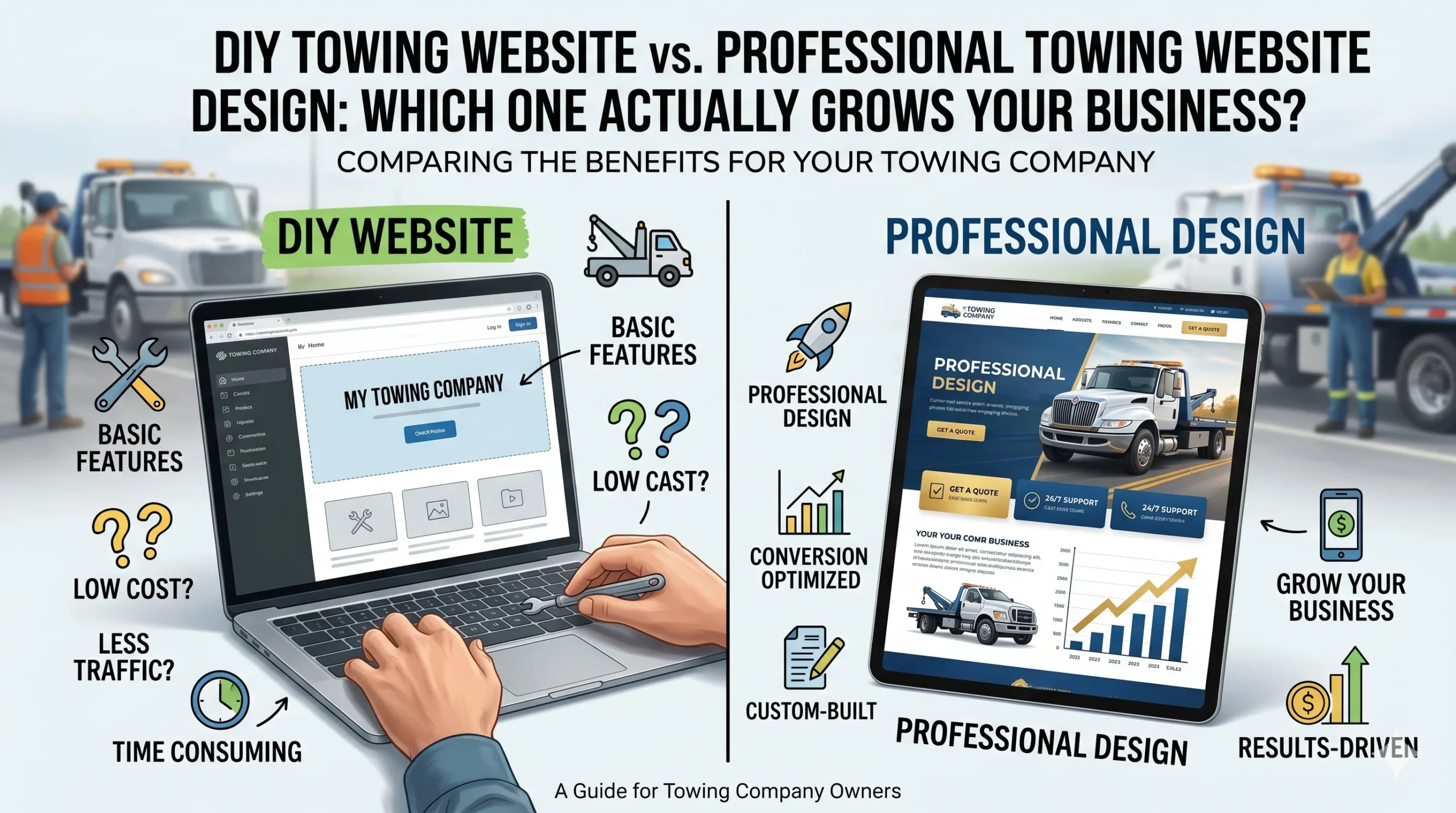
  • DIY Towing Website vs. Professional Towing Website Design: Which One Actually Grows Your Business?

    DIY Towing Website vs. Professional Towing Website Design: Which One Actually Grows Your Business?

    You’ve got a towing business to run — dispatch calls coming in, trucks on the road, drivers to manage. So when it came time to build a website, you handled it yourself (or had a nephew do it), got something live, and moved on.

    But here’s the problem: the phone isn’t ringing from it.

    You’re not alone. Most towing company owners assume that having any website is good enough. The truth is, there’s a massive difference between a website that just exists and a towing website design that actually converts visitors into paying customers. One is a digital placeholder. The other is your best salesperson — working 24/7, capturing calls at 2am when someone’s car breaks down on the highway.

    By the end of this article, you’ll know exactly why your website might be failing you, what a professionally built towing service website actually does differently, and how to find out what it’s costing you right now.


    Why Your Towing Website Isn’t Bringing In Calls

    Think about the moment someone needs a tow. Their car just died on the side of the road. They’re stressed, maybe in the dark, and they pull out their phone. They type “tow truck near me” or “towing service [city name]” — and they call the first company that looks trustworthy.

    If your website isn’t showing up in that search, or if it shows up but looks outdated or loads slowly, that customer calls your competitor. Not because they preferred them — just because your site didn’t show up or didn’t pass the split-second trust test.

    That’s not a traffic problem. That’s a towing website design problem.


    The DIY Website Trap: What It Costs You Without You Knowing

    A DIY site built on Wix, Squarespace, or a free WordPress template might look fine on your laptop. But “looks fine” and “performs” are two completely different things for a towing service website.

    Here’s what’s typically broken under the hood:

    • It loads too slowly. Most people searching for a tow truck are on their phones, often with spotty signal. If your site takes more than 3 seconds to load, the majority of visitors leave before they ever see your phone number. That’s not an exaggeration — it’s a consistent pattern across local service websites.
    • Google can’t figure out what you do or where you do it. Without the right technical setup (called local schema markup), Google doesn’t have the structured information it needs to confidently recommend your business in local searches. The fix isn’t complicated, but most DIY builders skip it entirely.
    • Your phone number isn’t click-to-call. On a phone, a number that isn’t tappable means the customer has to memorize it, switch apps, and dial manually. Most don’t bother.
    • You’re invisible in the city areas you actually serve. DIY sites rarely have the location-specific pages that tell Google “this towing company serves [city], [city], and [city].” Without those, you show up for almost nothing.

    What a Professional Towing Website Design Actually Does Differently

    Here’s the analogy that makes this click for most towing operators: imagine you’ve got a great truck, but the radio doesn’t work, the GPS is broken, and it doesn’t show up in dispatch. It can still tow — but you’d never get a call for it.

    That’s a DIY website. A professional towing website design is the fully operational truck: it shows up when someone needs help, it looks reliable, and it makes it effortless to call.

    Specifically, a professionally built towing company website does these things:

    • Loads in under 2 seconds — so customers on the side of the road aren’t waiting and bouncing
    • Has a prominent, click-to-call phone number visible above the fold on every page
    • Targets the specific cities and service areas where you actually want to win work
    • Is structured so Google understands your services — roadside assistance, flatbed towing, long-distance towing, whatever you offer
    • Builds immediate trust with real photos, clear service descriptions, and visible reviews

    💡 Pro Tip: Your Homepage Might Be Turning Customers Away in the First 5 Seconds

    Most DIY towing websites make the same mistake: they open with a generic tagline like “Reliable Towing Services” and a stock photo of a highway. There’s no immediate answer to what the customer is thinking: “Can you tow me right now, in my city, and how much will it cost?”

    A professional tow truck website answers those three questions before the visitor even scrolls. That means city-specific language, a visible service list, and a clear call button — all in the first screen they see. This single change alone can dramatically increase the number of people who actually pick up the phone.


    Real-World Example: What Changed When One Towing Company Got Serious About Their Website

    Take a roadside and recovery operation based in the Dallas–Fort Worth area — a 4-truck operation with solid word-of-mouth, but a website that had been cobbled together years ago and never updated.

    The problems: The site took nearly 7 seconds to load on mobile. The phone number wasn’t clickable. There were no city-specific pages, so the company only appeared in search results for their home city — missing out on five surrounding suburbs they regularly served. Google Business Profile existed but wasn’t connected properly to the site.

    What changed: A rebuilt towing service website design — mobile-first, fast-loading, with dedicated service area pages for each city they covered. The phone number moved to a sticky header visible on every page. Local schema markup was added so Google could fully understand the business. Reviews were integrated from their existing Google profile.

    The result: Within 90 days, organic calls from the website more than doubled. They started appearing in local pack results for three cities they’d been invisible in. The owner reported that he stopped relying entirely on referrals to keep his trucks busy during slow weeks — the website was now pulling its weight.


    Not sure if your towing website has these issues? Get a free website audit — no obligation, just a clear picture of what’s costing you leads.


    Your Path to More Leads: 5 Steps That Actually Move the Needle

    You don’t need to understand web development to know what a better website should do. Here’s what the path forward looks like in plain terms:

    1. Find out what’s broken first. Before spending anything, get a clear diagnosis. A free audit will show you exactly what’s costing you calls right now — slow load times, missing city pages, broken click-to-call, and more.
    2. Fix the mobile experience. The majority of towing searches happen on phones. If your site isn’t built for mobile, you’re losing customers every single day.
    3. Build pages for every city you serve. Each city you want work from needs its own page. This is how you show up in searches beyond your home city.
    4. Make calling effortless. One tap to call. That’s the only goal of every page on a towing website.
    5. Work with someone who knows the towing industry. Generic web agencies build generic websites. A team that has built websites for towing businesses knows which pages to build, which cities to target, and which trust signals actually convert a stressed-out driver into a call.

    Frequently Asked Questions

    Why am I not getting calls from my towing website?

    The most common reasons are slow load speed (people leave before the page opens), no click-to-call number, and missing local SEO — meaning your site doesn’t appear in searches for the cities you actually serve. Any one of these alone can kill your incoming calls. Together, they mean your website is essentially invisible to the customers who need you most.

    How do I know if my towing website is actually working?

    If you can’t point to a specific number of calls or form submissions that came directly from your website each month, it’s probably not working. A properly set up site will have call tracking and Google Analytics showing you exactly how many people found you online and what they did next. A free audit can show you the baseline — and what you’re currently missing.

    How long does it take to see results from a new towing website?

    For local SEO results, most towing businesses see meaningful movement within 60–90 days of launching a properly optimized site. Some improvements — like click-to-call rates and mobile conversions — happen immediately on launch day because the experience is simply better for the visitor.

    What makes a towing website different from a regular business website?

    Towing customers are almost always in an urgent situation. They’re not browsing — they need help right now. That means a towing service website has one job above all others: get the visitor to call in under 10 seconds. The design, the structure, and the content all have to support that single goal. Generic websites are built to inform. A towing website is built to convert under pressure.

    Do I really need a fast website if my customers are local?

    Especially if your customers are local. Local customers are searching on their phones, often outdoors with inconsistent signal. A slow site doesn’t just frustrate them — it gets abandoned. And Google’s ranking algorithm specifically penalizes slow mobile sites, meaning your slower competitor with a faster website will outrank you even if your business is better.

    I’ve been burned by a web agency before. How is this different?

    That’s a fair concern, and it’s one we hear often. The difference is specificity. Agencies that build generic websites can’t explain why a towing website needs different city pages than a plumber’s. They can’t tell you which trust signals matter most to someone on the side of the road at midnight. Digital Trace works specifically with towing and roadside businesses — so the strategy isn’t guesswork, it’s built on what actually works in your industry.


    There Are Calls You’re Missing Right Now — Let’s Find Them

    Every day your current website sits there underperforming, someone types “towing service near me,” finds a competitor, and calls them instead. That’s real revenue walking out the door — and most towing operators don’t even know it’s happening because they have no way to measure what they’re missing.

    A free website audit changes that. You’ll get a clear, honest look at exactly what’s broken on your current towing website, which cities you’re invisible in, and what it would take to fix it. No pressure, no complicated jargon — just a straightforward picture of what’s costing you leads.
    Get your free towing website audit today →

  • How a Professional Tow Truck Website Pays for Itself in 30 Days

    How a Professional Tow Truck Website Pays for Itself in 30 Days

    Your truck is ready. Your crew is ready. But your phone isn’t ringing — at least not the way it should be.

    Most towing business owners assume the problem is competition. There are just too many other companies out there, right? Maybe. But here’s what’s actually happening: customers are searching for a tow truck right now, in your area, and your website is quietly losing them before they ever pick up the phone.

    The average person in a roadside emergency makes a decision in under 10 seconds. They land on a site, scan it fast, and either call or go back to Google to find someone else. If your site loads slowly, looks outdated, or doesn’t immediately show them a phone number and a reason to trust you — they’re gone. And you never even knew they were there.

    This article breaks down exactly why that happens, what it’s costing you in real dollars, and how the right towing website design changes that equation — fast.


    Your Website Is Your Dispatcher. Is It Doing Its Job?

    Think about your best dispatcher. They answer fast, give callers confidence, and get the job booked before anyone hangs up. Now imagine your dispatcher taking 8 seconds to pick up the phone, speaking quietly, and forgetting to mention your service area.

    That’s what a slow, poorly built towing website does every single day.

    When someone searches “tow truck near me” at 11pm on the side of a highway, they are ready to hire. They’re not browsing — they need help now. Your website either closes that call or hands it to your competitor in the next Google result.

    The problem isn’t that you don’t have a website. The problem is that your website isn’t working fast enough, clearly enough, or confidently enough to win that customer in the moment they need you most.


    Why Your Towing Website Isn’t Generating Calls

    It Loads Too Slowly — and Customers Don’t Wait

    Most visitors decide whether to stay or leave within 3 seconds of landing on a page. If your site takes 6, 7, or 8 seconds to load on a phone, the majority of your visitors are already gone — without ever seeing your phone number.

    This isn’t just an inconvenience. Google also tracks how fast your site loads and uses it as a ranking signal. A slow site doesn’t just lose visitors; it gets buried lower in search results, meaning fewer people find you in the first place.

    The fix isn’t glamorous, but it’s powerful: properly compressed images, clean code, and fast hosting can cut load time dramatically. Websites built for towing services businesses by Digital Trace are built with speed as a foundation — not an afterthought.

    Your Phone Number Isn’t Obvious Enough

    This sounds too simple to matter. It isn’t.

    On mobile — where the majority of towing customers are searching — your phone number needs to be visible immediately, tappable with one finger, and present on every page. If a visitor has to scroll, zoom, or hunt for your number, most won’t bother. They’ll go back to Google and call whoever has it front and center.

    Check your own site right now on your phone. How many taps does it take to call you?

    Google Doesn’t Know Enough About Your Business to Recommend You

    There’s a behind-the-scenes layer of information that helps Google understand your business — things like your service area, your business category, your hours, and the specific services you offer. When that information is missing or incomplete, Google becomes less confident showing your site to searchers.

    This doesn’t mean you’re penalized. It means you’re invisible in moments where you should be the obvious answer. A properly structured towing website tells Google exactly who you are, where you serve, and what you do — so it shows your site to the right people at the right time.


    The Design Problem Nobody Talks About: Trust Signals

    Picture this: you’re stranded at midnight and you find two towing companies online. One has a clean site, real photos of their trucks, visible reviews, a clear service list, and a phone number at the top. The other has a cluttered layout, stock photos, no reviews, and it’s hard to tell what cities they even cover.

    Who do you call?

    Your website either builds trust instantly or raises doubt. And doubt, in a high-stress roadside situation, always loses.

    Trust signals that actually move the needle for towing businesses:

    • Real photos of your actual trucks and crew (not stock images)
    • Visible customer reviews — ideally pulled in from Google
    • A clear list of services with cities or counties covered
    • Licensing, insurance, or certifications mentioned prominently
    • Response time or availability (“24/7 Dispatch — We Answer Every Call”)

    Most towing websites are missing three or more of these. That’s not a branding problem — it’s a revenue problem.


    💡 Pro Tip: Your Homepage Is Probably Costing You Jobs

    Here’s a common mistake in the towing industry: business owners build a homepage that talks about their company — years in business, family-owned, proud to serve — but buries the things customers actually need in an emergency. Customers in roadside situations don’t care about your history in the first 5 seconds. They need to know: Can you come to me? How fast? What’s the number? Put your service area, response time, and phone number above the fold on your homepage — meaning visible without any scrolling. Everything else can come after. This one change alone can meaningfully increase the number of calls you get from people who land on your site.


    Real Story: From Ghost Town to Booked Solid

    A towing company in the Dallas-Fort Worth area had been in business for 11 years. They had a website — had for years — but most of their work still came from word of mouth and one referral relationship with a local auto shop. Their site was pulling in some organic traffic, but the phone rarely rang from it.

    Here’s what the audit found:

    • Site loaded in 7.4 seconds on mobile
    • No click-to-call button visible on mobile homepage
    • Phone number only appeared in the footer
    • Service area pages existed but weren’t optimized for local searches
    • No customer reviews visible on the site

    After a full redesign focused on speed, mobile usability, local SEO structure, and trust signals, the results shifted quickly:

    • Mobile load time dropped to under 2 seconds
    • Inbound calls from organic search increased by roughly 3x within the first 30 days
    • Within 60 days, they had reduced their reliance on the referral relationship because online leads were consistent enough to fill the schedule

    The investment in a proper towing website design paid for itself within the first month — not because of magic, but because the site finally started doing what it was supposed to do: convert searching customers into booked calls.


    Not sure if your website has these same issues? Get a free website audit — no obligation, just a clear picture of what’s costing you leads.

    What Makes a Towing Website Different From a Generic Business Website

    A plumber, a restaurant, and a towing company all need websites. But the urgency and decision-making speed of a towing customer is entirely different.

    When someone searches for a tow truck, they are almost always in a high-stress, time-sensitive situation. They’re not comparing five options over two days. They’re picking from the top two or three results and calling immediately.

    That means your site needs to be engineered for speed of decision — not depth of browsing. Every design choice, from where the phone number lives to how fast the page loads to whether reviews are visible, should be made with one goal in mind: get this customer to call in under 10 seconds.

    Generic website builders and templates aren’t designed with that in mind. They’re designed to look clean and check a box. A towing-specific build considers your emergency customer’s psychology, your local competition, and your specific service areas from the ground up.


    Your Path to More Leads: What the Next 30 Days Can Look Like

    Here’s what it looks like when a towing company gets serious about their website:

    Step 1: Audit what’s actually happening. Before changing anything, understand what your current site is doing and where it’s falling short. A good audit covers speed, mobile usability, local SEO structure, and conversion elements.

    Step 2: Fix the fast stuff first. Speed and mobile phone number visibility can often be addressed quickly — and they have an immediate impact on calls.

    Step 3: Build out your local presence. Service area pages, Google Business Profile alignment, and local keyword targeting make sure you show up when someone nearby searches for what you do.

    Step 4: Add trust signals. Real photos, visible reviews, and clear service information turn visitors into callers. These aren’t decorative — they’re functional.

    Step 5: Track what changes. After a professional towing website design build, you should be able to see changes in call volume, form submissions, and search rankings within 30 to 60 days. If you can’t measure it, you can’t improve it.


    Frequently Asked Questions

    Why am I not getting calls from my towing website?

    Usually it’s one of three things: your site loads too slowly on mobile, your phone number isn’t immediately visible and tappable, or your site isn’t showing up high enough in local search results for people to find you. Often it’s all three. A quick audit will tell you exactly which problems are actually costing you calls.

    How do I know if my towing website is actually working?

    If you can’t answer “how many calls did my website generate last month,” your site isn’t working. A properly built site is connected to call tracking and analytics so you can see exactly what’s happening. If your current site has no tracking in place, you’re flying blind.

    How long does it take to see results from a new website?

    For towing companies, improvements in mobile conversions and call volume typically show up within the first 30 days of a properly built site going live. Local SEO improvements — ranking higher in your service areas — generally take 60 to 90 days to fully take hold. The fastest wins come from speed improvements and better mobile usability.

    What makes a towing website different from a regular business website?

    Towing customers are almost always in emergency situations. They’re not browsing — they’re deciding in seconds. A towing website needs to be built for fast decisions: immediate phone number visibility, clear service area information, trust signals up front, and fast mobile load times. A generic template or builder doesn’t account for any of that.

    Do I really need a fast website if my customers are local?

    Yes — especially because your customers are local. Local searches happen overwhelmingly on mobile, and mobile users are the least patient. If your site takes more than 3 seconds to load on a phone, you’re losing a significant percentage of visitors before they ever see your number. Speed matters more for local emergency services than almost any other type of business. Get a free audit to see exactly how your site performs right now.

    I’ve paid for a website before and it didn’t help. How is this different?

    Most websites are built to look good — not to generate leads. The difference is in the strategy behind the build: local SEO structure, mobile conversion optimization, trust signal placement, and speed. Digital Trace builds towing websites specifically to drive inbound calls, not just to exist online.


    Stop Losing Jobs to a Website That Isn’t Working

    Every day your website loads slowly, hides your phone number, or fails to show up in local searches is a day you’re handing jobs to competitors — without knowing it.

    The good news: these problems are fixable, and the impact shows up fast when they’re fixed correctly.

    Digital Trace specializes in towing website design that’s built from the ground up to drive calls — not just look good. If you’re not sure what your site is actually costing you, find out now.

    Book your free website audit — no pitch, no pressure. Just a straight answer on what’s working, what isn’t, and what it would take to turn your website into your best salesperson.

  • 10 Things Every Towing Company Website Must Have to Convert Visitors Into Calls

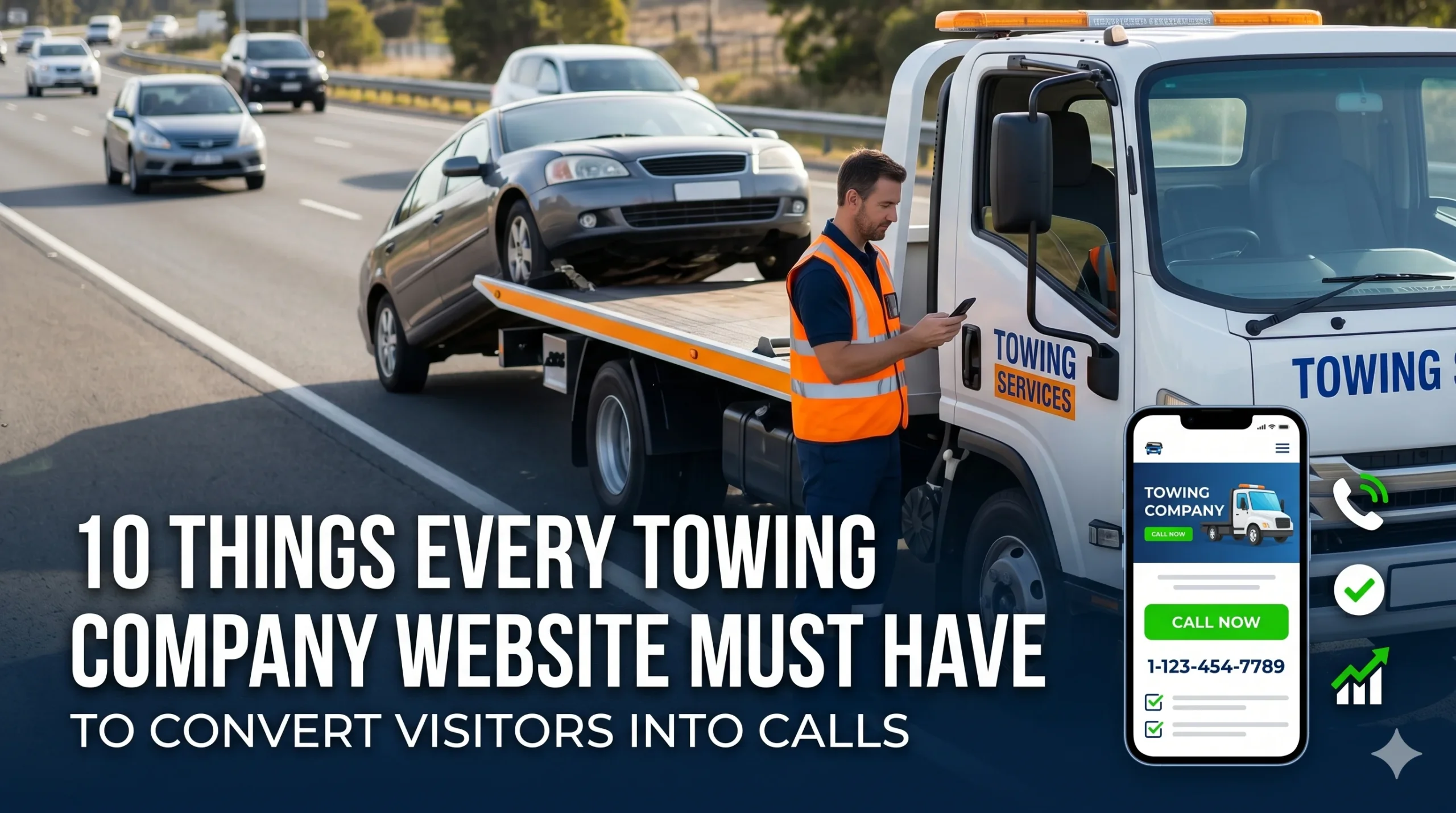
    10 Things Every Towing Company Website Must Have to Convert Visitors Into Calls

    Someone’s car just broke down on the side of I-95. They grab their phone, search “towing near me,” and your website comes up. They tap the link — and wait. And wait. The page loads slowly, your phone number is buried, and the site looks like it was built in 2014. They hit the back button and call your competitor instead.

    That call should have been yours.

    Most towing company owners assume their website is “fine” because it exists. But there’s a massive difference between a website that exists and a website that works — one that loads in under two seconds, earns trust instantly, and makes it dead simple for a stressed driver to call you right now. Bad towing website design doesn’t just look unprofessional. It actively costs you real money, every single day.

    Here are the 10 things your towing website absolutely must have — and why missing even a few of them is likely killing your inbound calls.


    1. Your Phone Number Front and Center — Above Everything Else

    A person searching for a tow truck is never relaxed. They’re stranded, stressed, possibly in a dangerous spot. The last thing they want to do is scroll, hunt, or figure out your website.

    Your phone number needs to be visible immediately — at the top of the page, large, and ideally a tap-to-call button on mobile. If someone has to look for it, you’ve already lost them.

    Most towing websites bury the number in a footer or a “Contact Us” page. That single mistake turns a hot lead into a call for your competitor. Put the number at the top of every single page.


    2. A Website That Loads in Under 3 Seconds

    Think of your website like a tow truck that takes 45 minutes to show up — nobody’s going to wait. They’re calling someone else.

    Most people will leave a website that takes more than three seconds to load. On mobile, that number is even less forgiving. Slow websites lose customers before those customers ever see what you offer.

    Slow loading usually comes from uncompressed images, cheap hosting, or bloated code that was never cleaned up. Websites built for towing services businesses are built lean and fast from the start — because in this industry, speed isn’t a luxury, it’s a requirement.


    3. Mobile-First Design — Because That’s Where Your Customers Are

    Nearly every towing call starts on a smartphone. A driver on the side of the road isn’t opening a laptop — they’re on their phone, thumb-scrolling, looking for the fastest solution.

    If your website isn’t built for mobile first, it’s broken for your most important visitors. Text that’s too small to read, buttons that are too close together to tap, images that don’t scale — these all send the message: call someone else.

    Your mobile site should feel like an app, not a shrunken desktop page. Big tap targets, readable text, fast loading, and that phone number always visible.


    4. Service Area Pages That Tell Google Exactly Where You Work

    Here’s a frustrating reality: you could be the best towing company in your city, but if Google doesn’t know exactly which towns and zip codes you serve, it won’t show you to the right people.

    A single generic homepage isn’t enough. You need individual pages — or at minimum, clear content — that names the cities, counties, and areas you serve. When someone types “towing in [their town],” Google needs a strong signal that you’re the answer.

    Without this, you’re invisible to the searches that matter most. You’re not competing for calls — you’re just hoping for them.


    💡 Pro Tip: Your Google Business Profile and Website Must Match

    One of the most common silent killers for towing companies: your Google Business Profile lists your address and service areas, but your website never mentions those same locations. Google sees the mismatch and gets confused — so it shows you less.

    Make sure your business name, address, phone number, and service areas are consistent across your website and your Google listing. This single fix can meaningfully improve how often you appear in local search results.


    5. A Clear, Trust-Building Homepage — Not a Wall of Text

    When a potential customer lands on your homepage, they’re asking one question in the first five seconds: “Can I trust these people to help me right now?”

    A homepage that answers that question looks like this: your logo, your service area, your phone number, a simple headline that says what you do and where, and a few trust signals — years in business, reviews, licensing, 24/7 availability. That’s it.

    What it does not look like: three paragraphs about your “commitment to excellence,” a slideshow of stock photos, and a form asking for someone’s name, address, and vehicle year just to get a quote.


    6. Real Customer Reviews Displayed Prominently

    Reviews are your most powerful sales tool — and most towing websites either hide them or don’t use them at all.

    A five-star rating from a real local customer does more to earn trust than anything you could write about yourself. Someone stranded at 2 AM reads “Showed up in 20 minutes, professional and fair price — highly recommend” and thinks: that’s who I’m calling.

    Display your Google reviews directly on your homepage. Show your star rating. If you have testimonials, put them where people can see them without scrolling to the bottom of the page.


    7. 24/7 Availability Stated Clearly — If You Offer It

    Towing is an emergency service. A huge portion of calls happen at night, on weekends, and during bad weather. If you’re available around the clock, your website needs to say so — loudly and clearly.

    “Available 24/7 — Call Now” is one of the highest-converting phrases a towing website can display. It removes a major objection immediately: will anyone even answer?

    If it’s not visible above the fold, you’re losing calls to competitors whose websites make that promise clearly.


    8. A Simple, Specific List of Your Services

    People don’t always need a full tow. They might need a jump start, a tire change, a lockout service, or a long-distance haul. If your website doesn’t clearly list what you offer, those customers assume you don’t do it — and they search elsewhere.

    List your services clearly. Use plain language:

    • Emergency towing
    • Roadside assistance (jump starts, flat tires, lockouts)
    • Long-distance towing
    • Accident recovery
    • Motorcycle towing
    • Heavy-duty towing

    Each service is a reason for someone to call you. Make sure every one of them is visible.


    Before & After: What a Real Fix Looks Like

    The situation: A two-truck towing operation in the Dallas–Fort Worth area had been in business for six years. The owner had built a basic website years earlier — it had his phone number, a photo of his truck, and a short paragraph about his services. He was getting some calls but knew he was missing out.

    The problems: His site took over eight seconds to load on mobile. His phone number wasn’t clickable. He had no service area pages, so Google wasn’t ranking him for any specific cities. His homepage had no reviews, no trust signals, and no clear call-to-action.

    What changed: His website was rebuilt with a mobile-first design, a tap-to-call button in the header, service area pages for nine cities in the DFW metro, and his Google reviews embedded on the homepage. Load time dropped to under two seconds.

    The result: Within 90 days, his inbound calls from the website more than doubled. His Google Maps ranking improved for several target cities. The same owner who felt like his website was “fine” was now treating it as his best salesperson.


    Not sure if your towing website has these issues? Get a free website audit — no obligation, just a clear picture of what’s costing you leads.

    9. Schema Markup — The Invisible Code That Helps Google Trust You

    You’ll never see schema markup on your website — it lives in the background code. But it makes a real difference in whether Google shows your business confidently in local search results.

    Think of it this way: without schema, Google is guessing what your business does, where it operates, and when it’s open. With schema, you’re handing Google a fact sheet. It knows you’re a towing company, your service area, your hours, and your phone number — so it shows you with more confidence.

    Most towing websites have none of this in place. It’s a straightforward fix that gives you a competitive edge in local search.


    10. A Strong, Visible Call-to-Action on Every Page

    Every page of your towing website should answer one question for the visitor: what do I do next?

    The answer is almost always: call us. But if your website doesn’t remind people to do that — repeatedly, visibly, on every page — many of them won’t. They’ll read, they’ll scroll, and they’ll leave.

    Every page needs a visible phone number, a “Call Now” button on mobile, and a clear prompt. Don’t make people think. The easier you make it to call, the more calls you get.


    Your Path to More Calls: 5 Simple Steps

    If you’re looking at this list and realizing your website is missing several of these elements, here’s where to start:

    1. Check your mobile load speed — use Google’s free PageSpeed Insights tool. If you’re scoring below 70 on mobile, your site is losing you calls.
    2. Make your phone number a tap-to-call link — every phone number on your site should open the dialer automatically on mobile.
    3. Add your service cities to your homepage and create basic location pages — even simple pages for your top five cities can make a measurable difference.
    4. Embed your Google reviews on your homepage — this is one of the fastest trust-builders available to any local business.
    5. Get a professional audit — before spending money on ads or SEO, understand exactly what your current website is and isn’t doing for you.

    Frequently Asked Questions

    Why am I not getting calls from my website?

    The most common reasons are slow load speed, a phone number that isn’t clickable on mobile, and no clear call-to-action. If someone lands on your site and has to work to figure out how to call you, most of them won’t bother — they’ll call a competitor whose website made it easier.

    How do I know if my towing website is actually working?

    If you’re not tracking calls from your website separately from other sources, you honestly don’t know. At a minimum, check your Google Analytics to see how many people visit your site and how quickly they leave. High “bounce rates” — people leaving immediately — usually point to slow load speed or a homepage that doesn’t answer the visitor’s question fast enough.

    How long does it take to see results from a new towing website?

    Most towing companies start seeing measurable improvements in local rankings and call volume within 60–90 days of launching a properly built website. The timeline depends on how competitive your market is and how much content your site has — but the foundation (speed, mobile design, local pages) starts working from day one.

    What makes a towing website different from a regular business website?

    Towing is an emergency service, which means your website has to perform under pressure — on a cracked phone screen, on a slow mobile connection, for someone who’s stressed and needs a fast answer. A standard business website optimized for browsing and comparison doesn’t serve that moment well. Your site needs to load instantly, show your phone number immediately, and communicate trust in under five seconds.

    Do I really need a fast website if my customers are local?

    Yes — especially because they’re local and on mobile. Local customers searching for a tow truck are almost always on their phones. If your site takes more than three seconds to load on a mobile connection, a large percentage will leave before it finishes loading. Speed matters more for local emergency services than almost any other business category.

    How do I know what my website is costing me in lost leads?

    That’s exactly what a free audit reveals. Book a free website review and you’ll get a clear breakdown of what’s working, what’s not, and what specific fixes would have the most impact on your inbound call volume — no jargon, no sales pitch, just straight answers.


    Stop Letting Your Website Cost You Calls

    Every day your towing website is missing these elements, calls are going to competitors. Not because those companies are better than you — but because their websites make it easier for customers to choose them in a split second of stress and urgency.

    The good news: most of these problems have clear, fixable solutions. You don’t need a complete redesign every time — but you do need a website that was built with one goal in mind: getting your phone to ring.

    How Digital Trace builds towing service websites is different from a generic web agency. Every site is built around conversion — fast, mobile-first, and optimized for local search from day one.

    Ready to find out exactly what your current website is costing you? Get your free towing website audit — no obligation, no hard sell. Just a clear, honest picture of what’s standing between your website and more calls.

  • How to Get Your Towing Company to Show Up on Google: The Website Guide for 2026

    How to Get Your Towing Company to Show Up on Google: The Website Guide for 2026

    Your tow truck is ready. Your drivers are ready. But when someone types “towing near me” into their phone at 11pm on the side of the highway — your company doesn’t show up.

    That’s not a luck problem. That’s a website problem.

    Most towing company owners assume Google just “figures it out” over time. It doesn’t. Google needs very specific signals from your website to trust it enough to show it to customers in your area. Without those signals, you stay invisible — while your competitor two towns over picks up every call.

    This guide breaks down exactly what’s holding your towing website back, what fixes actually move the needle, and what a properly built towing website looks like in 2026.


    Your Website Loads Slow — And You’re Losing Customers in the First 3 Seconds

    Think about what happens when someone calls for a tow. They’re stressed, stuck, and searching from their phone. If your website takes more than 3 seconds to load, most of them hit the back button before they ever see your phone number.

    The technical term is “page speed” — but the business reality is simpler: a slow site means a ringing phone for your competitor instead of you.

    Most towing websites are slow because they’re loaded with oversized images, outdated plugins, or cheap hosting that can’t keep up. None of that is visible to you as the owner — but Google sees all of it, and it penalizes slow sites by pushing them down in search results.

    The fix isn’t just compressing a few images. It means rebuilding the site with speed as a priority from the ground up — the way websites built for towing businesses should be from day one.


    Google Can’t Find Your Location — So It Doesn’t Show You

    Here’s something that surprises most towing company owners: having a website doesn’t automatically tell Google where you operate.

    If your site doesn’t clearly signal your city, service area, and business category in the right places, Google treats you like a ghost. It has no confidence in where you are or who you serve — so it doesn’t put you in front of local searchers.

    This is where “local SEO” actually lives. It’s not magic — it’s making sure your city and service area appear in your page titles, headings, and behind-the-scenes tags that Google reads. It also means your website needs to be consistent with your Google Business Profile.

    When these pieces are missing or mismatched, your site gets buried. When they’re done right, your business shows up in the map pack — those top 3 results that get the bulk of local calls.


    Your Homepage Doesn’t Answer the One Question Visitors Are Asking

    When someone lands on your towing website, they have one question: “Can this company help me, right now, where I am?”

    If your homepage takes more than a few seconds to answer that — with a visible phone number, your service area, and what you do — they’re gone. They’re not reading paragraphs about your company history. They’re in crisis mode, and they need certainty fast.

    Think of your homepage like the first 10 seconds of a dispatcher call. You answer fast, state your coverage area, and give the customer confidence. A homepage that buries the phone number, uses a slideshow, or leads with generic phrases like “Welcome to our company” fails that test every time.

    A high-converting towing website leads with:

    • A large, tappable phone number at the top of every page
    • Your service area stated clearly above the fold
    • One clear action for the visitor to take (call now or request a tow)
    • Trust signals: years in business, 24/7 availability, reviews

    💡 Pro Tip

    The biggest mistake towing websites make: only having one phone number buried in the footer.

    On mobile — where the majority of towing searches happen — your phone number needs to be a tappable button at the top of every single page. If a user has to scroll or search for it, you’ve already lost them. The technical fix is a sticky header with a click-to-call button that follows the user as they scroll. Simple change. Significant impact.


    Google Doesn’t Know Enough About Your Business to Trust It

    Even if your site loads fast and your phone number is visible, there’s one more layer Google is looking for: structured data that confirms who you are.

    Without getting into code, here’s what it means in practice: Google likes to see your business name, address, phone number, and service category written in a specific format in the background of your website. It’s called schema markup. Without it, Google is guessing at what your business does — and guessers don’t rank confidently.

    There’s also the matter of your Google Business Profile. If the details there don’t match your website exactly — down to your address format — Google treats that as a red flag. Inconsistency equals distrust.

    Fixing this isn’t something you need to manage manually. It’s built into the foundation of a properly designed towing service website — and it’s one of the fastest ways to start climbing in local search.


    What Happens When You Get It Right: A Real-World Example

    Consider a towing company operating out of a mid-sized city in the Southeast. They had a website — built years ago by a friend — with no mobile-friendly layout, a phone number only in the footer, and no local keywords anywhere on the page. Their Google Business Profile listed a slightly different address than the website. They were getting maybe 3–4 calls a week from online searches.

    After a full rebuild — fast-loading mobile-first design, proper local SEO structure, click-to-call button, and schema markup — the results shifted within about 60 days. They went from page 3 on Google to the local map pack for their primary city. Weekly calls from online search went from 4 to roughly 22. Same trucks. Same drivers. Same service area. Just a website that actually worked.

    That’s not a miracle — it’s what happens when a towing company website is built to perform, not just to exist.


    Not sure if your towing website has these issues? Get a free website audit — no obligation, just a clear picture of what’s costing you leads.


    Your Path to More Calls: 5 Steps That Actually Work

    You don’t need to become a web expert. You just need to make sure these five things are handled — either by you or by someone who knows what they’re doing.

    1. Speed check your site. Go to Google’s PageSpeed Insights and type in your URL. If your mobile score is below 70, you have a problem that’s costing you calls every day.
    2. Audit your phone number placement. Open your website on your phone. Is your number visible without scrolling? Is it tappable? If not, fix that first.
    3. Check your Google Business Profile. Make sure your name, address, and phone number match your website exactly — same format, same abbreviations.
    4. Add your service area to your homepage. Your city and surrounding areas should appear in your page title, your main heading, and naturally in your content.
    5. Have your site reviewed by someone who builds towing company websites. A general web designer won’t know what towing customers search for. Industry-specific experience matters.

    If steps 1–4 reveal real problems, step 5 is where Digital Trace builds towing service websites that address all of it — from performance to local SEO to conversion — in one build.


    Frequently Asked Questions

    Why am I not getting calls from my website?

    The most common reasons are: your site doesn’t rank locally because it lacks proper SEO structure, your phone number isn’t easy to find on mobile, or your page loads too slowly and visitors leave before they see anything. Any one of these alone can kill your lead flow — and most towing websites have all three.

    How do I know if my towing website is actually working?

    If you’re not tracking where your calls come from, you’re flying blind. A working website should show up in Google’s local map pack for your city and service keywords, load in under 3 seconds on mobile, and have a measurable call volume tied to online searches. If you can’t answer any of those, a free audit is the fastest way to find out what’s happening.

    How long does it take to see results from a new website?

    Most towing businesses start seeing movement in Google rankings within 45–90 days of launching a properly optimized site. The improvements to your conversion rate — more visitors calling — happen immediately once the site is live. SEO takes a little longer, but the foundation needs to be right from day one.

    What makes a towing website different from a regular business website?

    Towing customers are almost always searching from a phone, under stress, needing an immediate response. That means your site needs to prioritize mobile speed, a visible phone number, clear service area messaging, and 24/7 availability — not general business information or flashy design. A generic web template built for a retail store won’t convert towing customers the same way.

    Do I really need a fast website if my customers are local?

    Yes — especially because they’re local. Local searches happen almost entirely on mobile, often in low-signal areas. A slow site in that context doesn’t just frustrate visitors; it ranks lower in Google’s local results to begin with. Google officially uses page speed as a ranking factor for mobile search, which is exactly where your customers are finding you.

    How much does a towing company website cost, and is it worth it?

    Cost varies depending on what’s built and what’s needed. But the better question is: what’s it costing you to have a website that doesn’t work? If your site brings in even two or three more calls per week, it pays for itself quickly in most markets. The goal isn’t to spend money on a website — it’s to build something that generates a return.


    Ready to Find Out What’s Holding Your Website Back?

    Most towing company owners don’t know their website has problems until they have someone look at it. The slow load time, the buried phone number, the missing local signals — it all adds up to leads going to a competitor instead of you.

    A free audit takes minutes and shows you exactly what’s costing you calls. No sales pressure. No commitment. Just a clear, honest look at your website from people who specialize in towing website design.

    Book your free website audit now →

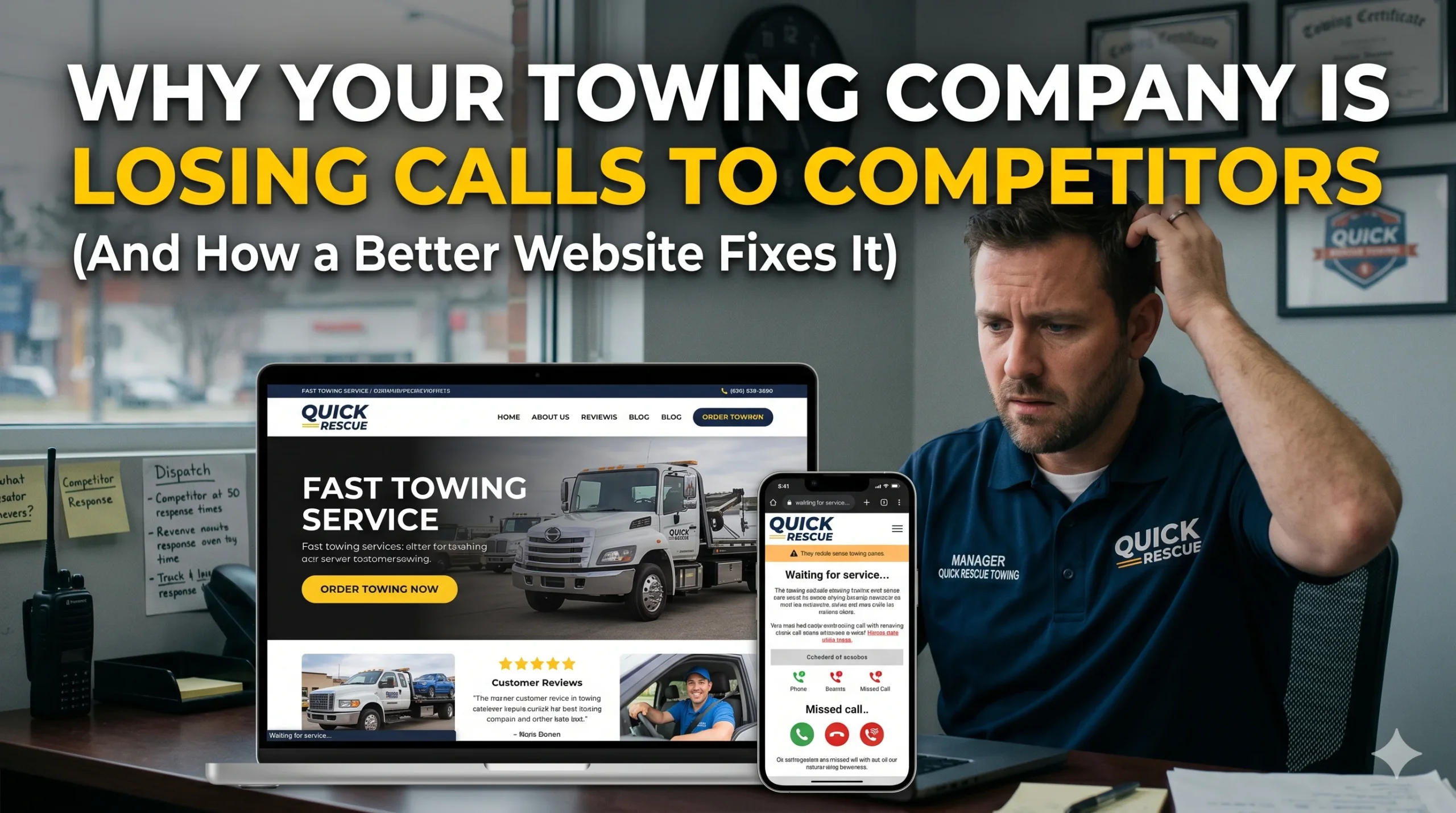
  • Why Your Towing Company Is Losing Calls to Competitors (And How a Better Website Fixes It)

    Why Your Towing Company Is Losing Calls to Competitors (And How a Better Website Fixes It)

    You answered every dispatch last night. Your drivers showed up on time. Your rates are fair. But somehow, your competitor three towns over is busier than you — and you can’t figure out why.

    Here’s what most towing company owners don’t realize: the calls you’re losing aren’t going to the guy with better trucks or lower prices. They’re going to the company with a better website. Not flashier. Not fancier. Just one that works the way a driver in distress actually behaves — pulling out their phone, searching “tow truck near me,” and calling the first number they trust.

    If your website isn’t built to win that moment, you lose the job. Every time.

    This post breaks down exactly why that happens and what a proper towing website design does to fix it.


    Your Phone Isn’t Ringing Because Google Can’t Find You

    Most people stranded on the side of the road aren’t scrolling through pages of results. They tap the first two or three options and call. If your towing company website isn’t showing up at the top of local search results, you’re invisible — even if you’ve been in business for 20 years.

    Why does this happen? Google looks at dozens of signals to decide who to show first — things like how fast your site loads, whether it’s optimized for mobile, and whether Google can clearly understand what services you offer and where. If your site is missing these signals, Google shows your competitor instead.

    The fix isn’t magic. It’s building your towing service website so that Google can read it clearly and confidently serve it to the right people at the right moment.


    Your Website Loads Too Slowly — And Callers Don’t Wait

    Think about the last time a customer called you. They were stressed. Their car was dead on the shoulder, it was late, maybe raining. They pulled out their phone, found your site, and then… waited three seconds for it to load.

    Most people don’t wait. Studies consistently show that a significant portion of mobile users abandon a site within the first few seconds if it hasn’t loaded. That’s not an SEO statistic — that’s a call you never got.

    The technical reason is usually oversized images, outdated code, or cheap hosting that can’t handle traffic spikes. A properly built tow truck website is lean, fast, and loads instantly on a phone — because that’s what your customers are using when they need you most.


    Your Phone Number Is Buried — And That Costs You Leads

    Here’s a test: pull up your website on your phone right now. How many times do you have to scroll or tap before you can call someone?

    If the answer is more than zero, you’re losing business. A person who just hit a deer on the highway at 11pm doesn’t want to navigate your site. They want to see your number immediately and tap it.

    Most towing company websites are built like online brochures — they look nice on a desktop and tell the story of the business. But a towing website needs to work more like a dispatcher: get the right information to the right person instantly, and make it stupid-easy to take action.

    Every page of your site should have a large, tap-to-call button visible without scrolling. This single change alone has helped towing companies increase call conversions noticeably.


    Google Doesn’t Know Enough About Your Business to Trust It

    You may have heard the term “SEO” tossed around — but here’s what it actually means for a towing company:

    Google is trying to answer this question for every search: “Which business in this area actually does this service, is still operating, and is worth sending my users to?”

    If your towing service website design doesn’t give Google clear signals — your service area, the types of towing you offer, your address, your hours, your reviews — Google answers that question with your competitor’s name instead.

    There’s a behind-the-scenes layer of code (called schema markup) that tells Google exactly who you are and what you do. Most generic websites skip it entirely. When it’s in place, your listing becomes more informative in search results — more details, more trust, more clicks, more calls.


    💡 Pro Tip: Don’t Let a Generic Website Template Cost You Customers

    One of the most common mistakes towing companies make is launching a site built from a generic small business template. These templates aren’t built with towing in mind. They don’t prioritize the tap-to-call button above the fold. They don’t have service-area pages that tell Google you cover specific towns and highways. They don’t load fast on mobile networks where signal is weak — exactly where your customers are when they need you most.

    The fix: make sure your site was built with the way towing customers actually search and call in mind — not just how it looks on a desktop.


    Real-World Example: Before and After

    A towing company in the Southwest was getting consistent referrals from their existing customers but almost zero calls from Google searches. Their site had been built years ago by a family member — it looked okay, but it loaded in over six seconds on mobile, had no tap-to-call button above the fold, and covered only their main city with no mention of the surrounding towns they serviced daily.

    After a proper towing website rebuild — including mobile speed optimization, a persistent click-to-call button on every page, and dedicated service-area pages for each town they covered — the results shifted within a few months. Their Google visibility for local searches expanded significantly, and inbound calls from new customers more than doubled compared to the prior period. The owner described it as “finally getting credit for work we were already doing.”

    That’s what purpose-built towing company website design actually does: it stops letting good work go unnoticed.


    Not sure if your towing website has these issues? Get a free website audit — no obligation, just a clear picture of what’s costing you leads.


    Your Path to More Calls Starts Here

    Getting your website working the way it should isn’t complicated — but it does require doing the right things in the right order:

    1. Speed check — Find out how fast your site actually loads on mobile. If it’s over three seconds, callers are leaving before they see your number.
    2. Call-to-action audit — Is your phone number visible and tappable without scrolling on every single page?
    3. Local visibility review — Does your site clearly tell Google what towns and highways you serve, not just your main city?
    4. Content check — Do you have pages covering your core services (flatbed, long-distance, roadside, heavy-duty)? Google ranks pages, not businesses.
    5. Trust signals — Are reviews, years in business, and licensing clearly visible? People call who they trust, even in an emergency.

    If you can’t confidently say yes to all five, there are leads leaving your site every day. Websites built for towing services businesses by Digital Trace are built around every one of these factors — because a site that doesn’t convert isn’t really a website, it’s just an expense.


    Frequently Asked Questions

    Why am I not getting calls from my website even though I’m listed on Google?

    Being listed and being found are two different things. If your site isn’t optimized for local search — including your service area, fast load times, and proper on-page signals — Google may not be ranking you high enough for people to see you. Most towing calls go to the first two or three results. If you’re not there, you’re not getting the call.

    How do I know if my towing website is actually working?

    The simplest test: search “tow truck” plus your city on your phone. If you’re not showing up in the top results or the local map pack, your site isn’t working hard enough. Beyond that, a proper audit will show exactly how many visitors come, how many take action, and where they drop off.

    How long does it take to see results from a new towing website?

    Most towing companies working with Digital Trace start seeing measurable improvements in local search visibility within 60 to 90 days. Call volume from new customers typically picks up in that same window. SEO isn’t instant, but the improvements compound — meaning your site keeps getting stronger over time, not weaker.

    What makes a towing website different from a regular business website?

    Towing customers are almost always on mobile, usually stressed, and making split-second decisions. A towing website needs to load fast on a weak signal, put the phone number front and center immediately, cover every town in your service area, and build instant credibility. A generic business site isn’t built for any of that. How Digital Trace builds towing service websites is specifically designed around how towing customers actually behave.

    Do I really need a fast website if my customers are local?

    Yes — especially because they’re local. Your customers are searching from the side of the road, in a parking lot, or on a slow highway connection. If your site takes five seconds to load on a 4G signal, they’ve already called someone else. Local doesn’t mean patient.

    I’ve been burned by marketing agencies before. How is this different?

    That’s a fair concern. Digital Trace starts with a free audit — no pitch, no contract, no pressure. You’ll see exactly what’s working and what isn’t on your current site before spending a dollar. Book your free audit here and make your own call from there.


    Stop Leaving Calls on the Table

    Every day your towing website has these issues is another day your competitor gets the call instead of you. The driver on the side of I-40 at 2am isn’t loyal to anyone — they’re calling whoever shows up first and looks trustworthy.

    A purpose-built towing website design doesn’t just look better. It loads faster, ranks higher, and turns visitors into calls. That’s what Digital Trace builds — sites that work as hard as you do.

    Get your free website audit today — find out exactly what’s costing you calls and what it would take to fix it. No jargon, no obligation, just a clear, honest look at your site and a path to more business.