Category: Solar

  • Solar Power Website Templates vs Custom Design: Which Is Right for Your Solar Business?

    Solar Power Website Templates vs Custom Design: Which Is Right for Your Solar Business?

    You spent good money on your solar business — panels, equipment, crews, certifications. But when a homeowner searches “solar installation near me” and finds your website, they’re gone in seconds. Not because your business isn’t great. Because your website isn’t doing its job.

    Most solar companies fall into one of two camps: they grabbed a cheap template to “get something up,” or they paid a web agency a lot of money and still wonder why the phone isn’t ringing. Neither option is automatically right. The real question is: what does your solar website actually need to do — and is it doing it?

    This guide breaks down exactly what separates a solar website that generates steady quote requests from one that just sits there. By the end, you’ll know which direction is right for your business and what to look for.


    The Hidden Cost of “Good Enough” Solar Websites

    You might think your website looks fine. It has your phone number, some photos of installs, maybe a contact form. That’s not the problem.

    The problem is what happens before a visitor ever decides to call you.

    A homeowner looking for solar installation is shopping. They’re comparing three or four companies in the same afternoon. Your website has roughly 5–7 seconds to answer the one question every prospect is silently asking: “Can I trust these people with a $25,000 purchase?”

    A generic template with stock photos of solar panels and boilerplate text doesn’t answer that question. It raises doubt. And doubt means they click back and call your competitor instead.

    This isn’t about aesthetics. It’s about conversion — turning visitors into calls, calls into consultations, consultations into signed contracts.


    What Solar Power Website Templates Actually Give You

    Templates have their place. If you’re a brand-new operation with zero budget and zero online presence, a template beats nothing. But here’s what you’re working with:

    • The same design your competitor might be using. Many solar businesses use the same Squarespace, Wix, or WordPress themes. Prospects notice sameness — even subconsciously.
    • Generic messaging baked in. Templates are built for no one in particular, which means they speak to everyone and convert almost no one.
    • Speed and mobile issues out of the box. Templates are loaded with code for features you’ll never use. That extra weight slows your site down — and slow sites lose visitors before they even see your offer.
    • No local SEO muscle. Templates don’t come pre-built to rank in your specific market. Getting found in Google requires structure that most templates skip entirely.

    Templates are like buying a stock service van off a lot — it drives, but it’s not set up for your routes, your tools, or your crew.


    What Custom Solar Website Design Actually Means (And Costs)

    “Custom design” can mean anything from a $500 Fiverr job to a $50,000 agency retainer. The price tag alone tells you nothing.

    What actually matters in a custom solar website design:

    Speed built in from the start. A custom-built site is trimmed down to only what it needs. That means faster load times — which keeps visitors on the page long enough to read your offer and pick up the phone.

    Messaging written for your specific customer. A homeowner in the Southeast worried about hurricane season has different concerns than a homeowner in Arizona focused on summer energy bills. Custom sites can speak directly to your market’s real objections.

    Lead flow built around how solar buyers actually decide. Solar purchases aren’t impulse decisions. A good solar website design walks prospects through the trust-building steps they need — proof of work, financing options, local reviews, clear next steps — before asking them to commit.

    Search visibility that compounds over time. A properly built site is structured so Google understands exactly what you do, where you do it, and why you’re worth showing to searchers. That structure is hard to retrofit onto a template.

    The difference isn’t just what your site looks like on day one. It’s how much business it generates over the next two to three years.


    The 4 Things Every Solar Website Needs to Convert Visitors into Leads

    Whether you go template or custom, these four elements determine whether your solar website design actually works:

    1. Speed — or visitors leave before they see your number. If your site takes more than 3 seconds to load on mobile, a significant portion of your visitors are already gone. Most solar buyers are researching on their phones. A slow site doesn’t just frustrate people — it signals that your business isn’t buttoned up.

    2. A clear, compelling offer above the fold. The first thing a visitor sees — before they scroll — should answer: What do you do, who is it for, and why should I trust you? Most solar websites bury this. The result is confused visitors who bounce.

    3. Proof that you do the work well. Real photos of your installs. Real reviews from local homeowners. Real numbers — panels installed, years in business, energy savings achieved. Stock imagery and vague testimonials don’t build trust with a prospect about to spend five figures.

    4. A low-friction next step. “Request a free quote” converts better than “Contact us.” A scheduler that lets prospects book a consultation in 60 seconds converts better than a form that says “we’ll get back to you in 2–3 business days.” Make it easy to say yes.


    💡 Pro Tip: Your Homepage Might Be Talking to the Wrong Person

    One of the most common mistakes in solar web design: the homepage is written for anyone who might be curious about solar — instead of the person who is ready to get a quote.

    If your messaging starts with “Solar energy is the future of clean power…” you’re writing an educational brochure, not a lead generation page.

    The fix: lead with the customer outcome. “Get a free quote and see how much you could save on your energy bill — most homeowners are surprised by the number.” That one shift in messaging angle can meaningfully change how many visitors actually reach out.


    Before & After: What a Real Solar Website Redesign Can Do

    The situation: A residential solar installer in the Carolinas had been in business for six years. Solid reputation, consistent referrals, decent reviews on Google. But their website — a WordPress template they’d set up themselves — was generating almost no inbound leads. They were relying almost entirely on referrals and door-to-door canvassing to fill their pipeline.

    The problem: The site loaded slowly on mobile (over 6 seconds). The homepage featured a stock photo of a generic rooftop and a headline that read “Affordable Solar Solutions.” There was no mention of their service area, no real project photos, no financing information, and no clear reason to choose them over a national installer.

    What changed: The site was rebuilt from scratch with a focus on local search visibility, mobile speed, and conversion. Real project photos from local installs replaced stock images. The homepage messaging was rewritten around the specific concerns of Carolina homeowners — including utility rate increases and storm resiliency. A simple quote request form replaced a generic contact page.

    The result: Within 90 days of launch, inbound quote requests climbed from near-zero to a consistent 15–20 per month. The team went from relying on referrals to having a full pipeline — without increasing their ad spend. Within six months, the site was ranking on the first page of Google for their primary local search terms.

    That’s the difference between a website that exists and a solar website design built to generate leads.


    Not sure if your solar website has these issues? Get a free website audit — no obligation, just a clear picture of what’s costing you leads.


    Templates vs Custom: How to Actually Decide

    Here’s the honest breakdown:

    A template might work for you if:

    • You’re brand new and need something up immediately
    • You’re running it as a temporary placeholder while you build budget
    • You have someone in-house who can customize it meaningfully

    Custom solar website design is the right call if:

    • Your current site isn’t generating consistent inbound leads
    • You’re competing in a market with established solar companies
    • You’re spending money on Google Ads and the traffic isn’t converting
    • Your business depends on a steady pipeline — not just referrals

    The hard truth: most solar businesses that are stuck at the referral-only stage have a website problem. The website isn’t converting the people who find it. Fixing that is almost always higher ROI than buying more ads.


    Your Path to More Leads: 5 Steps That Actually Work

    Step 1: Audit what you have. Before spending anything, find out what’s actually wrong. Speed, messaging, structure, local SEO — each issue has a different fix. See what’s costing you leads with a free audit before you commit to anything.

    Step 2: Prioritize mobile speed. More than half of solar research happens on phones. If your site loads slowly on mobile, fix that first — it affects everything downstream: your Google ranking, your bounce rate, your conversion rate.

    Step 3: Rewrite your homepage for the buyer who’s ready to decide. Stop educating. Start converting. Lead with outcome, trust signals, and a clear next step.

    Step 4: Build local SEO into the structure. Make sure Google knows your service areas, your business category, and exactly what you do. This isn’t just a Google Business Profile task — it’s built into how the site is coded and structured.

    Step 5: Track what’s actually happening. Set up call tracking and form tracking. You can’t improve what you can’t measure. Know which pages are converting, which are leaking visitors, and where your leads are actually coming from.


    Frequently Asked Questions

    Why am I not getting calls from my solar website?

    The most common reasons: your site loads too slowly for mobile visitors, your messaging doesn’t address the specific concerns of a buyer ready to get a quote, or Google isn’t surfacing your site for the searches your customers are actually typing. In most cases, it’s a combination of all three. A quick audit can pinpoint exactly which issue is doing the most damage.

    How do I know if my solar website is actually working?

    If you can’t answer “how many inbound leads did my website generate last month?” — that’s your answer. A working solar website has call tracking, form tracking, and analytics set up so you know your numbers. If you’re flying blind, you’re likely leaving leads on the table. Get a free website audit to see what your site is actually doing (or not doing).

    How long does it take to see results from a new solar website?

    You’ll typically see improvements in conversion rate and lead volume within the first 30–60 days of a properly built site launch. Organic search rankings take longer — usually 3–6 months to see meaningful movement for competitive local terms. That’s why the site needs to convert paid and referral traffic immediately while the SEO compounds in the background.

    What makes a solar website different from a regular business website?

    Solar is a high-consideration purchase. Homeowners don’t buy on impulse — they research, compare, and look for trust signals before ever picking up the phone. A solar website needs to do more trust-building work than a typical service business site. That means real project proof, clear financing messaging, local reviews, and a consultation process that feels low-pressure. Generic business website templates aren’t built for that sales cycle.

    Do I really need a fast website if my customers are local?

    Yes — especially if your customers are local. Local solar buyers are almost always researching on their phones, often while they’re at work or between errands. If your site takes 5+ seconds to load, they’re already looking at your competitor’s site. Google also uses site speed as a ranking signal, which affects whether local customers find you in the first place. Speed isn’t a luxury — it’s table stakes.

    Should I use the same web agency that built my competitor’s site?

    Only if your competitor’s site is generating strong, consistent leads. Most agency-built solar sites look polished but weren’t built with conversion and local SEO as the actual priority. Before hiring any agency, ask to see the lead generation results from sites they’ve built — not just the designs. Digital Trace’s solar website work is built around one metric: how many qualified leads your site generates.


    Stop Leaving Leads on the Table

    Your solar business earns every installation. Your website should be doing the same work.

    If you’ve been getting by on referrals and wondering why your site isn’t pulling its weight — or if you’ve already invested in a website that still isn’t generating calls — the problem is almost always fixable. But you need to know exactly where the breakdown is happening before you can fix it.

    Digital Trace offers a free, no-obligation website audit for solar businesses across the US. You’ll get a clear picture of what’s working, what’s costing you leads, and what the fastest path to improvement looks like.

    Claim your free solar website audit →

    No pitch. No pressure. Just a straight answer about what your solar website is actually doing — and what it should be doing instead.
  • Solar Energy Website Design Tips That Help You Rank on Google

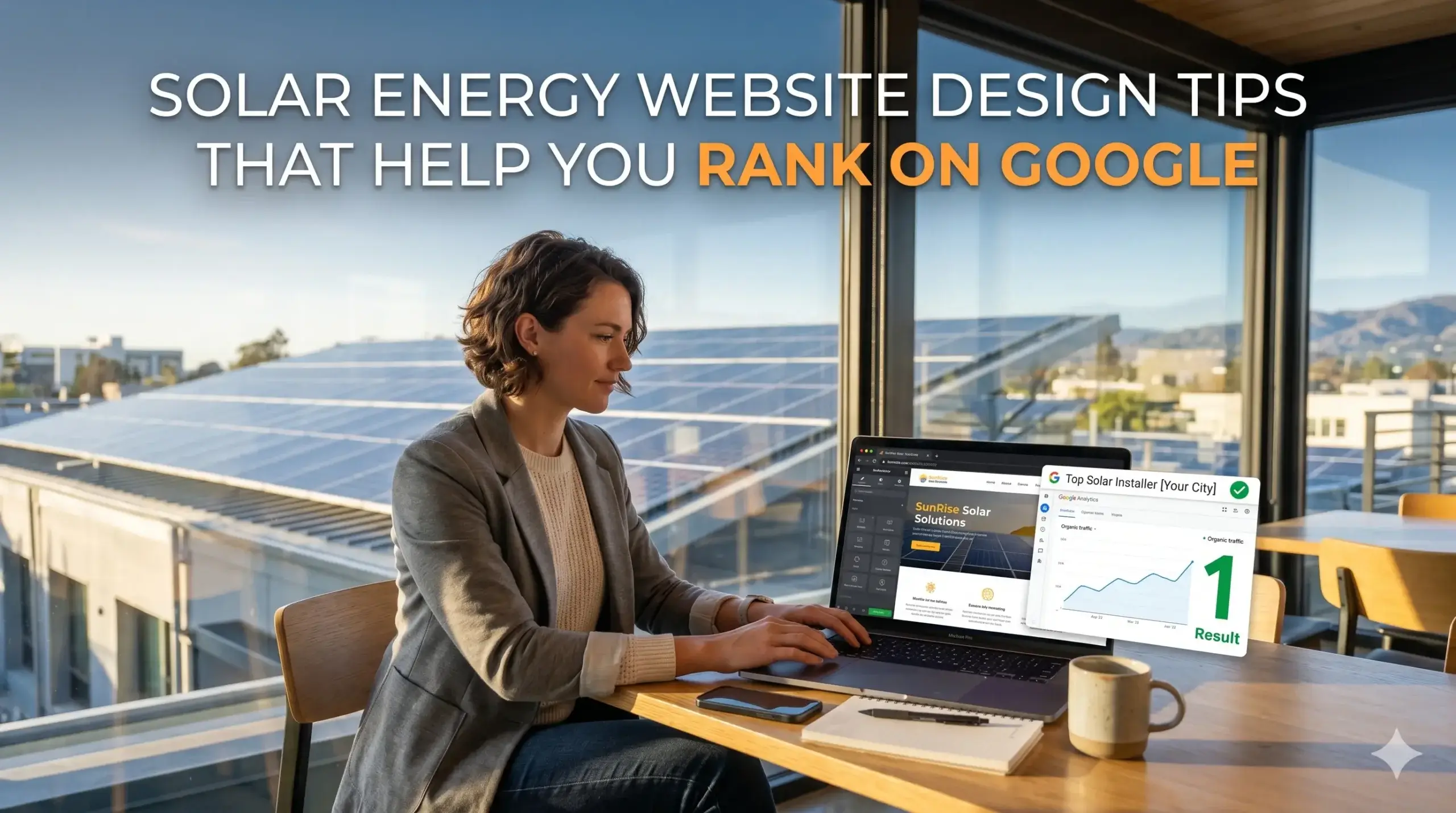
    Solar Energy Website Design Tips That Help You Rank on Google

    You spent money on a website. You’re doing some marketing. But the phone still isn’t ringing the way it should — and you’re not sure why.

    Here’s what most solar business owners get wrong: they think a website is just a place to put their logo and services. But your competitors who are winning jobs aren’t just online — they’re ranking on Google, loading fast on every device, and turning visitors into calls before doubt has a chance to creep in.

    Your website isn’t a pamphlet. It’s your best salesperson — and right now, it might be giving up before the pitch even starts.

    This guide breaks down exactly what separates a solar website that sits there from one that consistently generates qualified leads. Every tip is written in plain English, with zero jargon. By the end, you’ll know what to look for, what to fix, and where to start.


    Why Your Solar Competitors Show Up on Google and You Don’t

    When someone types “solar installation near me” into Google, they’re ready to buy. That search happens thousands of times a day across the US. The question is whether your business shows up — or your competitor’s does.

    Most solar websites miss Google’s ranking signals in ways that are completely invisible to the owner. It’s not that your work is worse. It’s that Google doesn’t have enough clear signals to trust your site over someone else’s.

    Three of the most common reasons solar websites don’t rank:

    • The site doesn’t clearly say where you serve — city names, counties, and regional terms need to appear naturally in your content
    • The pages are thin on information, which tells Google there’s nothing worth showing
    • The site isn’t earning any credibility signals, like backlinks or reviews baked into the page

    Websites built for solar businesses are built differently from generic sites. They’re structured from day one around the keywords your customers are actually searching — not what you think sounds good.


    Your Website Loads Too Slowly — And You’re Losing Leads Because of It

    Think about the last time you visited a slow website on your phone. You probably left before it finished loading. Your potential customers do the same thing — and they don’t come back.

    Most people decide whether to stay on a page within the first three seconds. If your solar site is still loading at second four, that visitor is already on your competitor’s site. You never even got a chance.

    The technical reason is usually image sizes, bloated code, or cheap hosting — but the business impact is simple: you’re paying for traffic that never converts.

    Signs your site is too slow:

    • Pages take more than three seconds to load on a mobile phone
    • Images look fuzzy or take a moment to “snap” into focus
    • You’ve never had your site’s speed tested

    Speed isn’t a nice-to-have anymore. Google uses page speed as a ranking factor — meaning a slow site doesn’t just lose visitors, it also drops in search results. You lose twice.


    💡 Pro Tip: Your Site Isn’t Just Slow on Desktop

    Most solar business owners test their website on a desktop computer and assume it looks fine. But more than 60% of local searches happen on a mobile phone — and desktop and mobile load very differently.

    A site that appears fine on your laptop may be loading slowly, cutting off text, or hiding your phone number behind a hard-to-tap button on Android and iPhone screens.

    The fix: Run your site through Google’s free PageSpeed Insights tool (search it — takes 60 seconds) and look at your mobile score specifically. Anything below 70 is costing you leads. A well-built solar website should score 85 or higher on mobile.


    Google Doesn’t Know Enough About Your Business to Show It Confidently

    There’s a simple piece of code — called schema markup — that tells Google exactly what your business is, where you operate, what services you offer, and how customers can contact you. Most solar websites don’t have it.

    Without it, Google has to guess. And when Google guesses, it tends to show the businesses it’s more confident about — which are usually your competitors who’ve got their technical setup right.

    The business cost is invisible but real. You might be doing everything else correctly and still lose ranking spots to a competitor with a weaker reputation, simply because their site speaks Google’s language more clearly.

    This is one of the first things Digital Trace checks during a site audit — and it’s one of the quickest wins to put in place.


    Visitors Land on Your Site and Leave Without Calling — Here’s Why

    Getting someone to your website is only half the battle. The other half is making sure they call or fill out a form before they talk themselves out of it.

    Most solar websites bury the contact information, use vague calls to action like “Learn More,” or don’t address the questions a prospect is asking in their head: How long does installation take? Are there financing options? Do you handle the permits?

    When those questions go unanswered, the visitor doesn’t call to ask — they leave and find a competitor whose site answered their questions.

    What a high-converting solar website does differently:

    • Shows the phone number prominently at the top of every page — especially on mobile
    • Uses specific calls to action like “Get Your Free Solar Quote” instead of generic buttons
    • Includes a short FAQ or “what to expect” section that addresses common objections
    • Features real photos of your team and completed installations — stock photos kill trust

    Think of it this way: your website is like a solar consultation. If the homeowner feels informed and at ease, they move forward. If they leave with unanswered questions, they shop around.


    The Real Cost of a Website That “Just Exists”

    Here’s a realistic scenario that plays out across the solar industry every month.

    Before: A solar installation company in the Southwest had a website they’d built themselves years ago. It looked professional enough — but it was loading slowly on mobile, had no schema markup, and the service pages were nearly identical, with barely a paragraph of content each. They were spending money on Google Ads to get traffic, but their conversion rate was under 1%. Most visitors bounced in under 20 seconds.

    After: After rebuilding the site with a focus on speed, mobile experience, local keyword targeting, and clear calls to action, their organic traffic grew by over 180% within six months. Their paid ad conversion rate climbed from under 1% to just over 4%. The phone started ringing from people who found them organically — without paying per click.

    The difference wasn’t magic. It was fixing the things that were quietly sending qualified buyers to competitors.

    Not sure if your solar website has these issues? Get a free website audit — no obligation, just a clear picture of what’s costing you leads.


    Your Path to More Solar Leads Starts Here

    You don’t need to understand code or SEO to take the right steps. Here’s what the process looks like when it’s done right:

    Step 1 — Audit what you have. Find out where your current site is losing people. Speed, mobile experience, keyword gaps, and missing trust signals are usually the first culprits.

    Step 2 — Fix the foundation. Before adding more marketing, the site needs to be fast, mobile-friendly, and technically set up for Google to understand it.

    Step 3 — Build pages that match what your customers are searching. Generic service pages don’t rank. Your site needs content that answers real questions your customers are typing into Google.

    Step 4 — Make it easy to call or convert. Every page should have a clear next step — a phone number, a form, or a low-friction offer like a free quote or consultation.

    Step 5 — Let it compound over time. Unlike paid ads that stop the moment you stop paying, a well-built solar website builds authority month over month. The longer it’s in good shape, the stronger it gets.

    See how Digital Trace builds solar websites designed around these principles from the ground up.


    Frequently Asked Questions

    Why am I not getting calls from my solar website even though I get some traffic?

    Traffic without calls usually means one of a few things: visitors can’t find your contact information easily, the site doesn’t answer their questions, or it doesn’t look trustworthy enough to take the next step. Getting people to your site is only half the job — the design and content need to close the gap between “browsing” and “calling.”

    How do I know if my solar website is actually working?

    If you can’t answer how many phone calls or form fills came from your website last month, it’s not being tracked properly — and you’re flying blind. A working solar website has clear conversion tracking set up and shows steady organic traffic growth month over month. Get a free website audit to find out exactly where yours stands.

    How long does it take to see results from a new solar website?

    Most solar businesses start seeing measurable improvements in organic traffic within 90 to 120 days of launching a properly optimized site. Significant ranking gains typically build over six to twelve months. It’s slower than paid ads but compounds — meaning you’re not paying per click every time someone finds you.

    What makes a solar website different from a regular business website?

    Solar customers do a lot of research before committing to a purchase that costs tens of thousands of dollars. A solar website needs to build trust faster, answer more technical questions, address financing concerns, and be optimized for local search terms that reflect how homeowners actually look for solar installers. A generic template won’t do that effectively.

    Do I really need a fast website if my customers are mostly local homeowners?

    Yes — especially because most local searches happen on mobile phones. A homeowner searching “solar installation in [your city]” is probably on their phone, and if your site takes four or five seconds to load, they’ll hit the back button and call whoever comes up next. Local buyers are not more patient than anyone else on the internet.

    I’ve already paid an agency for a website. Why isn’t it ranking?

    Most web design agencies build sites that look good — but looking good and ranking on Google are two different skills. SEO requires keyword research, technical setup, page structure, and content strategy baked in from the start. If your agency handed you a beautiful site without those elements, you’ve got a great-looking problem.


    Ready to Find Out What Your Solar Website Is Really Costing You?

    Most solar business owners have no idea how many leads their website quietly loses every week — not because the business isn’t good, but because the site isn’t set up to compete.

    A free audit from Digital Trace gives you a clear, honest look at what’s working, what isn’t, and what’s costing you the most. No sales pitch. No obligation. Just a real picture of where you stand.

    Get your free solar website audit today →

  • Solar Panel Website Design: What Every Solar Company Needs on Their Homepage

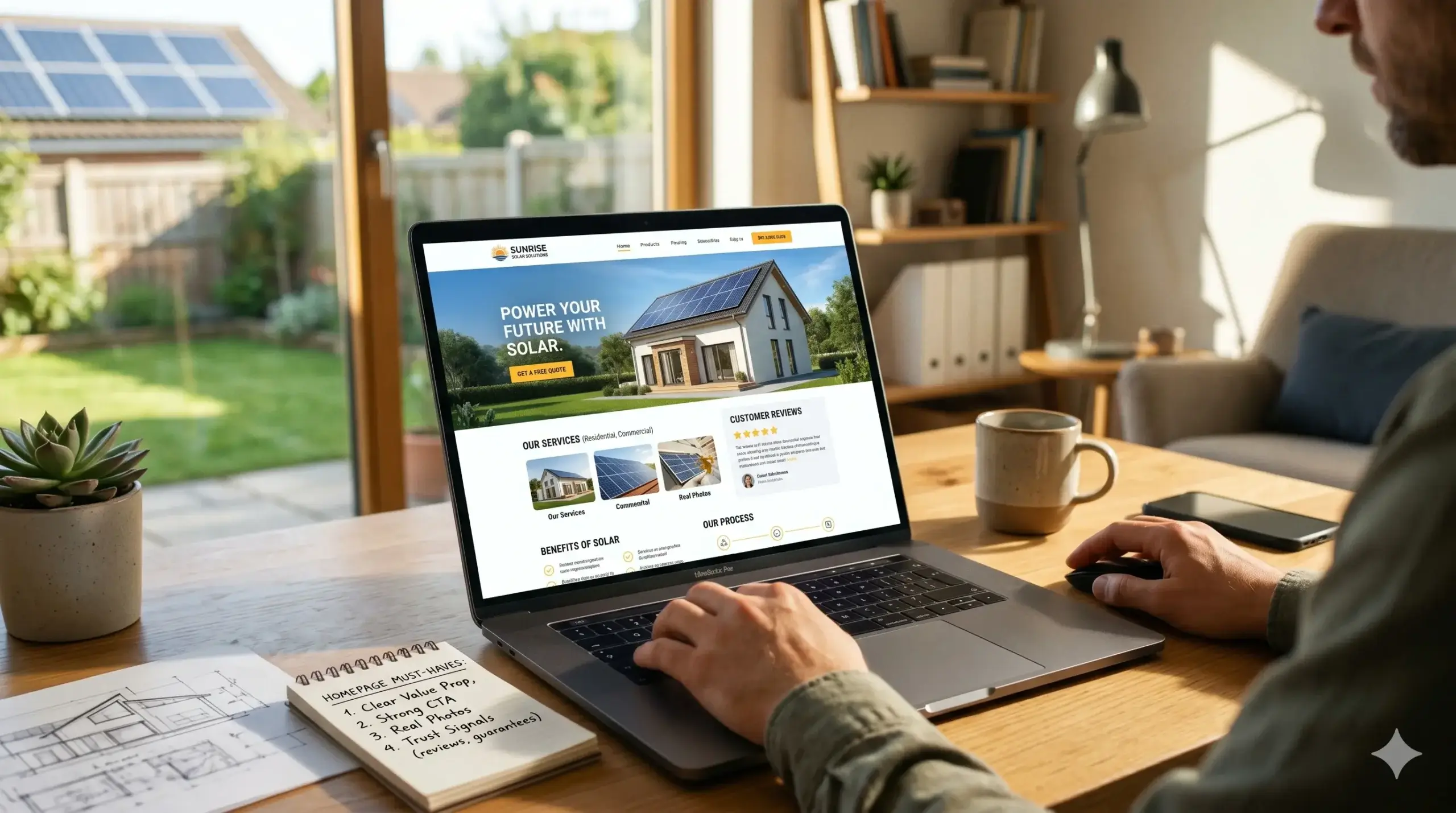
    Solar Panel Website Design: What Every Solar Company Needs on Their Homepage

    You spent real money building your solar website. Maybe you hired someone, bought a template, or had a nephew put it together. Either way, the phone isn’t ringing the way it should — and you’re not sure why.

    Here’s what most solar companies don’t realize: a website that looks professional and a website that generates leads are two very different things. Most solar websites fall into the first category. They show up online, they have photos of panels and a contact form — and they quietly lose dozens of potential customers every single month.

    This guide breaks down exactly what your solar homepage needs to convert visitors into calls, quotes, and signed contracts. No fluff. No jargon. Just the specific things that separate a solar website that works from one that doesn’t.


    Why Most Solar Websites Lose Leads Before Anyone Picks Up the Phone

    Think about what happens when a homeowner starts researching solar. They Google something like “solar installation near me,” skim a few results, and click on two or three sites. Within about 10 seconds, they’ve already formed an opinion.

    If your site loads slowly, looks cluttered, or doesn’t immediately answer their biggest questions — they’re gone. They’re on your competitor’s site.

    That’s not a traffic problem. That’s a conversion problem. And it starts on your homepage.

    The solar industry has a higher purchase hesitation rate than almost any other home improvement sector. Customers are spending $20,000–$40,000+ on a system they can’t fully see before it’s installed. That means your website has to do a lot of heavy lifting — building trust, answering objections, and making it easy to take the next step.

    Most solar sites aren’t built to do any of that.


    The 6 Things Every Solar Homepage Actually Needs

    1. A Headline That Speaks to the Customer’s Situation — Not Your Company

    Most solar homepages open with something like: “Powering Homes Across [State] Since 2015” or “Your Trusted Solar Partner.”

    That means nothing to a homeowner who just got a $280 electric bill and wants to know if solar is worth it.

    Your headline should speak directly to where they are right now. Something like: “Cut Your Electric Bill by Up to 80% — See If Your Home Qualifies” or “Solar Installation for [City] Homeowners — Get Your Custom Savings Estimate.”

    The difference is massive. One headline talks about you. The other talks about them. Visitors stay on pages that feel relevant to their situation.

    2. A Fast, Mobile-First Design (This Is Where Most Solar Sites Quietly Bleed Leads)

    More than 60% of homeowners researching solar are doing it on their phones — often after seeing an ad, a neighbor’s install, or their latest utility bill.

    If your site takes more than 3 seconds to load on a phone, most of those visitors are already gone before your phone number even appears on screen.

    This isn’t about looking pretty on mobile. It’s about the site loading fast enough that people actually stay. A slow site is like a sales rep who shows up 20 minutes late to an appointment — by the time they arrive, the homeowner has already moved on.

    The websites built for solar businesses at Digital Trace are built speed-first, on lean, optimized code — not bloated page builders that add load time with every feature.

    3. Trust Signals That Appear Before the Scroll

    Here’s a real pattern: a homeowner lands on your homepage. They’re skeptical. Solar has a reputation for pushy salespeople and confusing contracts. Within the first few seconds, their guard is up.

    What they’re looking for — before they read a single word of your pitch — is evidence that you’re a real, credible business.

    That means your homepage needs to show, above the fold (before any scrolling), at least three of these:

    • Google review rating and count (e.g., “4.9 stars — 183 reviews”)
    • Years in business or installs completed (“500+ homes installed across Texas”)
    • Certifications and licenses (NABCEP, state licenses, manufacturer partnerships)
    • Real photos of your team and local installs — not stock imagery
    • Financing badge or partner logos (Sunrun, GoodLeap, etc.)

    Generic solar sites skip most of these. That’s a lead walking out the door.

    4. One Clear, Obvious Next Step

    This is the most common mistake on solar websites: too many CTAs, none of them compelling.

    “Get a Quote,” “Learn More,” “Contact Us,” “Request an Estimate,” “Schedule a Consultation” — all of them competing for attention on the same page.

    When everything is a CTA, nothing is a CTA.

    Your homepage should have one primary action you want visitors to take, and it should appear in at least three places: the top of the page, after your trust section, and at the bottom. Make the button specific:

    • ❌ “Get a Quote” (vague, commitment-heavy)
    • ✅ “See How Much You Could Save” (benefit-focused, low friction)
    • ✅ “Check Your Home’s Solar Potential” (interactive, curiosity-driven)

    The goal is to get them to click — not to make them feel like they’re signing a contract before they’ve even talked to you.

    5. An Answer to the Question They’re All Thinking: “Is Solar Worth It for Me?”

    Every person landing on your site has the same internal question: “Will this actually save me money? Is my house even a good fit?”

    If your homepage doesn’t address this, they’ll either stay stuck or find a competitor who does.

    A simple section that walks them through what makes a home a good solar candidate — roof age, utility rates, sun exposure, available incentives — builds trust and positions you as the expert before you ever get on a call.

    This doesn’t need to be complicated. A short FAQ, a 3-step explainer, or a savings calculator widget all work. The point is: answer their real question before they have to ask it.

    6. Local Signals That Prove You’re Not a National Middleman

    The solar lead generation space is full of companies that collect homeowner info and sell it to multiple installers. Homeowners know this, and they’re suspicious of it.

    Your homepage needs to make it immediately obvious you’re a real, local company — not a lead-gen operation.

    That means:

    • A physical address (or service area map)
    • Local project photos with city names
    • Reviews from local homeowners (not just a generic rating)
    • A local phone number — not an 800 number

    These signals are small, but they do a lot of work. They answer the unspoken question: “Are these people actually going to show up?”


    💡 Pro Tip: Your Contact Form Is Probably Losing You Leads

    Most solar contact forms ask for too much upfront: name, email, phone, address, roof type, monthly bill, and more. That’s a lot of friction before a homeowner has any reason to trust you.

    The fix is simple: use a two-step form. Step one asks only one question — something like “How much is your average monthly electric bill?” Step two collects their contact info. This approach reduces drop-off dramatically because the first question feels easy, not like a commitment. Once they’ve answered it, they’re already engaged — and much more likely to complete the form.


    Before & After: What Happens When a Solar Website Is Built Right

    The Situation: A residential solar installation company in the Southwest had been running Google Ads for 18 months with mediocre results. Their homepage had good traffic — around 800–1,000 visitors per month — but was only converting at about 0.8%. That meant roughly 6–8 form submissions per month for a significant monthly ad spend.

    The Problem: Their homepage opened with a full-width video (slow to load), had no reviews above the fold, used a 6-field contact form, and the main CTA said “Request a Free Quote” — which felt like a big commitment to someone still in research mode.

    What Changed: The homepage was rebuilt with a clear savings-focused headline, a 2-step micro-form (“What’s your average monthly electric bill?”), Google review stars in the header, local project photos, and a mobile load time cut from 6.2 seconds to under 2.

    The Result: Within 90 days, conversion rate climbed from 0.8% to 3.1% — nearly 4x as many leads from the same traffic. Monthly form submissions went from 6–8 to 25–30. Ad spend stayed the same. The phone started ringing.

    That’s the difference between a solar website that exists and a solar website that works.


    Not sure if your solar website has these issues? Get a free website audit — no obligation, just a clear picture of what’s costing you leads.


    Your Path to More Solar Leads: What to Do Next

    If you’re reading this and recognizing your own site in some of these problems, here’s where to start:

    1. Pull up your homepage on your phone. Count how long it takes to load, and look at it like a first-time visitor would. What’s the first thing you see? Is it clear what you do and who you do it for?
    2. Check if your reviews are visible. If a homeowner lands on your site and can’t see a review rating without scrolling, that’s trust you’re not building.
    3. Find your main CTA and test it. Click the button yourself. Does it feel like a big commitment or a small, easy step? If it feels big, rewrite it around the benefit — not the action.
    4. Look at your contact form. Count the number of fields. If there are more than three, you’re probably losing leads before they finish.
    5. Talk to a team that builds solar websites specifically. Not a generalist agency that’s done everything from dentist offices to food trucks. Solar buyers are unique — their hesitation, their decision timeline, and their objections are specific to this industry. You want a website built by people who understand that. See how Digital Trace builds solar websites that are designed to convert from the ground up.

    Frequently Asked Questions

    Why is my solar website getting traffic but no calls?

    Traffic without calls usually means one of three things: the wrong visitors are finding your site, the page loads too slowly for them to stay, or the site doesn’t give them a clear, low-friction next step. Often it’s a combination. A site audit can pinpoint exactly where visitors are dropping off.

    How do I know if my solar website is actually working?

    If you can’t answer “how many leads did my website generate this month,” your site isn’t working — or at least you have no way of knowing. A properly set up solar website tracks form submissions, phone call clicks, and where visitors come from. You should know your conversion rate (leads ÷ visitors) every month. Anything below 2% usually means there’s a conversion problem worth fixing.

    What makes a solar website different from a regular business website?

    Solar is a considered purchase with a long decision cycle and a lot of buyer hesitation. A solar homepage needs to do specific things a regular business site doesn’t: pre-handle financing objections, showcase local credibility, answer the “is my home a good fit?” question, and move people toward a low-commitment first step rather than an immediate quote request. Generic templates don’t account for any of this.

    How long does it take to see results from a rebuilt solar website?

    Most solar businesses start seeing measurable conversion improvements within 60–90 days of launching a properly optimized site, assuming they already have consistent traffic. If organic SEO improvements are also part of the rebuild, those typically compound over 3–6 months. The conversion gains — more leads from your existing traffic — show up fastest.

    Do I really need a fast website if most of my customers are local?

    Yes — especially if they’re local. Local homeowners are searching on their phones, often in the middle of the day between tasks. If your site doesn’t load quickly, they’ll click back and call your competitor before you even know they were there. Speed isn’t a tech luxury; it’s a basic expectation that every visitor has whether they know it or not.

    How do I know if my solar website has hidden problems costing me leads?

    The fastest way is a professional audit that looks at load speed, mobile performance, conversion flow, local SEO signals, and trust elements. Get a free website audit from Digital Trace — there’s no obligation, and you’ll walk away with a clear picture of what’s working, what isn’t, and what it’s costing you.


    Your Solar Website Should Be Working as Hard as You Do

    Every month your homepage isn’t converting is a month of leads going to a competitor who built a better site. That’s not an exaggeration — it’s just what the numbers show.

    The good news: the fixes aren’t complicated. A clearer headline, a faster load time, visible trust signals, and a contact form that doesn’t feel like a commitment. These are the things that move the needle.

    If you want to know exactly where your site stands, book a free website review with Digital Trace. We’ll look at your homepage the way a potential customer would — and show you, specifically, what’s costing you leads. No pitch. No obligation. Just a clear, honest assessment from a team that builds solar websites that convert.

    Get Your Free Solar Website Audit →

  • How to Choose the Best Solar Website Design for Your Solar Business

    How to Choose the Best Solar Website Design for Your Solar Business

    You’ve invested in your solar business — the equipment, the crew, the licensing. But when a homeowner Googles “solar installation near me,” your competitor’s name shows up and yours doesn’t. Or worse: they find your site, spend ten seconds on it, and call someone else.

    That’s not a lead problem. That’s a website problem.

    Most solar business owners assume their site is “fine” because it looks decent. But there’s a big difference between a website that looks good and one that actually generates calls. The gap between the two is where most solar companies are silently losing thousands of dollars every month — without ever knowing why.

    This guide breaks down exactly what separates a high-performing solar website from one that’s just taking up space on the internet. By the end, you’ll know what to look for, what to fix, and how to turn your website into your best salesperson.


    Why Your Solar Website Isn’t Bringing in Calls

    Think of your website like a sales rep who never sleeps. If that rep shows up to appointments looking disheveled, can’t answer basic questions, and takes forever to get to the point — homeowners walk out. That’s what a poorly designed solar website does, 24 hours a day.

    The three biggest reasons solar websites fail to convert visitors into leads:

    • They load too slowly. If your site takes more than 3 seconds to load, more than half your visitors are already gone — before they ever see your phone number.
    • They don’t speak to local homeowners. Generic content about “clean energy” doesn’t make someone in Phoenix feel like you’re the right company for their home.
    • They make people work too hard to take action. If your phone number isn’t visible immediately, if your contact form has six fields, or if there’s no clear reason to call you — visitors bounce.

    These aren’t design opinions. They’re the difference between a website that rings your phone and one that sits quietly while your competitors collect the leads.


    The Hidden Speed Problem Costing You Leads

    Your site might load fine on your office computer with fast Wi-Fi. But most homeowners searching for solar are doing it on a phone, on the go, sometimes on a weak connection.

    When your site is slow on mobile — and most solar websites are — Google notices. It actively ranks faster sites above yours. So even if everything else is perfect, a slow site means you’re invisible to the homeowners most likely to convert.

    What makes a solar website slow?

    • Oversized images that weren’t compressed for web
    • Cheap or shared hosting that can’t handle real traffic
    • Bloated website builders with code that loads dozens of unnecessary scripts
    • No caching or content delivery network (CDN) in place

    A properly built solar website loads in under 2 seconds on mobile. That alone can separate you from 80% of your local competition.

    At Digital Trace, every solar website we build is tested for mobile speed before it ever goes live — because a slow website isn’t just frustrating, it’s expensive.


    Your Website Isn’t Telling Google Enough About Your Business

    Here’s something most solar business owners don’t realize: Google doesn’t automatically understand what your business does, where you serve, or who you work with. You have to tell it — explicitly — through the way your site is structured.

    When your site is missing the right signals, Google doesn’t confidently show it in search results. That means homeowners in your exact service area who are actively searching for solar are finding your competitors instead of you.

    What Google needs to rank your solar site:

    • Pages dedicated to your specific service areas (not just one generic “Service Area” page)
    • Content that directly answers the questions homeowners are searching for
    • Structured data markup that tells Google you’re a local solar business with reviews, hours, and a service area
    • A Google Business Profile that’s tightly connected to your website

    This isn’t about gaming the system. It’s about giving Google the information it needs to confidently recommend you — the same way a trusted neighbor would.


    💡 Pro Tip: One Page Does Not Fit All

    One of the most common (and costly) mistakes solar businesses make is using a single page to target every city they serve. It feels efficient, but it signals to Google that you’re not actually local anywhere.

    The fix: create a dedicated landing page for each city or county you serve — with content that speaks to homeowners in that specific area. A solar company serving Austin, Round Rock, and Cedar Park should have three separate pages, not one page with all three city names crammed in. This alone can dramatically improve how often your site shows up for local searches.


    What “Best Solar Website Design” Actually Means

    There’s a lot of noise about what makes a website look good. Clean design, nice photos, a logo that pops. That stuff matters — but it’s the floor, not the ceiling.

    The best solar website designs do three things that most don’t:

    1. They build trust fast. Homeowners making a decision about a $20,000–$40,000 solar installation are not going to call the company with a generic website and no social proof. Real photos of your team, your actual installs, verified reviews, and certifications all tell a homeowner: these people are real, and they do good work.

    2. They make the next step obvious. A visitor shouldn’t have to search for how to contact you. Your phone number should be visible at the top of every page. Your CTA (whether it’s “Get a Free Quote” or “Schedule a Consultation”) should appear multiple times — not just buried at the bottom.

    3. They’re built for conversion, not just looks. A beautiful website that doesn’t convert is just an expensive brochure. The layout, the copy, the button placement, the page flow — all of it should guide a visitor toward one action: contacting you.

    This is what separates websites built specifically for solar businesses from generic templates that any contractor might use.


    Before & After: What a Real Solar Website Overhaul Looks Like

    SunPath Solar — Phoenix, AZ

    SunPath Solar had been in business for six years with a solid reputation built almost entirely on referrals. Their website was a template from a general website builder — functional but forgettable. It loaded slowly on mobile, had no city-specific pages, and their contact form was buried on page three.

    On average, they were getting fewer than 10 online inquiries per month. Most of their calls came from past customers or people who’d seen their yard signs.

    After a full website redesign focused on solar web design best practices — fast mobile load times, dedicated pages for each of their 8 service cities, clear trust signals, and a click-to-call button pinned to the top of every page — the results shifted within 90 days:

    • Online inquiries jumped from 8–10/month to 34–40/month
    • Their Google search visibility in Phoenix and surrounding cities increased significantly
    • Their close rate improved because incoming leads were already pre-sold on the company before they even called

    The website didn’t change what SunPath Solar did. It just made sure the right homeowners could find them — and trusted them enough to reach out.


    Not sure if your solar website has these issues? Get a free website audit — no obligation, just a clear picture of what’s costing you leads.


    Your Path to More Solar Leads: 5 Steps That Actually Work

    You don’t need to overhaul everything overnight. Here’s the clearest path from where you are to a website that works as hard as you do:

    1. Test your site on mobile — right now. Pull out your phone, go to your website, and time how long it takes to load. If it’s more than 3 seconds, that’s your first problem to fix.
    2. Check what a homeowner sees first. When someone lands on your homepage, is your phone number visible without scrolling? Is there a clear reason to call you over anyone else? If not, your layout is working against you.
    3. Look at what cities you serve — and whether each has its own page. If you’re targeting more than one city with a single page, you’re leaving local search visibility on the table.
    4. Make sure your reviews are showing up. Your Google Business Profile should be active, up to date, and linked to your website. Reviews aren’t just trust signals for homeowners — they influence how Google ranks you.
    5. Get a professional audit. You can fix the easy stuff on your own. But the hidden issues — technical speed problems, missing structured data, pages that should be ranking but aren’t — those require a set of expert eyes.

    FAQ: What Solar Business Owners Actually Ask

    Why am I not getting calls from my website even though I get some traffic?

    Traffic and leads are two different things. A site can attract visitors who are just browsing, doing research, or not in your service area. What converts visitors into callers is a combination of clear trust signals, fast load speed, an obvious path to contact you, and content that speaks directly to what they’re looking for. If any one of those is missing, people leave without calling.

    How do I know if my solar website is actually working for me?

    Look at two numbers: how many people visit your site each month, and how many of those submit a form or call you. If you’re getting hundreds of visitors but fewer than 10–15 inquiries, something’s broken in between. A free audit can show you exactly where the drop-off is happening. Book a free review here and get a clear answer in days, not weeks.

    How long does it take to see results from a new solar website?

    A properly built site with strong local SEO can start showing ranking improvements within 60–90 days. Lead volume typically follows within the same window, though it compounds over time. The businesses that see the fastest results are usually the ones that had the biggest technical gaps to close — because fixing those gaps has immediate impact.

    What makes a solar website different from a regular contractor website?

    Solar purchases are high-ticket and high-consideration. Homeowners spend weeks or months researching before they call. Your website needs to do more than list your services — it needs to answer financing questions, showcase real installs, address common objections, and build enough trust that a stranger is willing to invite you to their home for a $30,000+ purchase. A generic contractor template wasn’t built for that sales cycle.

    Do I really need a fast website if my customers are mostly local referrals?

    Referrals are great — until the neighbor passes along your name and the homeowner Googles you. If what they find is a slow, outdated, or thin website, you’ve just lost a warm lead. Your website is your credibility check. Even referral-based businesses lose deals when their site doesn’t match the quality of work being recommended.

    Should I use a solar website template or get a custom design?

    Templates can work if they’re fast, mobile-optimized, and built with conversions in mind. Most aren’t. The bigger issue is that a template doesn’t adapt to your specific service area, your team, or your differentiators — and Google rewards specificity. A custom-built site that speaks directly to homeowners in your market will almost always outperform a template over time.


    Ready to Find Out What’s Costing You Leads?

    If you’ve made it this far, you already know your website could be doing more. The question is how much more — and what exactly is standing in the way.

    Digital Trace specializes in solar website design that ranks on Google, loads fast on mobile, and converts visitors into qualified leads. We work exclusively with solar businesses, so we’re not guessing at what works in your industry.

    Get your free website audit today — no sales pressure, no obligation. Just a detailed look at what’s working, what isn’t, and what to fix first. Most solar business owners are surprised by what they find.

    Your competitors aren’t waiting. Neither should you.

  • Best Solar Website Design Practices to Get More Leads in 2026

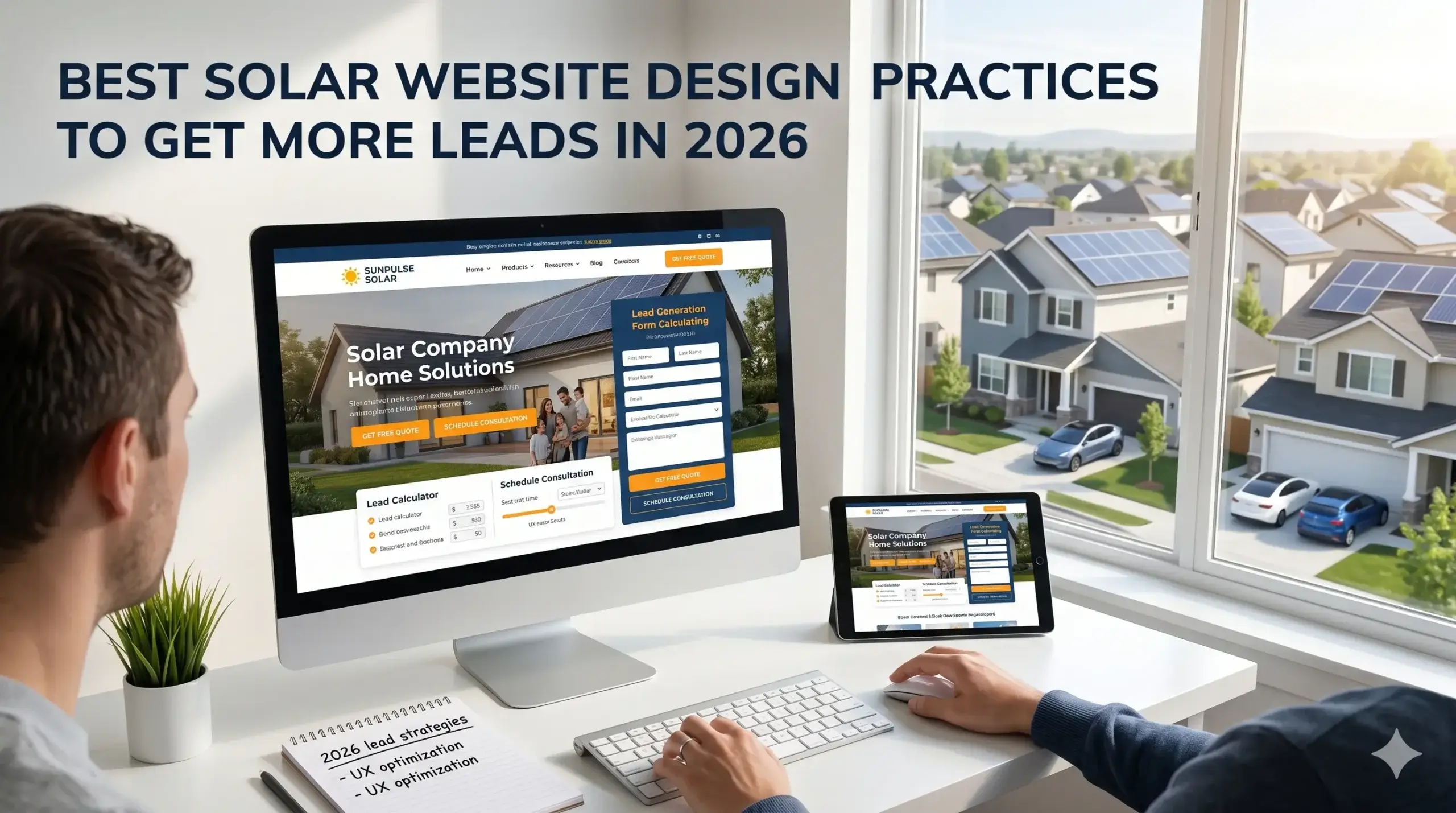
    Best Solar Website Design Practices to Get More Leads in 2026

    You’ve spent money on panels, trucks, training, and a crew — and yet your website sits there like a brochure no one picks up. Homeowners searching “solar installation near me” are finding your competitors, getting quotes, and signing contracts. Not because your competitors do better work. Because their websites do a better job of converting curious visitors into paying customers.

    Most solar business owners assume they just need more traffic. More ads. More posts. But the real problem is usually the website itself — slow pages, confusing layouts, missing trust signals, and calls-to-action buried so deep no one ever sees them. This article breaks down exactly what’s holding your solar website back and what a high-performing solar website design actually looks like in 2026.


    Why Most Solar Websites Drive Visitors Away Instead of Calling You

    Think of your website like a solar consultant walking into a homeowner’s living room. If that consultant mumbles, fumbles through papers, and can’t answer a simple question in under 30 seconds — the homeowner checks out. Your website works the same way.

    When a homeowner lands on your site, they make a snap judgment in about 3 seconds. If the page is cluttered, takes forever to load, or doesn’t immediately answer “Can you help me save money on electricity?” — they hit the back button. They don’t give second chances.

    Here’s what usually drives them away:

    • A homepage that talks about the company instead of the customer’s problem
    • Generic stock photos of solar panels with no local credibility markers
    • No clear answer to: “How do I get a quote?”
    • A phone number buried at the bottom of the page

    The fix isn’t a total rebuild — but it does require rethinking what your homepage is actually supposed to do.


    Your Website Speed Is Costing You Customers Right Now

    Here’s something most solar business owners don’t realize: if your website takes more than 3 seconds to load, a large share of visitors leave before they’ve even seen your phone number. This isn’t theory — it’s well-documented user behavior that Google tracks and uses in rankings.

    Why it happens: Images from your gallery, heavy video backgrounds, or outdated hosting can quietly bloat your site’s load time. On mobile (where most homeowners search), this gets even worse.

    What it costs you: A homeowner searching on their phone after work, comparing three local solar companies, will simply call the one whose site loads first. They don’t wait. They don’t refresh. They move on.

    What Digital Trace does instead: Every website built for solar businesses by Digital Trace goes through a performance audit — images are compressed, code is cleaned up, and hosting is configured to serve pages fast. Speed is a lead-generation tool, not just a technical checkbox.


    Your Site Looks Fine on a Desktop. It’s a Mess on Mobile.

    Over 60% of homeowners searching for solar services do it on a smartphone. If your site was designed five years ago, or designed by someone who only previewed it on a laptop, your mobile visitors are likely seeing broken layouts, tiny text, and buttons that are nearly impossible to tap.

    The technical reason: Many older websites weren’t built “mobile-first.” The desktop version was designed first, then awkwardly scaled down for phones. That creates layouts where text overlaps, images cut off, and the quote form is basically unusable.

    The real cost: A homeowner trying to fill out your contact form on their phone — and giving up — is a lost lead you never knew you had. There’s no notification that says “someone tried and failed.” They just vanish.

    The better approach: Mobile-first design means your site works perfectly on a 6-inch screen before anything else. Tappable buttons, readable text without zooming, and a contact form that takes 30 seconds to complete — not 5 minutes of frustration.


    💡 Pro Tip: Google Can’t Show Your Business Confidently — And There’s a Simple Fix

    Many solar websites are missing what’s called “local structured data” — a small piece of code that tells Google your exact business name, service areas, phone number, and what you do. Without it, Google doesn’t fully understand your business, which makes it less likely to show you in local results when homeowners are searching.

    The fix is a schema markup addition that doesn’t change how your site looks to visitors — but signals to Google that your solar business is legitimate, local, and worth showing. Most solar website owners don’t know this exists. Most of their competitors don’t either, which is exactly why fixing it can move the needle fast.


    Why Your Competitor Shows Up on Google and You Don’t

    You might have a better installation crew, better panels, and better reviews — but if your competitor’s site is better optimized for search, they win the click. Every time.

    Google’s local results — the map listings and the top organic results — favor websites that have a few non-negotiable ingredients:

    • Clear, location-specific pages: A page that says “Solar Panel Installation in [Your City]” outranks a generic homepage every time for local searches.
    • Fast load times: (Covered above — but it’s also a ranking factor, not just a user experience issue.)
    • Consistent business information: Your name, address, and phone number need to match exactly across your website, Google Business Profile, and any directories.
    • Reviews woven into the site: Not just on Google — having testimonials and star ratings visible on your actual web pages builds trust with both visitors and search engines.

    Solar business owners often say “We tried SEO and it didn’t work.” In most cases, what they tried was adding a few keywords to their homepage — without the structural groundwork that makes rankings stick.


    Trust Signals: The Thing Between a Visitor and a Phone Call

    A homeowner considering solar is making a big financial decision — $15,000 to $30,000 or more. They’re not just looking for the cheapest option. They’re looking for the safest one. Your website needs to answer the question: “Can I trust these people in my home?”

    Most solar websites fail at this. Here’s what’s usually missing:

    • Real photos of your team and actual completed installations — not stock images
    • Specific reviews: “Great company” means nothing. “They saved us $180 a month starting in month two” is a reason to call
    • Credentials and certifications: NABCEP certification, manufacturer partnerships, state licensing — these belong front and center, not buried on an About page
    • A clear warranty explanation: Homeowners are worried about what happens if something breaks in year 5. Answer that question before they have to ask.

    Every one of these elements is a reason for a visitor to stay — or leave. Adding them doesn’t require a redesign. It requires knowing what a solar buyer actually needs to see before they pick up the phone.


    Before & After: What Happens When a Solar Website Actually Works

    The situation: A residential solar installer in Texas was running Google Ads and getting decent traffic — around 800 visitors a month. But they were averaging only 3–4 inquiry form submissions per month. Their cost per lead was approaching $400, which made their ad spend barely worth it.

    The problem: Their homepage had a 6-second load time on mobile, their contact form was on a separate page with no strong call-to-action pointing to it, and their site had no location-specific pages — just one generic homepage serving the entire metro area.

    What changed: A performance overhaul cut mobile load time to under 2 seconds. Individual city pages were created for their three main service areas. Testimonials with real savings numbers were added to the homepage. The quote form was moved above the fold with a clear headline: “Find Out How Much You’ll Save — Free 20-Minute Assessment.”

    The result: Within 90 days, monthly inquiries climbed from 4 to 22. Cost per lead dropped significantly. The same ad spend that was barely breaking even started producing a consistent pipeline of qualified homeowner leads.

    The traffic didn’t change much. The website started doing its job.


    Not sure if your solar website has these issues? Get a free website audit — no obligation, just a clear picture of what’s costing you leads.


    Your Path to More Leads: 5 Practical Steps

    You don’t need to do everything at once. Here’s where to start:

    1. Test your mobile experience right now. Pull up your own website on your phone and try to submit a contact form. Time yourself. If it takes more than 60 seconds or anything feels broken — that’s a problem to fix immediately.
    2. Make your phone number impossible to miss. It should be in the top-right corner of every page, clickable on mobile, and repeated near every call-to-action.
    3. Add one real customer story with real numbers. Not a generic “Great service!” quote — one specific story that shows a homeowner what their outcome could look like.
    4. Create a page for each city or metro area you serve. One generic homepage trying to serve three counties will rank for none of them. Specific pages rank for specific places.
    5. Book a free audit with Digital Trace. Before you invest in ads, content, or a full rebuild, know exactly what’s working and what isn’t. A free website audit from Digital Trace will show you the specific issues costing your solar business leads — and what to fix first.

    Frequently Asked Questions

    Why am I not getting calls from my website even though I get some traffic?

    Traffic without calls usually means one of a few things: your site loads too slowly and people leave before they see anything, your call-to-action isn’t clear enough, or your site isn’t building enough trust for homeowners to take the next step. Getting visitors to your site is only half the job — converting them is the other half, and most solar websites are set up only for the first part.

    How do I know if my solar website is actually working?

    A working solar website converts visitors into inquiries. If you’re getting 500 visitors a month and fewer than 10–15 contact form submissions or calls, something is broken in the experience. Tracking where visitors drop off — and fixing those friction points — is what separates a website that generates leads from one that just exists online.

    How long does it take to see results from a new or improved website?

    Performance improvements like speed and mobile fixes can start impacting bounce rates within days. SEO improvements — like location-specific pages and structured data — typically take 60 to 90 days to show meaningful ranking movement. The combination of both is what delivers sustainable results, not just a short-term spike. Get a free website audit to understand your specific timeline based on where you’re starting.

    What makes a solar website different from a regular business website?

    Solar buyers are making a 15- to 30-year decision about their home. They need to see financial outcomes (savings, payback periods, incentives), trust markers (licenses, certifications, warranties), and social proof from real local homeowners — not just a pretty design. A generic website template doesn’t address any of that. A solar-specific site is built around the specific fears and questions a homeowner has before they’re ready to get a quote.

    Do I really need a fast website if my customers are local?

    Yes — especially if your customers are local. Local homeowners search on their phones while they’re thinking about it, often in the evening or weekend. If your site loads slowly on a mobile connection, they move to the next result before they’ve seen a single thing about your business. Speed is even more important for local businesses competing for the same searches in the same area.

    I’ve been burned by agencies before. How is this different?

    That’s a fair concern — and it’s worth asking directly. Digital Trace specializes specifically in solar website design, not generic web design for any business that walks in. That focus means the work is grounded in what actually drives solar leads, not just what looks good in a portfolio. The free audit is a no-pressure way to see exactly what’s holding your site back before committing to anything.


    Ready to Stop Losing Leads You Don’t Know About?

    Every day your solar website has a slow load time, a broken mobile experience, or missing trust signals — you’re handing potential customers to your competitors. Most of those leads never tell you they visited. They just leave.

    A free website audit from Digital Trace shows you exactly where your solar website is losing leads, what it’s costing you in real revenue, and what to prioritize first. No jargon, no sales pitch — just a clear, honest picture of what’s working and what isn’t.

    See what’s costing you leads — get your free audit today

    There’s no obligation and no commitment. Just answers.