Category: Medical Spa

  • How Top-Performing MedSpas Use Their Website to Book More Consultations

    How Top-Performing MedSpas Use Their Website to Book More Consultations

    You invested in your space, your equipment, your staff. Clients who walk through your door almost always book again. So why does your website feel like a waiting room that nobody visits?

    Most MedSpa owners assume the problem is advertising — that they just need to run more Google ads or post more on Instagram. But the real issue is usually the website itself. It’s not converting. Visitors land on it, look around for a few seconds, and leave without calling, without booking, without doing anything.

    This guide breaks down exactly what separates a MedSpa website that books consultations from one that just exists. You’ll see the specific mistakes that quietly kill your lead flow, what top-performing MedSpas do instead, and how a smarter approach to med spa website design can turn your site into your best-performing front desk rep.


    Your Website Is Open 24/7 — But Is It Actually Working?

    Think of your website like a new front desk employee you hired and never trained. She shows up every day, greets every visitor, but has no idea how to answer questions, explain your services, or close a booking. Visitors get confused, feel uncertain, and walk out.

    That’s what a poorly designed MedSpa website does. Visitors arrive from Google, a social post, or a friend’s referral — but the site gives them no clear reason to act. No obvious next step. No sense of trust or expertise. So they close the tab and call your competitor instead.

    The fix isn’t more traffic. It’s making sure the traffic you already have actually turns into consultations.


    The 5 Reasons Your MedSpa Website Isn’t Booking Consultations

    1. Visitors Can’t Figure Out What to Do Next

    The problem: A visitor lands on your site, scrolls through some photos, reads a few lines about your services — and then stares at the screen wondering what happens next. There’s no clear path to booking.

    Why it happens: Most MedSpa websites are built around the owner’s vision of what looks good, not around what a potential client needs to feel confident enough to take action. The result is a beautiful-looking site with no real direction.

    What it costs you: Every confused visitor is a lost consultation. If someone has to hunt for your phone number, your booking link, or even just confirmation that you offer the treatment they’re looking for, they won’t wait around.

    What top-performing MedSpas do instead: Their sites are built with one job in mind — move the visitor from curious to booked. Every page has a single, clear call-to-action. The phone number is visible at the top of every page. A “Book a Consultation” button appears before the visitor even scrolls. Digital Trace designs medspa websites around this conversion path from day one.


    2. Your Site Loads Too Slowly — and People Leave Before They Even See You

    The problem: Most people visiting your site for the first time are doing it on a phone, often while in between tasks. If your site takes more than three seconds to load, most of them are already gone.

    Why it happens: MedSpa websites often run on bloated page builders stuffed with oversized images, unnecessary plugins, and outdated code. Every extra second of load time costs you a percentage of your visitors — before they’ve seen a single word about your services.

    What it costs you: Slow sites don’t just lose visitors — they rank lower on Google too. Speed is a direct ranking factor. So the same problem that’s driving visitors away is also making it harder for new ones to find you.

    What top-performing MedSpas do instead: Their websites are technically optimized for speed — compressed images, clean code, fast hosting. They load quickly on mobile and desktop. Visitors see what they came for almost instantly, which keeps them engaged long enough to convert.


    3. Google Doesn’t Know Enough About Your MedSpa to Show It Confidently

    The problem: You search for your own MedSpa on Google and you barely show up. Or you show up for your business name, but not for phrases like “Botox consultation [your city]” or “best medspa near me.”

    Why it happens: Your site isn’t giving Google the right signals. There’s no clear structure telling Google what treatments you offer, who you serve, or where you’re located. Without that structure, Google has no confidence in showing your site to someone searching for exactly what you do.

    What it costs you: Your competitor — who may offer a nearly identical service — is showing up first because their site communicates more clearly with Google. You’re invisible to the people actively searching for what you provide right now.

    What top-performing MedSpas do instead: Their sites are built with dedicated pages for each core service, clear geographic signals, and proper technical setup that tells Google exactly who they are and who they serve. It’s not magic — it’s structure. And it’s one of the first things Digital Trace addresses when building or auditing a MedSpa’s website.


    4. Your Site Doesn’t Feel Premium — Even If Your Services Are

    The problem: A potential client Googles you after getting a referral from a friend. They land on your site expecting to feel the same confidence they felt when their friend raved about you. Instead, they see a generic template, a stock photo of a smiling woman, and text that could belong to any MedSpa in the country.

    Why it happens: Most MedSpa websites use the same off-the-shelf templates and the same borrowed language. There’s nothing specific, nothing distinctive, nothing that earns trust.

    What it costs you: In the MedSpa world, trust is everything. Clients are considering putting their face — literally — in your hands. If your website doesn’t project quality and expertise, they won’t take the risk. They’ll go to the practice whose website made them feel confident.

    What top-performing MedSpas do instead: They invest in a website that reflects the actual experience of walking through their door. Real photography. Specific treatment descriptions. Clear credentials. Patient-focused language that addresses real concerns — not generic spa-speak. The best med spa websites make visitors feel like they’ve already met the team before they pick up the phone.


    5. Your Booking Process Has Too Much Friction

    The problem: A motivated potential client is ready to book. She clicks the “Contact Us” button and lands on a form with twelve fields, or worse — just an email address. She closes the tab.

    Why it happens: The booking process is usually an afterthought. The website was built to look good, not to make booking easy. Every extra step — every unnecessary field, every redirect, every delay — costs you a real person who was ready to become a client.

    What it costs you: Friction at the booking stage is one of the most expensive problems a MedSpa website can have, because it happens at the exact moment you’ve already done everything right. The person found you, liked what they saw, and decided to act — and the site let them down at the finish line.

    What top-performing MedSpas do instead: Their sites make booking effortless. A short, simple consultation request form. A click-to-call button that works on mobile. Sometimes an integrated calendar. The goal is to reduce the steps between “I’m interested” and “I’m booked” to as few as possible.


    💡 Pro Tip: The Treatment Page Problem Most MedSpas Miss

    Many MedSpa websites have one generic “Services” page that lists every treatment in a single block of text. This is one of the most common and costly design mistakes in the industry.

    When a potential client is researching a specific treatment — say, RF microneedling or lip filler — they want a dedicated page that answers their exact questions: How does it work? Who is it for? What should I expect? What does it cost?

    A single catch-all services page can’t do that well. And because Google sees that page as general rather than specific, it won’t rank it for the specific treatment searches your clients are typing.

    The fix is a separate page for each core treatment, written for both the client and Google. It takes more time to build, but it drives more qualified traffic — and converts that traffic at a much higher rate.


    Real-World Results: What Changes When the Website Actually Works

    A MedSpa in the Southeast had been open for three years and was doing solid in-person business, mostly through referrals and loyal returning clients. But their website was almost entirely invisible on Google — and the few visitors who did land on it were bouncing within seconds.

    Their site had a common combination of problems: slow load times on mobile, a services page that listed everything in one dense paragraph, no clear call-to-action above the fold, and no location-specific content to signal their area to Google.

    After rebuilding the site with dedicated treatment pages, a streamlined consultation form, fast hosting, and a proper local SEO structure, the results shifted noticeably within four months. Organic traffic from Google more than doubled. The consultation request form — previously almost unused — started generating multiple submissions per week. New client bookings from the website alone grew significantly, and for the first time, the site was ranking on page one for their core treatment keywords in their market.

    None of it required more ad spend. The site just finally did its job.


    Not sure if your MedSpa website has these same issues? Get a free website audit — no obligation, just a clear picture of what’s costing you leads.


    Your Path to More Leads: 5 Steps to a MedSpa Website That Actually Converts

    Step 1: Audit what you have. Before fixing anything, understand what’s broken. Look at your load speed, your bounce rate, and how many people actually reach your contact form. If you don’t have access to this data, a website audit can surface it in minutes.

    Step 2: Build dedicated pages for your core treatments. Each major treatment you offer deserves its own page — written specifically for the client considering that treatment, and structured clearly for Google.

    Step 3: Make the next step impossible to miss. Every page of your site should have one clear call to action. Not five options. One. Usually: “Book a Consultation.” Make it visible without scrolling on both mobile and desktop.

    Step 4: Speed up your site. Check your site’s load time on mobile using Google’s PageSpeed Insights. If it’s below a score of 70, you likely have a speed problem that’s costing you both visitors and rankings.

    Step 5: Work with a team that understands the MedSpa space. Generic web agencies build generic websites. A team that has built websites for MedSpa businesses understands what clients are looking for, how the search landscape works in aesthetics, and how to turn your site into a real business asset.


    Frequently Asked Questions

    Why am I not getting calls from my website even though I get some visitors?

    Traffic without conversions almost always points to one of three problems: your site doesn’t make it clear what to do next, it doesn’t build enough trust to make someone comfortable calling, or the booking process has too many steps. Getting visitors is only half the job — the site also has to convert them.

    How do I know if my MedSpa website is actually working?

    A working website generates a steady stream of consultation requests, not just page views. If you’re not getting regular form submissions or click-to-call actions from new visitors, the site isn’t doing its job. A free website audit can show you exactly where visitors are dropping off and what’s stopping them from booking.

    How long does it take to see results from a new or redesigned website?

    You’ll often see improvements in user behavior — more form submissions, longer time on site — within the first few weeks after launch. Organic search rankings typically improve over two to four months as Google re-indexes and evaluates the new structure. A faster, better-structured site tends to move the needle faster than one that’s been stagnant for years.

    What makes a MedSpa website different from a regular business website?

    A MedSpa website has to do something most business sites don’t: build enough personal trust that someone is willing to book an aesthetic treatment. That means real photography (not stock images), treatment-specific pages that answer detailed questions, clear credentials, and design that feels as refined as your actual practice. Generic templates don’t get there.

    Do I really need a fast website if most of my clients are local and already know me?

    Yes — and especially because they’re local. When someone hears about your MedSpa through a referral or sees your social post, the first thing they do is Google you. If your site loads slowly on their phone, looks outdated, or doesn’t answer their questions quickly, you’ve lost them before they ever picked up the phone. Local clients still judge you by your website.

    I’ve hired marketing agencies before and didn’t see results. How is this different?

    Most agencies focus on driving traffic — ads, social media, SEO volume. The problem is that traffic to a broken website doesn’t book consultations. Digital Trace starts with the website itself: making sure it converts before layering any traffic strategy on top. If the foundation isn’t right, nothing else sticks.


    Your MedSpa Deserves a Website That Books Consultations — Not Just Looks Pretty

    Every week your current website underperforms is revenue that’s going to a competitor whose site converts better than yours. Not because their treatments are better. Not because their prices are lower. Just because their website does its job.

    The good news: this is entirely fixable. A properly built MedSpa website — fast, clear, structured for Google, and designed around conversion — can change the trajectory of your practice.

    Digital Trace works specifically with MedSpas across the US to build websites that generate real consultation bookings. Not just impressions. Not just traffic. Actual booked clients.

    Get your free website audit — we’ll show you exactly what your site is missing, where you’re losing potential clients, and what it would take to fix it. No sales pitch. No obligation. Just a clear, honest look at what’s costing you leads right now.

  • Med Spa Website vs. DIY Builder: Which One Actually Grows Your Practice?

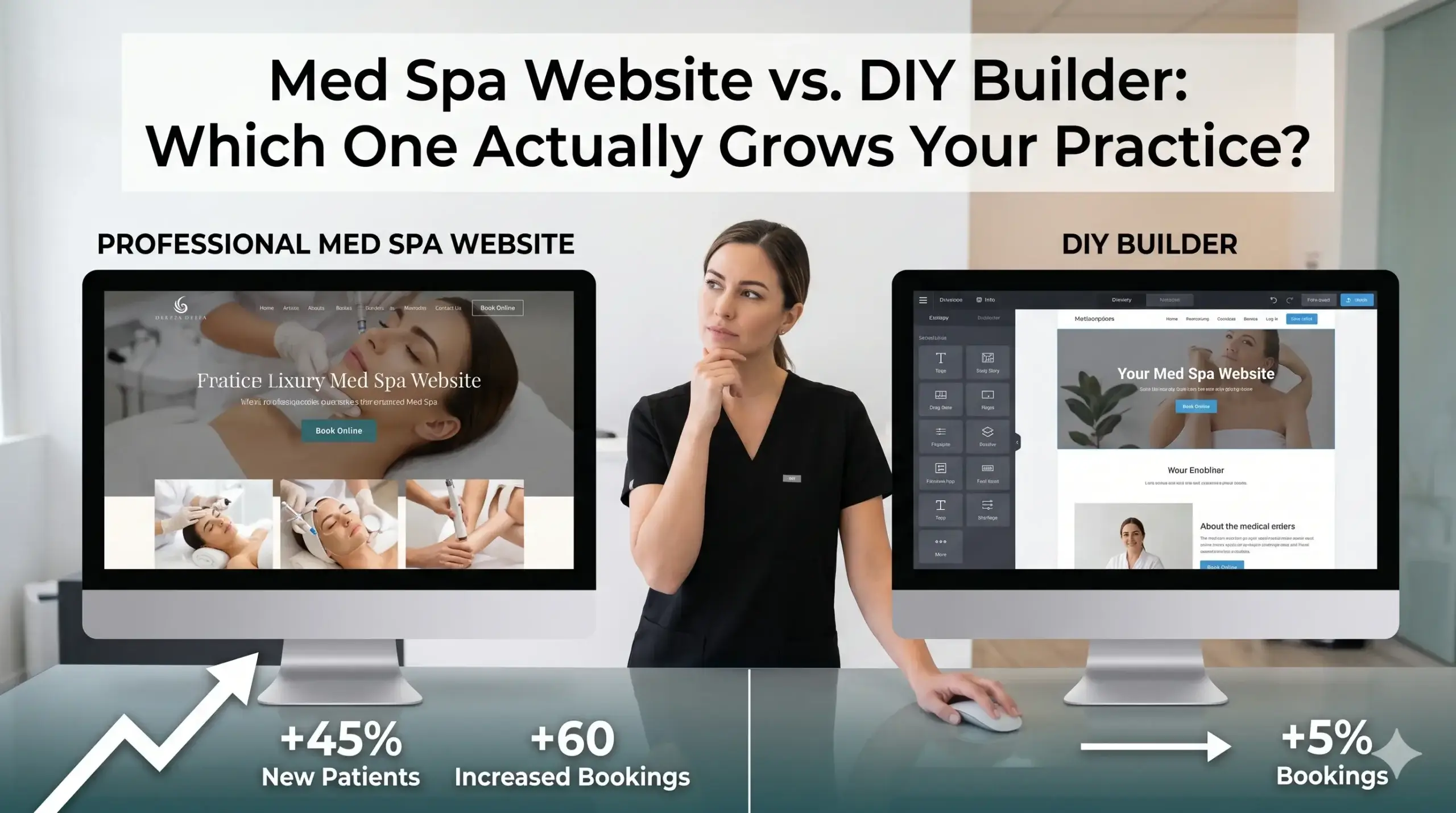
    Med Spa Website vs. DIY Builder: Which One Actually Grows Your Practice?

    You spent real money on equipment, training, staff, and build-out. Your treatments are excellent and your clients love you. So why is your phone not ringing as much as it should?

    For a lot of med spa owners, the answer lives on a webpage they built themselves three years ago — and haven’t touched since.

    DIY website builders like Wix, Squarespace, and GoDaddy make it easy to get something online fast. But “something online” and “a website that grows your practice” are two completely different things. One checks a box. The other works for you while you’re in a treatment room.

    This post breaks down exactly what’s costing you leads, what the best medspa websites actually do differently, and how to know whether it’s time to stop patching your current site and start building one that pays for itself.


    Your Website Is Your Front Desk — And Right Now, It’s Turning Clients Away

    Think about what happens when a potential client walks into your med spa for the first time. They’re immediately sizing you up — cleanliness, professionalism, warmth. If the experience feels off, they walk out.

    Your website is that first impression for the majority of people who will ever consider booking with you. They Google “botox near me” or “laser skin treatments in [city],” find your site, and form an opinion in about three seconds.

    If your site looks dated, loads slowly, or doesn’t answer their basic questions quickly — they close the tab and book with the practice that shows up right below you.

    Here’s the real problem: most DIY-built medspa websites fail that three-second test. Not because they’re ugly, but because they weren’t built to convert a skeptical, time-pressed consumer who has five other options a click away.


    The Hidden Speed Problem That’s Draining Your Bookings

    What you experience: You feel like your website is “fine.” It loads on your laptop at the office, and it looks decent on your phone.

    What’s actually happening: Your site is loading in 6, 7, maybe 9 seconds on a mobile connection — and over half of your potential clients are browsing on their phones. Most people leave a site that takes longer than 3 seconds to load. They don’t wait. They don’t come back.

    What this costs you: Every slow-loading page is a potential client who never saw your before-and-after photos, never read your treatment menu, never found your phone number. They went to your competitor’s site, which loaded in under 2 seconds, and booked there.

    DIY builders are convenient, but they’re packed with bloated code, unnecessary scripts, and shared hosting that can’t handle load. That’s the tradeoff you make for “easy.”

    Websites built for medical spa businesses are built lean and fast from the ground up — optimized for mobile speed specifically because that’s where your clients are finding you.


    Google Doesn’t Know Your Practice Exists — Here’s Why

    What you experience: You search your own business and you show up. So you assume you’re ranking fine.

    What’s actually happening: Searching your own business name shows you your own listing. That’s not the same as showing up when someone types “CoolSculpting near me” or “best med spa for microneedling in [your city].”

    There’s a difference between being findable and being found by the right people at the right moment.

    Most DIY-built medspa websites are missing the technical signals Google uses to understand what a business offers and who it serves — things like properly structured service pages, local SEO signals, and metadata that matches what people are actually searching for. Without those signals, Google won’t confidently show your site to people who don’t already know your name.

    The real cost: Your competitor — maybe a bigger chain, maybe just a more digitally-savvy solo practice — is showing up every time your ideal client searches. You’re not even in the conversation.

    The best med spa websites aren’t just pretty. They’re architected so Google can read them clearly and rank them confidently for the treatments people are actively searching for.


    Your Website Looks Like a Brochure. It Should Work Like a Booking Machine.

    Here’s a comparison that hits close to home for most med spa owners:

    Imagine you hired a front desk person, but they had no training, no script, and zero authority to book an appointment. A client walks in, asks about your HydraFacial pricing, and the front desk person just shrugs and points to a printed menu on the wall.

    That’s what a DIY-built medspa website does. It presents information. It doesn’t guide, reassure, or convert.

    The best medspa websites are designed around the psychology of a client who’s on the fence — someone who’s interested but hasn’t committed. They need:

    • Social proof (before-and-after photos, testimonials, specific results)
    • Reassurance (credentials, safety information, what to expect)
    • A clear, frictionless next step (book now, text us, claim a special offer)
    • Fast answers to their most common questions

    If your current site doesn’t do all four of those things on every page, you’re leaving bookings on the table every single day.


    💡 Pro Tip: Your “Book Now” Button Might Be Costing You Clients

    A lot of med spa websites have a booking button — but it links to a third-party scheduling tool that opens in a new tab, requires account creation, and takes four steps to complete. On mobile, half of those potential clients drop off before finishing.

    The fix isn’t just a button — it’s building a booking flow that feels seamless from click to confirmation. That means fewer steps, mobile-optimized forms, and ideally a click-to-call option for clients who’d rather just speak to someone. This is a small detail that makes a measurable difference in how many inquiries you actually receive.


    Before & After: What Happens When a Med Spa Gets the Right Website

    The Practice: A laser and injectables med spa in a mid-size market with strong local competition. They had a Squarespace site they’d built themselves when they opened, plus an active Instagram following. Despite solid reviews and a loyal client base, their new client inquiries from the web were inconsistent — maybe 5 to 8 new contact form submissions or calls per month from people who didn’t already know them.

    The Problems:

    • Site loaded in 7+ seconds on mobile
    • No dedicated service pages (everything was on one long scrolling homepage)
    • No local SEO signals — they weren’t appearing for treatment-specific searches
    • No before-and-after gallery integrated with their service pages
    • Booking process required navigating to a third-party tool

    What Changed: A full rebuild focused on med spa website design — fast-loading service pages, local SEO structure, an integrated gallery, and a mobile-first booking flow.

    The Result: Within 90 days of launch, new client inquiries from organic search went from 5–8 per month to consistently 25–35. The phone rang more. The contact form filled up. And they stopped relying entirely on Instagram to drive new business.

    That’s not magic. That’s what happens when your website is actually built to work.


    Not sure if your med spa website has these issues? Get a free website audit — no obligation, just a clear picture of what’s costing you leads.


    What the Best Med Spa Websites Actually Have in Common

    When you look at high-performing medspa websites — the ones that consistently generate inquiries and show up in search — a few patterns emerge:

    • Speed. They load fast on mobile, full stop.
    • Dedicated service pages. Not one page with a list of treatments — individual pages for each major service, optimized for how people search.
    • Local SEO signals. Their structure tells Google exactly where they are, what they do, and who they serve.
    • Real social proof. Before-and-afters, specific testimonials, named staff with credentials — not stock photos and generic quotes.
    • A clear conversion path. Every page has one obvious next step. Not three. One.
    • Trust signals above the fold. Certifications, associations, and experience shown immediately — not buried at the bottom.

    DIY builders can produce some of these elements. But replicating all of them, consistently, across a site that’s also fast and technically sound? That requires intentional medical spa web design — not a drag-and-drop template that was built for a yoga studio.

    See how Digital Trace builds medical spa websites that check every one of these boxes.


    Your Path to More Leads: A Simple 5-Step Reality Check

    You don’t need to become a web developer to understand whether your site is working. Here’s a straightforward process:

    Step 1: Test your site’s speed on mobile. Go to Google’s PageSpeed Insights (free), type in your URL, and run a mobile test. If your score is below 70 — or your load time is over 3 seconds — you have a real problem that’s costing you clients right now.

    Step 2: Search for your own treatments, not your own name. Type “[your city] botox” or “[your city] laser skin treatment” into Google. If you’re not on the first page, your ideal clients aren’t finding you organically.

    Step 3: Count your service pages. If all your treatments live on one page, you’re invisible for most of the searches your clients are doing. Each treatment deserves its own page, optimized for how people search.

    Step 4: Walk through your booking flow on your phone. Open your site on your personal phone, find a treatment, and try to book. Count every click, every redirect, every form field. If it takes more than 3 steps to connect with you — fix it.

    Step 5: Ask an honest question about your site’s first impression. Show your homepage to someone who has never seen it. Ask them: “What does this business do? Would you trust them? Do you know how to book?” If they hesitate on any of those answers, your website is working against you.


    FAQ: What Med Spa Owners Actually Ask Before Hiring a Web Agency

    Why am I not getting calls from my website even though I have one?

    Having a website and having a website that generates calls are two different things. Most med spa websites that don’t convert are missing speed optimization, local SEO structure, or a clear booking path. The site exists — it’s just not doing any of the work.

    How do I know if my med spa website is actually working?

    If you can’t answer “how many new client inquiries came directly from my website last month,” your site probably isn’t working as hard as it should be. A working website generates a measurable, trackable number of inquiries. If you want to know where yours stands, a free website audit will show you exactly what’s happening under the hood.

    How long does it take to see results from a new website?

    A new website built with strong local SEO structure typically starts seeing meaningful organic traffic growth within 60–90 days of launch — sometimes faster in lower-competition markets. Results are not instant, but the improvements in speed and user experience often produce quicker wins in conversion rates (more inquiries from existing traffic) even before search rankings fully catch up.

    What makes a med spa website different from a regular business website?

    Med spa clients are buying trust as much as they’re buying a service. They want to see credentials, real results, and reassurance before they’ll hand over their email — let alone book. A med spa website needs to establish clinical authority and warmth simultaneously, with a booking flow that removes every possible point of friction. That’s a very different design brief than, say, a plumber’s website.

    Do I really need a fast website if all my clients are local anyway?

    Yes — especially because they’re local. Local searches happen overwhelmingly on mobile, often while someone is out and about and actively ready to book. If your site loads slowly on a mobile connection, you lose that person in real time. Local doesn’t mean low stakes; it means the competition is happening right in your backyard.

    I’ve been burned by marketing agencies before. How is this different?

    That’s a completely fair concern. The difference is in what’s being measured and delivered. A website audit starts by showing you exactly what’s wrong — in plain English, with no upsell pressure. You’ll see the specific issues, what they’re costing you, and what it would take to fix them. No vague promises, no long retainer before you see anything. Just a clear picture of your current situation.


    There’s Real Money Sitting in Your Website Right Now

    Every month your med spa website runs slow, ranks invisibly, and fails to convert visitors into calls — that’s real revenue walking out the door. Not theoretical revenue. Actual clients who found you, looked at your site, and chose someone else.

    The good news: this is completely fixable. The technical problems that kill most medspa websites are known, solvable, and the results are measurable.

    Ready to see exactly what your website is costing you?

    Get your free website audit from Digital Trace — no obligation, no sales pitch. Just an honest look at what’s working, what isn’t, and what a better website would actually mean for your practice’s bottom line.

    → Claim Your Free Med Spa Website Audit

  • How to Choose the Right Medical Spa Web Design Company in the US

    How to Choose the Right Medical Spa Web Design Company in the US

    You invested in a beautiful website. Maybe it even won you a compliment or two. But the phone isn’t ringing the way it should, your booking calendar has more gaps than it used to, and somewhere in the back of your mind you wonder — is my website actually doing anything?

    Most medical spa owners blame the market, the season, or their ad budget. The real answer is usually sitting right on their homepage: a website that looks good but isn’t built to convert. There’s a difference between a site that looks like a medical spa and one that works like a marketing engine for one.

    This guide will show you exactly what separates a high-performing medspa website from a pretty placeholder — and what to look for when choosing a medical spa web design company that actually delivers results.


    Your Website Has One Job. Is It Doing It?

    Think of your website like your front desk. If a new patient walked in and your receptionist took 10 seconds to look up, handed them a brochure with no pricing, gave them no way to book, and left them standing there in silence — they’d walk out. That’s exactly what most medspa websites do every single day.

    Visitors land on your site after searching for something specific — Botox near me, laser hair removal pricing, med spa in [their city]. They’re ready to book. But if your site loads slowly, buries your services, or makes them hunt for a phone number, they’re gone in under five seconds. And they booked with your competitor.

    The best medspa websites are built like a trained front desk team: fast, clear, and always ready to guide someone to the next step.


    Why Most Medical Spa Websites Bleed Leads Without the Owner Knowing

    Here’s the uncomfortable truth: website problems are invisible from the owner’s side. You see the design. You don’t see the visitors who clicked away before your site even loaded.

    Here are the most common ways medical spa websites quietly lose business:

    • Slow load times. If your site takes more than 3 seconds to load on a phone, most visitors leave before they ever see your services. Google has confirmed this. And the majority of your traffic is on mobile.
    • No clear call to action above the fold. If someone has to scroll to find a “Book Now” button, most of them won’t. The action you want them to take needs to be the first thing they see.
    • Stock photos that scream “generic.” Visitors can spot stock imagery instantly. Real photos of your team, your space, and your results build trust in a way that purchased photos never will.
    • Missing or buried pricing signals. People searching for med spa services are comparison shopping. If you give them no pricing context, they’ll find a competitor who does.
    • No social proof above the fold. Reviews, before-and-afters, and client numbers aren’t just nice to have — they’re what nervous first-time clients look for before they commit.

    Every one of these issues costs you real bookings. Not hypothetical ones.


    The Google Problem Nobody Tells You About

    Your website might look great to you and still be invisible to Google. That’s because Google doesn’t experience your site the way you do — it reads the technical code behind it. And if that code is missing key signals, Google simply doesn’t trust your site enough to show it to people searching for what you offer.

    Layer 1 — What you experience: You search “med spa [your city]” and your competitors show up on page one. You don’t.

    Layer 2 — Why it happens: Your site is likely missing structured data (which tells Google clearly what your business is, where it is, and what services you offer), your pages may not be properly optimized for the specific treatments you provide, and your site speed may be dragging down your rankings before anyone even clicks.

    Layer 3 — What the fix looks like: Websites built for medical spa businesses are built from the ground up with Google’s requirements in mind — fast-loading pages, properly structured content, and technical signals that tell Google exactly what your business does and where you serve clients.


    What the Best Medspa Websites Have in Common

    The best med spa websites aren’t just pretty. They’re precise. Here’s what separates them from sites that cost their owners leads every month:

    They load fast on every device. Speed isn’t a technical nice-to-have — it’s a conversion factor. Slow sites lose clients before a single word is read.

    They speak to the client’s hesitation, not just their desire. First-time med spa clients are often nervous. The best sites address those hesitations with clear FAQs, before-and-after galleries, and staff bios that build trust.

    They make the next step obvious. One clear path. One visible button. Whether that’s booking a consultation, viewing a treatment menu, or calling directly, the best sites never make the visitor guess what to do next.

    They’re built for local search. Service pages are written for specific treatments and cities. A great medspa site doesn’t just say “we offer Botox” — it signals to Google that you’re the right result for “Botox in [city].”

    They track what’s actually working. The best sites are connected to tools that show you how visitors behave — where they click, where they drop off, and which pages are driving bookings vs. driving bounces.


    💡 Pro Tip: One of the most common mistakes medical spa owners make is combining all their services onto a single page. It feels organized to you, but to Google it’s a mess — the page ends up ranking for nothing specific. The fix is simple: each major service (Botox, laser hair removal, facials, body contouring, etc.) should have its own dedicated page, written for the way clients actually search. This one change alone can dramatically improve how often you show up when someone searches for a specific treatment in your area.


    A Before-and-After Story: What a Real Website Overhaul Can Do

    The situation: A medical spa in Austin, Texas was averaging around 40 website visitors per day but converting fewer than 1% of them into consultation bookings. Their site was three years old, built on a generic template, loaded in over 5 seconds on mobile, and had no service-specific landing pages. Their Google Business Profile was active, but organic search traffic was almost entirely branded — meaning people only found them when they already knew their name.

    What changed: The site was rebuilt with individual service pages for their top eight treatments, a mobile-first design that loaded in under 1.8 seconds, a prominent booking CTA visible on every page, real client photos, and a structured FAQ section addressing the most common hesitations for first-time clients. Local SEO signals were embedded throughout.

    The result: Within 90 days, organic traffic grew by roughly 3x. Consultation bookings from the website doubled. The front desk reported that incoming callers were more informed and more ready to commit — because the website had already answered their questions before they picked up the phone.

    The difference wasn’t magic. It was a website that was actually built to do a job.


    Not sure if your medical spa website has these issues? Get a free website audit — no obligation, just a clear picture of what’s costing you leads.


    Your Path to More Leads: 5 Steps to a Website That Actually Works

    If you’re serious about turning your website into your best-performing front desk employee, here’s where to start:

    1. Test your site speed on mobile. Go to Google’s PageSpeed Insights (free tool), enter your URL, and run the mobile test. If your score is under 70, your site is losing you clients every single day.
    2. Check what your homepage actually says. Look at your site as if you’ve never heard of your business. Is it clear within 3 seconds what you offer, who you serve, and what to do next? If you have to think, your visitors already left.
    3. Count your service pages. If all your services live on one page, or if you only have a general “Services” dropdown, you’re missing dozens of ranking opportunities. Each treatment deserves its own page.
    4. Read your reviews — then look for them on your website. If you have strong Google reviews but they’re not visible on your site, you’re hiding your best social proof from the people who need it most.
    5. Reach out to a web design company that specializes in med spas. Generic web agencies build generic websites. Choosing a team that understands how Digital Trace builds medical spa websites — including the specific treatments, the client psychology, and the local SEO requirements — makes a measurable difference in results.

    Frequently Asked Questions

    Why am I not getting calls from my website even though I get decent traffic?

    Traffic without calls usually means one of three things: your site loads too slowly so visitors leave before they engage, your call to action is buried so visitors don’t know what to do next, or your site doesn’t address the hesitations that stop first-time clients from committing. Traffic is a starting point — your site’s job is to convert that traffic into conversations.

    How do I know if my medical spa website is actually working?

    If you don’t know exactly how many people visit your site, which pages they land on, and how many of them click your booking button or call your number — your site isn’t being measured, which means it’s not being managed. A properly set-up website gives you those numbers clearly. Get a free website audit to see exactly where yours stands right now.

    How long does it take to see results from a new medical spa website?

    A rebuilt, properly optimized website typically shows meaningful improvements in organic search visibility within 60–90 days. Conversion improvements — more calls and bookings from the same traffic — can happen much faster, sometimes within the first few weeks once structural issues are fixed.

    What makes a medical spa website different from a regular business website?

    A medical spa website has to do several things a standard business site doesn’t: build trust with first-time clients who are anxious about procedures, answer detailed questions about treatments before the phone call, surface before-and-after results credibly, and rank for highly specific local search terms like “Botox [city]” or “laser hair removal near me.” It also needs to work harder on mobile, where most med spa searches happen.

    Do I really need a fast website if my clients are mostly local?

    Yes — especially because they’re local. When someone in your city searches for a med spa, Google ranks results based on relevance and performance. A slow site ranks lower and loses visitors faster than a fast one, regardless of how local your audience is. Your local competitor with a faster, better-optimized site is getting the clicks you should be getting.

    How do I choose a medical spa web design company I can actually trust?

    Look for a company that has built sites specifically for the med spa or aesthetics industry — not just general healthcare or retail. Ask to see real results, not just design portfolios. Ask how they handle local SEO, site speed, and conversion optimization. And ask what happens after launch — ongoing support and updates matter as much as the initial build.


    Your Medical Spa Deserves a Website That Works as Hard as You Do

    You’ve built something real — a team, a reputation, a list of clients who trust you with their faces and their confidence. Your website should reflect that. Right now, it might be doing the opposite: turning away potential clients before they ever pick up the phone.

    The right medical spa web design company won’t just make your site look better. They’ll make it work — bringing in more of the right clients, answering their questions before they ask, and making it easy for them to book.

    Ready to find out exactly what your website is costing you? Book your free website audit — no sales pitch, no obligation, just a clear, honest look at what’s working and what’s standing between you and more bookings.

  • Medical Spa Website Design: 10 Must-Have Features Best MedSpas Use in 2026

    Medical Spa Website Design: 10 Must-Have Features Best MedSpas Use in 2026

    You spent serious money on your med spa — the equipment, the training, the build-out. But your website? It’s probably costing you clients every single week without you knowing it.

    Most medical spa owners assume their website is “fine.” It loads, it has their phone number, it lists their services. But “fine” isn’t the same as working. When a potential client lands on your site and doesn’t see exactly what they need in the first few seconds, they don’t call — they click away to the competitor down the road who figured this out before you did.

    The best medspa websites aren’t just pretty. They’re designed to do one specific job: turn curious visitors into booked consultations. Below are the 10 features that separate high-performing medical spa websites from the ones that quietly bleed leads every month.


    1. A Homepage That Speaks to the Right Client in 5 Seconds

    Here’s the test: pull up your homepage on your phone and read only the first screen — no scrolling. Does it immediately communicate what you offer, who it’s for, and why someone should choose you over every other option?

    If the answer is even slightly “maybe,” you’re losing people.

    Visitors make a split-second decision about whether your practice feels right for them. If your headline is something vague like “Welcome to Glow Med Spa,” that decision is often “leave.” The best medical spa websites lead with a specific benefit — something like “Body contouring and skin rejuvenation for [City] residents who want real results, not cookie-cutter treatments.”

    What to fix:

    • Lead headline states the transformation, not just the service name
    • Subheadline addresses the ideal client directly
    • Primary call-to-action button is visible without scrolling (on mobile especially)

    2. Mobile-First Design That Actually Works on a Phone

    Over 70% of people searching for a medical spa are doing it from their phone. If your website was built for a desktop and “adjusted” for mobile, it’s not the same thing — and visitors feel that immediately.

    A truly mobile-first medspa website means buttons are easy to tap, text is readable without zooming, images load fast, and your phone number is one tap away. When any of those things break down, the visitor leaves. They don’t send you an email about it. They just go.

    What to look for:

    • Tap-to-call button prominent at the top of every page
    • No pinching or horizontal scrolling required
    • Forms are short and easy to complete on a small screen
    • Images don’t push content out of the way

    3. Page Speed That Doesn’t Kill the Sale Before It Starts

    Think of your website like your front desk. If a potential client walks in and has to wait three minutes before anyone acknowledges them, they walk out. That’s exactly what a slow website does — it makes people wait, and most of them won’t.

    Studies consistently show that most visitors leave a site that takes more than 3 seconds to load. For a medical spa, where trust and first impressions are everything, that slow load isn’t just annoying — it signals unprofessionalism before the visitor sees a single photo of your work.

    The technical fix involves properly compressing images, using fast hosting, and optimizing the code that runs your site. The business result is that more of the people who find you actually stay long enough to book.

    💡 Pro Tip: The biggest culprit behind slow medspa websites is usually uncompressed before/after photos. High-resolution images are important for showing results — but they need to be optimized for web. A 4MB photo looks identical to a 200KB version on screen, but the 4MB version can tank your load speed and your Google ranking at the same time. Compress every image before uploading, and your site will feel noticeably faster overnight.


    4. Before/After Galleries That Build Trust Without Losing It

    Before/after photos are one of the most powerful conversion tools a medical spa has. They’re also one of the most common places where med spa websites go wrong.

    The mistake isn’t showing the photos — it’s showing them poorly. Tiny thumbnails, inconsistent lighting, no context about the treatment or the timeline — these don’t build trust, they raise doubts. Potential clients want to see results for someone who looks like them, with a problem they recognize.

    What high-converting med spa galleries do differently:

    • Organize photos by treatment type so visitors can find what’s relevant to them
    • Include brief captions: the treatment, number of sessions, and approximate timeline
    • Display images large enough to actually see the difference
    • Are optimized so they don’t slow the page to a crawl (see Feature #3)

    5. Service Pages That Answer Questions Before They’re Asked

    Most med spa service pages do the bare minimum: a paragraph about the treatment, maybe a photo, and a “Book Now” button. That’s not enough for someone deciding whether to spend $800 on a laser package.

    A well-built service page walks the visitor through their specific concern, explains the treatment in plain English, addresses common hesitations (does it hurt? how long is recovery? what results can I realistically expect?), and leads them naturally to a consultation. It answers the questions they’d ask your front desk — before they ever pick up the phone.

    Websites built for medical spa businesses treat each service page like a quiet sales conversation, not a brochure.

    What every service page needs:

    • Clear explanation of who the treatment is best for
    • Realistic outcome expectations (not just marketing language)
    • FAQ section specific to that treatment
    • Social proof — a testimonial or result photo tied to that specific service
    • One clear next step: book a consultation

    6. Online Booking That Doesn’t Require a Phone Call

    A significant portion of your potential clients are browsing your website at 10pm. Your front desk isn’t available. If your only option is “call us during business hours,” you’re losing every one of those after-hours visitors to a competitor who has online scheduling.

    Online booking doesn’t have to be complicated. Even a simple form that captures a name, contact info, preferred service, and preferred time — and sends an automatic confirmation — is miles better than “we’ll call you back.” The key is that the visitor leaves feeling like they’ve done something, not like they’re waiting for you to respond.


    7. Local SEO Signals Baked Into Every Page

    When someone searches “CoolSculpting near me” or “Botox [city name],” Google has to make a split-second decision about which medical spas to show. If your website doesn’t give Google the right signals, it doesn’t show your practice confidently — even if you’re the best option in the area.

    This goes beyond just having your address on your site. It means your location is woven into your page titles, your service descriptions, and the technical metadata Google reads behind the scenes. It means your site is connected to a well-maintained Google Business Profile. It means you’re consistently mentioned across local directories.

    When these signals are all aligned, Google starts showing your practice to people who are actively looking for what you do — in the area you serve.


    8. Trust Signals Placed Where Decisions Get Made

    A visitor might love your photos and your services — but they still need a reason to trust you with their face or their body. Trust signals are the proof points that tip undecided visitors toward calling.

    The mistake most med spa websites make is clustering all their social proof at the bottom of the page, where most visitors never scroll. Reviews, credentials, media features, before/after results — these need to appear throughout the site, especially near call-to-action buttons.

    Trust signals that convert for medical spas:

    • Google or RealSelf reviews displayed natively (not just a star rating)
    • Staff credentials and training listed clearly (not buried in an “About” page)
    • Any press, awards, or recognitions
    • A real team photo (stock photos undermine trust immediately)

    9. A Clear Conversion Path on Every Page

    Here’s a question worth sitting with: on every page of your site, is there one obvious next step for the visitor to take?

    Many medspa websites are beautiful but directionless. Visitors don’t know whether to call, book, fill out a form, or keep reading. When there are too many options — or none at all — people don’t decide. They leave.

    Every page of a high-performing medical spa website points visitors toward a single action: usually booking a consultation or requesting a specific treatment. The path is obvious, the friction is low, and the message around the CTA actually gives the visitor a reason to act now rather than later.


    10. Analytics and Tracking That Tell You What’s Actually Working

    A website without tracking is like running a front desk with no appointment book. You have no idea who’s coming in, what they’re interested in, or where they’re dropping off.

    Proper tracking means knowing which service pages get the most visits, which traffic sources bring people who actually book, and where visitors abandon the booking process. That data is how you stop guessing about your marketing and start making decisions based on what’s actually happening.

    How Digital Trace builds medical spa websites includes baseline analytics setup — so from day one, you can see what’s working.


    Real-World Results: What Happens When These Features Work Together

    A medical spa in Phoenix — a two-provider practice specializing in injectables and laser skin resurfacing — came to Digital Trace with a common problem. Their site was three years old, professionally designed, and generating almost no inbound leads. The owners were relying entirely on repeat clients and word of mouth.

    The core issues: the homepage didn’t speak to their ideal client (women 35–55 dealing with sun damage and early aging signs), the before/after gallery was buried and displayed poorly on mobile, there were no local SEO signals connecting them to Phoenix-area searches, and the contact page was a generic form with no incentive to fill it out.

    After a full redesign using the features above — with a mobile-first build, restructured service pages, a properly formatted gallery, local SEO integration, and a simplified consultation booking flow — the results over 90 days were measurable: organic search traffic more than doubled, consultation form completions increased by over 180%, and phone inquiries that previously averaged 4–6 per week climbed to 18–22 per week.

    The practice didn’t add a single new service. The only thing that changed was how their website communicated with the people already looking for them.


    Not sure if your medical spa website has these issues? Get a free website audit — no obligation, just a clear picture of what’s costing you leads.


    Your Path to More Leads: 5 Simple Steps

    You don’t need to overhaul everything at once. Here’s how to approach this in a way that’s manageable and actually moves the needle:

    1. Start with an honest mobile check. Pull up your site on your phone. If anything feels clunky, slow, or hard to tap — your visitors are experiencing that too.
    2. Audit your homepage message. Read only the first screen. Does it clearly say who you help and what makes you different? If not, that’s your highest-priority fix.
    3. Fix your slowest pages first. Usually your homepage and your top service pages. Faster load times improve both user experience and Google rankings.
    4. Get your before/after gallery organized and visible. Results are your strongest sales tool. Make sure they’re easy to find, filter, and view on mobile.
    5. Talk to a web team that knows your industry. A generic web agency treats your medical spa like a plumber’s website. The difference in results is significant.

    Frequently Asked Questions

    Why am I not getting calls from my website even though people are visiting it?

    Traffic without calls usually means your site isn’t giving visitors a clear reason to act, or the path to booking feels uncertain. The most common culprits are a vague homepage message, no trust signals near your call-to-action buttons, and a contact process that feels like too much work. A medical spa website should convert visitors into consultations — not just inform them.

    How do I know if my medical spa website is actually working?

    If you don’t have Google Analytics or call tracking set up, you genuinely can’t know — and most med spa owners are in this position. The first step is getting proper tracking in place so you can see where visitors come from, which pages they spend time on, and where they drop off before booking. Get a free website audit and we’ll show you exactly what your site is — and isn’t — doing.

    What makes a medical spa website different from a regular business website?

    Medical spas sit at the intersection of healthcare trust and luxury consumer experience. Your visitors are making decisions about their appearance and sometimes their health — they need to trust you before they book. That requires different design choices, a specific approach to social proof, a more careful tone in copywriting, and a conversion path tailored to consultations rather than immediate purchases.

    How long does it take to see results from a new medical spa website?

    A well-built site can show improved inquiry volume within the first 30–60 days just from better conversion of existing traffic. SEO improvements — getting you found by people who weren’t finding you before — typically show measurable movement within 60–90 days, with stronger results building over 4–6 months. Anyone promising overnight rankings is overpromising.

    Do I really need a fast website if my clients are local and mostly find me through referrals?

    Referrals are great — until a referred client Googles you, lands on a slow or outdated site, and second-guesses the recommendation. Your website either reinforces the trust that brought someone to you, or it undermines it. Even if most of your clients come through word of mouth, your website is the first thing they check before they call. A slow, dated site quietly costs you referrals you never knew you were losing.

    I’ve worked with web agencies before and felt burned. Why would Digital Trace be any different?

    Fair question. The difference is industry focus and outcome orientation. Generic agencies build websites. Digital Trace builds medical spa websites specifically — which means the strategy, the design decisions, and the features we prioritize are all based on what actually converts in your industry. And we don’t disappear after launch: we track results and can tell you in plain numbers what your site is doing for your business.


    Your Medical Spa Website Should Be Working as Hard as You Are

    You’ve built a practice worth finding. The question is whether the people looking for what you offer can actually find you — and whether your website convinces them to call when they do.

    Most medical spa websites fail quietly. No error messages, no obvious problems — just a steady trickle of visitors who leave without ever becoming clients. The 10 features above are what separate the practices that rely on word of mouth from the ones consistently filling their books through their website.

    If you want to know exactly where your site stands — what’s working, what’s broken, and what’s costing you leads right now — book a free website audit with Digital Trace. No sales pitch, no obligation. Just a clear, honest picture of your website’s performance and a roadmap for improving it.

    See what your medical spa website is missing →

  • Why Your Medical Spa Website Is Losing You Clients (And How to Fix It)

    Why Your Medical Spa Website Is Losing You Clients (And How to Fix It)

    You’re running a busy medical spa. You’re booking appointments, managing staff, ordering supplies, and keeping clients happy — all at once. Your website is the last thing on your mind. And that’s exactly the problem.

    Most medical spa owners assume their website is “fine.” It looks decent. It has their services listed. It’s been up for a couple of years. But “fine” is quietly costing you booked appointments every single week.

    The truth is, your medical spa website isn’t just a page on the internet — it’s your highest-volume front desk. It works 24/7, handles first impressions, and either earns trust or destroys it in seconds. When it fails, you don’t get a notification. You just stop getting calls. This post breaks down exactly why that happens — and what a website built to actually convert looks like.


    Your Website Loads Slowly — And Most People Leave Before They See Your Phone Number

    Here’s a scenario most medical spa owners don’t realize is happening: a potential client searches “Botox near me” at 9pm, clicks on your website, and waits. Three seconds. Four. Five. She closes the tab and books with a competitor.

    She never called. You never knew she was there.

    Slow websites are the single biggest silent killer of medical spa leads. Studies consistently show that most mobile users abandon a site that takes longer than three seconds to load — and the majority of people searching for medical spa services are on their phones.

    The technical reason is usually preventable: oversized images, cheap hosting, unoptimized code, or too many plugins stacked on a template that was never built for performance. The fix isn’t complicated, but it requires someone who knows what they’re doing.

    At Digital Trace, every medical spa website is built from the ground up for speed — optimized images, lean code, and hosting that can handle traffic spikes. Because the fastest way to lose a lead is to make her wait.


    Your Site Looks Generic — And Clients Can Tell the Difference

    Think about how a client chooses a medical spa. She’s not shopping for the cheapest price. She’s looking for someone she can trust with her face, her body, and her confidence. Trust is built visually before a single word is read.

    If your website looks like a template bought for $49, it signals — unconsciously but immediately — that you’re not the premium provider she was hoping for. Even if your results are exceptional.

    The medical spa industry is one of the most visually competitive spaces in local business. Your competitors are investing in photography, clean design, and a brand experience that makes clients feel confident before they even call. If your site hasn’t been updated in three or more years, you’re likely losing high-value clients to spas that look more polished — regardless of who actually delivers better results.

    A well-designed medical spa website does three things:

    • It communicates expertise and trust through visual consistency
    • It makes the path to booking feel effortless and obvious
    • It reflects the quality of the experience a client will have in your treatment room

    Google Doesn’t Know Enough About Your Business to Show It

    You might be doing everything right operationally, but if Google isn’t showing your medical spa when people search for your services, none of that matters. And the reason your competitor shows up on page one while you don’t isn’t always about how long they’ve been around.

    It’s often because their website speaks Google’s language — and yours doesn’t.

    Here’s what that means in plain terms: Google reads your website to decide what you do, where you operate, and whether you’re trustworthy enough to recommend. If your site is missing key signals — like proper page structure, locally relevant content, and structured data that tells Google you’re a licensed medical spa in your city — Google hedges its bets and shows someone else instead.

    A few things that commonly cause this:

    • Service pages that are too thin (a paragraph or two isn’t enough for Google to understand what you offer)
    • No location-specific content (Google can’t confidently match you to local searches)
    • Missing technical signals that confirm your business details
    • No internal linking between related services and pages

    💡 Pro Tip: One of the most common mistakes we see on medical spa websites is having a single “Services” page that lists everything from Botox to laser treatments in one generic block. Google sees that as one page about many things — not a strong signal for any of them. Breaking each treatment into its own dedicated page, with real detail about what it does, who it’s for, and what results to expect, dramatically increases your chances of ranking for those specific searches. It’s one of the fastest structural fixes that moves the needle.


    Your Contact Process Is Killing Conversions

    Imagine a client is interested. She’s on your site, she likes what she sees, she’s ready to reach out. Then she hits a form with eight fields asking for her name, phone, email, date of birth, preferred treatment, preferred date, preferred time, and a message. She closes the tab.

    Or she finds your “Book Now” button — and it takes her to a third-party booking platform that looks nothing like your website, requires her to create an account, and times out before she finishes.

    Friction in the booking process is invisible to you but painfully obvious to your clients. Every unnecessary step between “I’m interested” and “I’m booked” costs you appointments. The bar for what’s acceptable has risen significantly — people expect the same seamless experience they get booking a restaurant or ordering a car.

    Your medical spa website’s contact and booking process should be:

    • One click away from any page
    • Simple — name, phone or email, and preferred service at most
    • Visually consistent with the rest of your site
    • Confirmed instantly with a clear next step

    Before & After: What a Real Fix Looks Like

    A day spa and medical aesthetics practice in suburban Atlanta had been operating for six years with a website they’d built themselves on a popular DIY platform. They were busy — but mostly through word of mouth and returning clients. New client acquisition through the web had flatlined.

    When they came to Digital Trace, the audit revealed three core problems: the site took over seven seconds to load on mobile, they had no individual service pages (everything was on one long scrolling page), and their contact form required nine fields before submission.

    Within 90 days of launching a redesigned site — with fast mobile performance, dedicated pages for each service, and a streamlined two-field inquiry form — their website contact requests increased from an average of 4 per month to over 30. New client bookings from online traffic more than doubled. Nothing about their services changed. Only the website did.


    Not sure if your medical spa website has these issues? Get a free website audit — no obligation, just a clear picture of what’s costing you leads.


    Your Path to More Leads: Where to Start

    If you’ve recognized your website in any of the problems above, here’s what the path forward looks like — step by step, in plain terms:

    Step 1: Audit what you have. Before changing anything, understand what’s actually broken. Speed, structure, content, and conversion flow all need to be assessed independently. A proper audit surfaces the problems that matter most.

    Step 2: Fix speed first. If your site loads slowly on mobile, that’s the first thing to address. Fast load times affect both your Google rankings and whether visitors actually stay long enough to book.

    Step 3: Build proper service pages. Each treatment you offer should have its own page — written clearly for both Google and your clients. Think of it as the online version of a thorough consultation.

    Step 4: Simplify the path to contact. Reduce your booking form to the bare minimum. Add your phone number to the header of every page. Make it impossible to miss.

    Step 5: Make the design match your brand quality. Your website should feel like walking through the front door of your spa — clean, professional, and immediately reassuring. If it doesn’t, it’s working against you.


    Frequently Asked Questions

    Why am I not getting calls from my website even though people are visiting it?

    Traffic without calls almost always means a conversion problem, not a traffic problem. Your site might load slowly, your booking process might have too many steps, or your layout might not make it obvious enough what to do next. A website audit will usually pinpoint the exact drop-off point within a few minutes of analysis.

    How do I know if my medical spa website is actually working?

    If you’re not tracking it, you genuinely don’t know — and most medical spa owners aren’t. At a minimum, you should know how many people visit your site each month, where they come from, and how many of them reach out. If those numbers aren’t in front of you monthly, your website is running blind. Start with a free audit to get a baseline picture.

    How long does it take to see results from a new website?

    Speed and conversion improvements can show results within weeks — faster load times and a better booking flow produce measurable changes quickly. Organic search ranking improvements from new content and structure typically take two to four months to gain meaningful traction. Paid traffic results are faster because you control the volume.

    What makes a medical spa website different from a regular business website?

    Medical spa clients are making decisions about their appearance and wellbeing — which means trust and visual presentation carry more weight than in almost any other local business category. Your website needs to communicate clinical credibility and emotional reassurance at the same time, while also performing technically well for search. That combination requires specific experience with the industry, not a generic web template.

    Do I really need a fast website if most of my clients are local?

    Yes — especially because they’re local. Local clients search on their phones while they’re out, during lunch breaks, or in the evening at home. Mobile performance is where slow websites hurt most. And Google’s local search rankings factor in page speed directly. A slow website in a competitive local market is handing bookings to your nearest competitor.

    I’ve worked with agencies before and didn’t see results. Why would this be different?

    Most agencies either over-promise or build websites that look good but aren’t built to convert or rank. The difference is specificity: a website built by someone who understands the medical spa industry — your clients’ decision-making process, your service structure, your compliance considerations — will outperform a generic template every time. The proof is in measurable outcomes: contact form submissions, calls tracked, and new client bookings.


    Ready to See What Your Website Is Actually Costing You?

    Every week your medical spa website has these issues, you’re losing clients to competitors who look more credible, load faster, and make it easier to book. Those aren’t leads that don’t exist — they’re leads that found someone else.

    Digital Trace builds websites designed specifically for medical spa businesses — focused on speed, trust, and converting visitors into booked appointments. We don’t do generic. We work with the specific dynamics of how medical spa clients search, compare, and decide.

    The first step costs you nothing. Book your free website audit and get a clear, honest picture of exactly what’s holding your site back — with no sales pressure and no obligation. Just the truth about what your website is doing (and not doing) for your business.