
Category: Kitchen Remodeling

  • Is Your Kitchen Remodeling Website Costing You Thousands? Here’s How to Tell

    Is Your Kitchen Remodeling Website Costing You Thousands? Here’s How to Tell

    You do beautiful work. Your finished kitchens speak for themselves — clean lines, custom cabinetry, countertops that make homeowners stop and stare. But when someone types “kitchen remodeling near me” into Google, a competitor shows up instead of you. And even when people do land on your site, the phone stays quiet.

    Most kitchen remodeling business owners assume the problem is they “need more marketing.” But the real issue is usually buried right in their website — and it’s silently turning away qualified leads every single day.

    This post breaks down the most common kitchen remodeling website design problems, what they actually cost you in lost revenue, and what a well-built site does differently. By the end, you’ll know exactly where to look — and what to fix.


    Your Website Is Like Your Showroom Floor — And Right Now, the Lights Are Off

    Think about your physical showroom or the kitchen displays you’ve worked years to build. If the lighting was terrible, the floor was sticky, and nobody greeted visitors when they walked in — they’d turn around and leave. You’d never let that happen in person.

    That’s exactly what a slow, outdated, or confusing website does. Homeowners planning a $30,000 kitchen remodel are not going to trust a contractor whose website looks like it was built in 2014 and takes eight seconds to load. They’re going to click over to whoever looks polished, fast, and professional.

    The gap between your actual craftsmanship and what your website communicates can cost you dozens of leads a month — without you ever knowing they were there.


    Problem #1: Your Site Loads Too Slowly — And Visitors Are Gone Before They See Your Phone Number

    Here’s what happens when someone finds your site on their phone: if it doesn’t load in under three seconds, most people hit the back button. Not because they aren’t interested — but because they assume a slow site means a slow, disorganized contractor.

    The technical reason is usually bloated image files, outdated code, or cheap hosting that wasn’t built for business websites. These are fixable problems. But left alone, they silently kill your conversion rate.

    What you lose: a homeowner with a $25,000–$50,000 project budget clicks away in frustration and calls your competitor instead. That happens dozens of times a month on most slow kitchen remodeling sites.

    At Digital Trace, every kitchen remodeling website is built and tested for speed — because a fast site isn’t a luxury, it’s the cost of entry for earning that first phone call.


    Problem #2: Google Doesn’t Know Your Business Well Enough to Recommend It

    When a homeowner in your city searches “kitchen remodeling contractor,” Google has to decide whose website to show. It’s making that decision based on signals your site either sends clearly — or doesn’t send at all.

    Most kitchen remodeling websites are missing basic information that Google needs to feel confident recommending them: their service area, the specific types of kitchens they remodel, how long they’ve been in business, and trust signals like reviews and credentials. There’s a technical layer to this (called structured data), but the plain-English version is: your site isn’t telling Google enough about you.

    The result? You’re invisible in the searches that matter most — local, high-intent homeowners who are ready to hire.

    What websites built for kitchen remodeling businesses do differently is communicate all of this clearly, both to Google and to the homeowner reading the page. Every section of the site works together to build trust and push you up the rankings.


    Problem #3: Your Homepage Looks Nice But Doesn’t Make Anyone Call

    A lot of kitchen remodeling websites have beautiful photos. The problem is that beautiful photos alone don’t convert. When a homeowner lands on your site, they have three questions running through their head simultaneously:

    • Can this contractor handle a project like mine?
    • Are they trustworthy enough to let in my home?
    • How do I reach them — and will they get back to me?

    If your homepage doesn’t answer all three questions within the first few seconds, most visitors leave. No call. No form fill. Just gone.

    The fix isn’t a redesign for the sake of looks. It’s strategic placement — clear headlines that speak to the homeowner’s situation, social proof (reviews, before/afters, project types), and a visible phone number that follows them as they scroll. Every element should be pulling the visitor toward one action: contacting you.


    Problem #4: Your Website Disappears on Mobile — Where Most Homeowners Are Searching

    More than half of all local service searches happen on a smartphone. Homeowners are searching while they’re standing in their kitchen, frustrated with the outdated layout, imagining what a remodel could look like. That’s a high-intent moment.

    If your website is hard to navigate on a phone — tiny text, buttons that don’t work, images that run off the screen — you’re losing those leads at exactly the moment they’re most motivated to call.

    A mobile-first design isn’t about shrinking your desktop site. It’s about building for the way homeowners actually search and behave on their phones. That means tap-to-call buttons, fast-loading project galleries, and a clean layout that guides someone from “curious” to “calling” without friction.


    💡 Pro Tip: Your Contact Form Might Be Turning Away Serious Leads

    One of the most common mistakes on kitchen remodeling websites is a contact form that asks for too much information upfront — project budget, timeline, square footage, preferred materials. Homeowners in early research mode see a long form and close the tab.

    The fix is simple: ask for a name, phone number, and one sentence about their project. That’s it. Qualify them on the phone call, not before it. A shorter form consistently produces more submissions — and more conversations with homeowners who are ready to move forward.


    What a Real Kitchen Remodeling Business Gained From Fixing These Problems

    A mid-size kitchen remodeling company in the Southeast was getting traffic to their website — but almost no calls from it. Their site was five years old, loaded slowly on mobile, and their contact page had a seven-field form. Their Google Business Profile wasn’t connected properly to the site, and they were invisible for most local search terms.

    After rebuilding the site with speed, mobile performance, and conversion in mind — and properly structuring their local SEO signals — their inbound call volume increased significantly within 90 days. More importantly, the quality of leads improved: callers already knew the company’s work, had seen the before/after photos, and were ready to book a consultation rather than just “get a quote.”

    The site went from being a digital placeholder to being their most productive salesperson.


    Not sure if your kitchen remodeling website has these issues? Get a free website audit — no obligation, just a clear picture of what’s costing you leads.


    Your Path to More Leads: What to Do Next

    You don’t need to fix everything at once. Here’s how most kitchen remodeling businesses prioritize a website overhaul:

    1. Test your site speed. Open your website on your phone using cellular data (not Wi-Fi). If it takes more than three seconds to load, you’re losing leads.
    2. Check your mobile experience. Can a homeowner tap your phone number directly? Is the navigation clean and easy to use on a small screen?
    3. Look at your homepage through fresh eyes. Does it immediately communicate what you do, where you work, and why someone should trust you — or does it just show pretty photos?
    4. Simplify your contact form. Count the fields. If there are more than four, cut them down.
    5. Talk to a specialist who understands kitchen remodeling. Generic web agencies build generic websites. A team that knows your industry will build something that speaks directly to your customers.

    Frequently Asked Questions

    Why am I not getting calls from my website even though people are visiting it?

    Traffic without calls usually means one of two things: the wrong people are visiting, or the right people are visiting but leaving before they act. Most kitchen remodeling websites have friction points — slow load times, vague messaging, hard-to-find contact info — that break the path between “I’m interested” and “I’m calling.” Fixing these conversion issues often produces more results than chasing more traffic.

    How do I know if my kitchen remodeling website is actually working?

    A working website produces inbound leads consistently — calls, form fills, or quote requests from homeowners who found you through search. If you can’t point to a steady flow of website-generated leads each month, your site isn’t working hard enough. A free audit can show you exactly where the drop-off is happening.

    How long does it take to see results from a new website?

    Most kitchen remodeling businesses start seeing improved lead volume within 60–90 days of launching a properly built site. Some improvements — like fixing page speed or making the site mobile-friendly — can produce noticeable changes faster. SEO-driven results build over time, but the conversion improvements often show up quickly.

    What makes a kitchen remodeling website different from a regular business website?

    Kitchen remodeling is a high-consideration, high-trust purchase. Homeowners are inviting someone into their home for weeks or months and spending tens of thousands of dollars. The website needs to do more heavy lifting than most — showing proof of craftsmanship, communicating professionalism, addressing objections before the homeowner even picks up the phone. A generic website template doesn’t account for any of that. Get a free audit to see how your current site measures up.

    Do I really need a fast website if my customers are local?

    Yes — especially because they’re local. Local homeowners are searching on their phones while they’re busy. They don’t wait for slow sites; they move on to the next contractor on the list. In a competitive local market, site speed is often the difference between your phone ringing and your competitor’s.

    I’ve worked with web agencies before and didn’t see results. Why would this be different?

    Most agencies build websites that look nice but aren’t designed around how kitchen remodeling customers actually search and decide. The difference is building a site with your specific buyer in mind — someone local, high-intent, and skeptical — and optimizing every element for that person. Results-focused design combined with local SEO strategy is what moves the needle for trade businesses specifically.


    Your Kitchen Remodeling Website Should Be Earning You Money — Not Costing You Leads

    Every week your website sits with these problems unfixed, you’re handing qualified leads to competitors. Homeowners with real budgets who searched, found your site, and left without calling. You’ll never know how many — but you can stop the bleed starting now.

    Book your free website audit and find out exactly what’s costing your kitchen remodeling business leads. No jargon, no pressure — just a clear, honest look at your site and a concrete plan to fix it.

  • 5 Kitchen Remodeling Websites That Book More Jobs (And What They Do Differently)

    5 Kitchen Remodeling Websites That Book More Jobs (And What They Do Differently)

    You do beautiful work. Your finished kitchens speak for themselves — the custom cabinetry, the waterfall countertops, the before-and-after transformations that leave homeowners speechless.

    So why is your phone quiet?

    Most kitchen remodeling business owners assume it’s a slow season, word-of-mouth taking a dip, or just bad luck. The real answer is usually sitting right there on their screen: their website is working against them.

    A website that doesn’t convert isn’t a minor inconvenience. It’s a 24/7 employee actively losing you jobs — turning away the exact homeowners who searched for you, looked at your page for a few seconds, and clicked over to your competitor instead.

    This post breaks down what the kitchen remodeling websites that actually book jobs are doing differently. Not in theory — in practical, specific terms you can act on. By the end, you’ll know exactly where your site is leaking leads and what to do about it.


    1. They Load Fast Enough That People Actually See Them

    Think about the last time a homeowner got three quotes for a $40,000 kitchen remodel. They didn’t wait patiently. They clicked around until someone answered.

    Here’s what happens on a slow website: a homeowner searches “kitchen remodeling near me,” clicks your link, and stares at a blank screen or a half-loaded page. After about three seconds, they’re gone — and they’re calling the contractor whose site loaded instantly.

    Why it happens: Images that haven’t been compressed, outdated hosting, and websites built years ago on platforms that weren’t designed for speed. The technical term is “page load time,” but the business translation is: your first impression never happens.

    What converting sites do instead: They keep load times under two seconds. Images are compressed without losing quality. Hosting is fast. The phone number is visible before anything else loads.

    Think of it like this — if a homeowner walked up to your showroom and the front door was jammed, most of them would walk away before you even got the chance to say hello. A slow website is that jammed door.


    2. Their Phone Number Is Impossible to Miss

    Pull up your website on a phone right now. How many taps does it take to call you?

    If the answer is more than one, you’re losing calls every single day.

    The majority of homeowners searching for kitchen remodelers are doing it from their phones — often while standing in their current kitchen, frustrated with the layout. They want to call you. Make it effortless.

    What most kitchen remodeling sites get wrong:

    • Phone number buried in the footer
    • No click-to-call functionality on mobile
    • Contact page hidden two or three clicks deep
    • The only option is a contact form with six required fields

    What high-converting kitchen remodeling websites do instead:

    • Sticky header with a tap-to-call button that follows the user as they scroll
    • “Call Now” button above the fold on every page
    • A simple contact form that asks for name, phone, and project type — nothing more

    The sites that book more jobs don’t make homeowners hunt for a way to reach them. They put it directly in front of them, repeatedly.


    3. They Show Real Work — Not Stock Photos

    There’s nothing that kills trust faster than a kitchen remodeling website full of photos that clearly came from a photo library. Homeowners know. They’ve seen those same staged kitchens on a dozen other contractor sites.

    The websites that convert show real projects. Real kitchens in real homes — the kind a homeowner in your area would recognize as achievable for their own space.

    Why it matters: A homeowner looking to spend $30,000–$60,000 on a kitchen remodel is making a huge emotional and financial investment. They need to trust you before they pick up the phone. Nothing builds that trust faster than authentic project photos with brief context: square footage, materials used, how long it took.

    💡 Pro Tip: One of the most common mistakes kitchen remodeling businesses make is uploading high-resolution photos directly from their camera to their website. A raw DSLR photo can be 8–10MB. Loading a page with six of those photos is like trying to load a full movie every time someone visits — it crushes your speed and sends visitors away before they see your best work. Resize and compress every photo before uploading. Tools like Squoosh.app can do this for free in under a minute per image.

    What winning sites do: They treat their project gallery like a portfolio, organized by kitchen style or budget range. Each project has a short description. Some include a brief client quote. This gives homeowners a clear picture of what working with you actually looks like.


    4. They Make It Obvious Who They Serve and Where

    Here’s a mistake that costs kitchen remodeling businesses thousands of dollars a year without them realizing it: their website doesn’t clearly say where they work.

    If your homepage says “kitchen remodeling services” but doesn’t mention your city, county, or service area, Google doesn’t know where to show you. And homeowners landing on your page don’t know if you even serve their neighborhood.

    The result: You’re invisible to the people three miles away who are ready to hire someone right now.

    Why it happens: Most website templates are built to be generic. They’re designed to look clean, not to rank in local search results. Google needs specific signals — your city name, neighborhoods you serve, the kinds of projects you do — to connect you with local homeowners.

    What websites built for kitchen remodeling businesses get right:

    • Service area clearly stated on the homepage
    • City and region woven naturally into page headings and copy
    • Dedicated pages for high-value project types (full kitchen remodels, cabinet refacing, countertop upgrades)
    • Consistent business name, address, and phone number across the site

    This isn’t about stuffing your city name into every sentence. It’s about making it crystal clear — for Google and for homeowners — exactly who you are, what you do, and where you do it.


    5. They Have a Clear Reason for Someone to Reach Out Today

    The websites that book the most jobs don’t just describe their services. They give homeowners a specific, low-friction reason to make contact now — not after they’ve browsed six more contractors.

    What most kitchen remodeling sites rely on: “Contact us for a quote.” That’s it. No urgency. No next step. No reason to choose today over next month.

    What high-converting sites offer instead:

    • Free in-home consultation or estimate (clearly stated, not hidden)
    • A “Get Your Kitchen Remodel Plan” offer that sounds like help, not a sales call
    • A short quiz or form that helps homeowners understand what their project might cost
    • Social proof near the CTA: a review, a completed project count, or a guarantee

    The goal is to reduce the perceived risk of reaching out. A homeowner sitting on the fence between calling you and waiting another week needs one more reason to act. The best kitchen remodeling websites give them that reason — and make the next step feel easy.


    Real-World Example: Before and After

    The Situation: A family-owned kitchen remodeling company in the Dallas–Fort Worth area had been in business for 11 years. Their reputation locally was solid — mostly word-of-mouth and a few Houzz referrals. But their website hadn’t been updated in six years. It loaded slowly on mobile, had no clear service area mentioned, and the only contact option was a form that asked for project timeline, budget range, preferred materials, and three other fields before a homeowner could even say hello.

    What Changed: Their site was rebuilt with speed as the foundation — load time dropped from 8 seconds to under 2. Their homepage led with a clear “Serving DFW Homeowners” headline, real project photos from their best jobs, and a single-step contact option: name, phone number, and “Tell us about your kitchen.” A tap-to-call button was pinned to the top of every page on mobile.

    The Result: Within 90 days, inbound calls from the website more than doubled. Their Google Business Profile started showing up in the local map pack for searches they’d never ranked for before. The owner later said the website had been the last thing on her priority list — until she realized it was the reason her best season in years was sitting right there, waiting.


    Not sure if your kitchen remodeling website has these issues? Get a free website audit — no obligation, just a clear picture of what’s costing you leads.


    Your Path to More Leads: 5 Steps That Actually Work

    You don’t need to overhaul everything overnight. Here’s a straightforward path:

    1. Test your site on your phone. Load it fresh, on mobile data (not WiFi), and time how long it takes. If it’s over three seconds, that’s your first fix.
    2. Check your contact options. Can someone call you in one tap? If not, add a click-to-call button to your header immediately.
    3. Audit your photos. Replace any stock images with real project photos. Compress them before uploading.
    4. Add your service area to your homepage. Somewhere in your headline or first paragraph, your city or region should appear naturally.
    5. Simplify your contact form. If you’re asking for more than three fields, you’re asking for too much. Name, phone, and a brief project description is enough to start a conversation.

    If any of these steps feel overwhelming — or if you want to know exactly which ones are costing you the most leads — that’s exactly what Digital Trace’s kitchen remodeling website design work is built around.


    Frequently Asked Questions

    Why am I not getting calls from my website even though people are visiting it?

    Traffic without calls usually means one of three things: visitors can’t find your phone number easily, the site takes too long to load and people leave before they see your services, or the site doesn’t make a strong enough case for why someone should call you over a competitor. Getting people to your site is only half the job — the site itself has to convert them.

    How do I know if my kitchen remodeling website is actually working?

    A working website should be generating consistent inbound inquiries — calls, form submissions, or direct messages — from people who found you through Google. If your website traffic exists but leads don’t follow, the site isn’t converting. A quick way to check: if you couldn’t tell whether your website was generating leads or not without digging into analytics, it probably isn’t doing enough. A free website audit can show you the exact gaps.

    How long does it take to see results from a new or improved website?

    For local search visibility, most kitchen remodeling businesses start seeing meaningful improvement within 60–90 days of launching a properly built site. Some changes — like mobile speed and click-to-call improvements — can impact your conversion rate almost immediately. SEO takes longer to build, but the results compound over time in a way that paid ads don’t.

    What makes a kitchen remodeling website different from a regular business website?

    Kitchen remodeling is a high-trust, high-ticket purchase. Homeowners aren’t buying a $40 service — they’re inviting you into their home and spending tens of thousands of dollars. Your website needs to communicate credibility, show real work, and make the first step feel safe. Generic business websites aren’t built with that psychology in mind. A site built specifically for kitchen remodeling needs to address those hesitations before a homeowner even picks up the phone.

    Do I really need a fast website if my customers are local?

    Especially if they’re local. Local homeowners are searching on their phones while running errands or standing in their kitchen. A slow-loading site on mobile data is an instant dealbreaker. Speed also directly affects how Google ranks your site in local search results — a faster site is more likely to show up when someone nearby searches for a kitchen remodeler. It’s not a luxury; it’s a competitive requirement.

    I’ve been burned by marketing agencies before. How is this different?

    That’s a fair concern, and it’s one we hear often. The difference is specificity: Digital Trace works specifically with home service businesses, not every type of business under the sun. The audit we offer isn’t a sales pitch dressed up as a review — it’s a genuine look at what your site is and isn’t doing, with no obligation to move forward. You’ll walk away knowing more about your website than you did before, regardless of what you decide.


    Ready to See What Your Website Is Costing You?

    Most kitchen remodeling business owners don’t realize how many leads their current website is quietly turning away. It’s not always obvious — but it shows up in the phone not ringing as much as it should, in homeowners choosing competitors with similar work and worse reputations, and in jobs that should have been yours going elsewhere.

    There’s no reason to keep guessing.

    Book a free website audit with Digital Trace — we’ll look at your site, identify exactly what’s working against you, and give you a clear picture of what needs to change to start booking more jobs. No pressure, no jargon, no generic advice.

    Just honest answers from a team that builds websites specifically for businesses like yours.

    Get your free audit →

  • How to Get More Kitchen Remodeling Leads From Google Without Paying for Ads

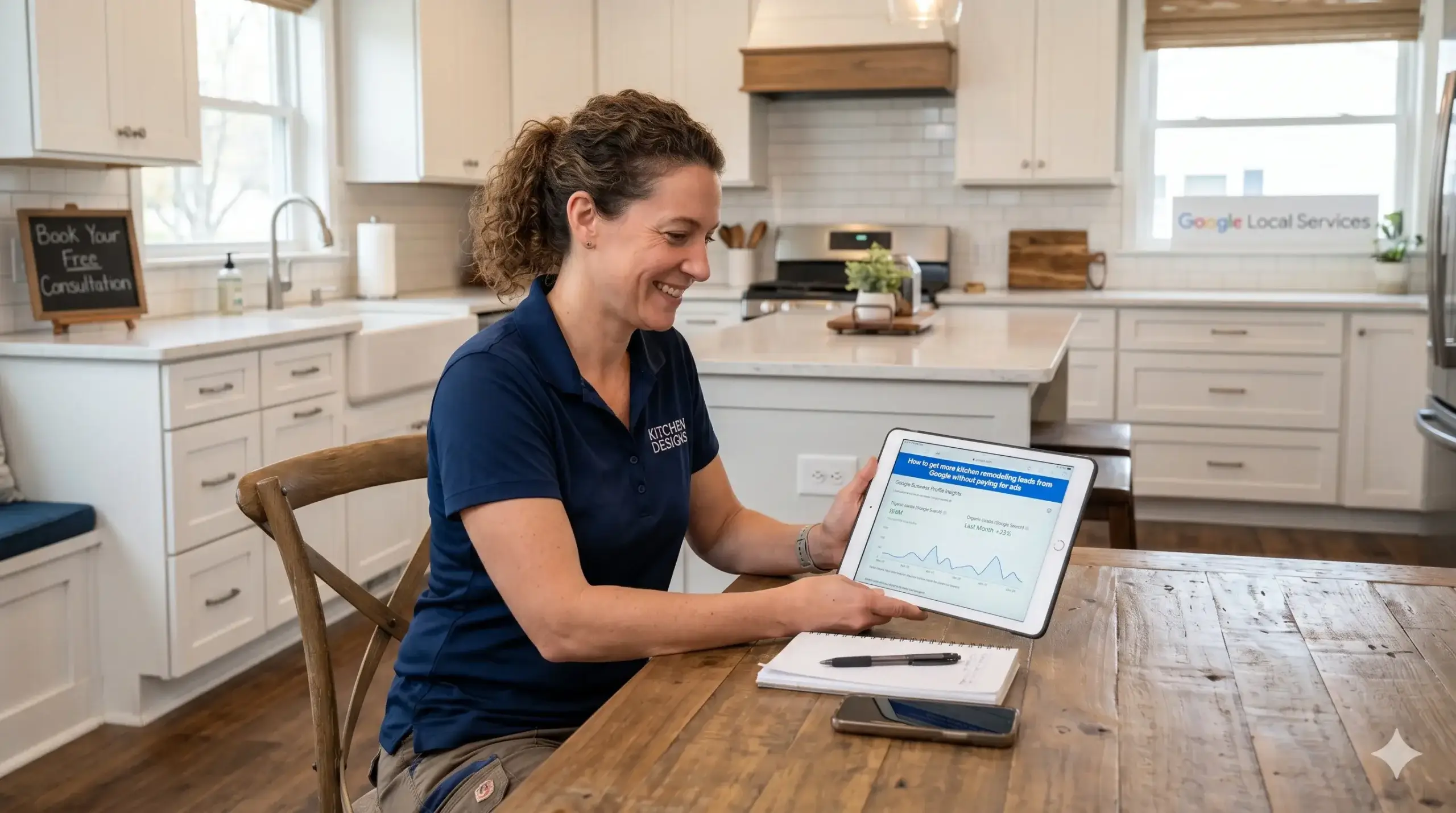
    How to Get More Kitchen Remodeling Leads From Google Without Paying for Ads

    You do great work. Your finished kitchens look amazing. Past clients love you. But when someone in your city types “kitchen remodeler near me” into Google, your phone stays quiet.

    You’ve probably been told the answer is Google Ads. Run a campaign, pay per click, and the calls will come. Maybe you’ve tried it. Maybe it worked for a bit, then stopped making sense the moment you did the math on what each lead actually cost you.

    Here’s what most kitchen remodeling businesses never get told: before you spend a single dollar on ads, your website has to earn those clicks. And right now, if your site is built the way most remodeling sites are built, it’s quietly pushing potential clients away — every single day.

    This post walks you through exactly what’s happening and what a proper kitchen remodeling website design actually looks like when it’s built to generate leads.


    Why Google Isn’t Showing Your Business to the People Who Need You

    Think of Google like the world’s most distrustful general contractor. Before it sends a homeowner your way, it wants proof — proof that your website is fast, easy to navigate, credible, and relevant to what that homeowner is searching for.

    Most kitchen remodeling websites fail that trust check. Not because the business isn’t good, but because the website was never built with Google’s criteria in mind. It was built to look nice. Those are two very different goals.

    When Google can’t confirm your relevance, it skips you — and shows your competitor instead. That competitor might not even do better work than you. They just have a site that signals the right things.


    Your Website Loads Too Slowly — and Most People Are Already Gone

    You have about three seconds. That’s the window between someone clicking your site and deciding whether to stay or hit the back button. If your pages are heavy with large photos, outdated code, or bloated plugins, you’re losing the majority of your visitors before they ever see your phone number.

    This isn’t a minor issue. For a kitchen remodeling business where a single job can be worth $30,000 to $80,000, even a handful of lost visitors per week adds up to serious money walking out the door.

    Speed problems usually come down to:

    • Images that were never compressed for the web
    • Hosting that was chosen for price, not performance
    • Website themes packed with features you don’t need or use
    • No caching or performance optimization in place

    The fix isn’t complicated, but it requires someone who knows what they’re looking at. Digital Trace audits site speed as a first step before anything else touches a kitchen remodeling client’s website.


    Google Doesn’t Know Enough About Your Business to Recommend You

    Imagine a homeowner asking their neighbor for a kitchen remodeler recommendation. The neighbor can only vouch for you if they actually know who you are, where you work, and what you specialize in. Google works the same way.

    Without the right technical signals on your site, Google can’t comfortably place you in front of someone searching “kitchen remodeling contractor in [your city].” It doesn’t know if you’re local, active, or even still in business.

    There’s a behind-the-scenes layer of code — called structured data or schema markup — that tells Google exactly who you are, what you do, and where you serve. Most kitchen remodeling websites don’t have it at all.

    💡 Pro Tip: One of the most common and costly mistakes kitchen remodeling websites make is having no location-specific content beyond a city name buried in the footer. Google needs to see service pages, content, and signals that are specifically tied to the areas you work in. If your site is one generic page trying to rank everywhere, it’s effectively ranking nowhere. Adding city-specific service pages — even just a few — can meaningfully shift where you show up in local search results.


    Visitors Land on Your Site and Don’t Know What to Do Next

    Here’s a scenario that plays out thousands of times a day across remodeling websites: A homeowner finds your site, scrolls through a few photos, likes what they see — and then closes the tab. Not because they weren’t interested. Because your site never told them what to do next in a way that felt easy.

    A kitchen remodel is a big investment. Homeowners are nervous about calling the wrong contractor. They want reassurance before they pick up the phone. Your website needs to do that reassurance work for you.

    That means:

    • Clear, specific calls-to-action that appear at the right moments (not buried at the bottom)
    • Real photos of completed kitchens — not stock images
    • Reviews and testimonials that feel authentic, not just a generic star rating
    • A simple, low-friction way to reach out (not a lengthy contact form)

    Most remodeling websites treat the homepage like a brochure. But a brochure doesn’t close the sale — it just hands the lead off to someone else. A properly built kitchen remodeling website design acts more like your best salesperson: it shows the right things, answers the right questions, and guides the right people toward contacting you.


    A Real Before-and-After: What Happens When You Fix the Foundation

    Take a kitchen remodeling company based in the Phoenix metro area — call them Summit Kitchen & Bath. They had a five-year-old website that looked decent enough but wasn’t ranking for anything useful. Most of their work came from word-of-mouth referrals and a handful of Houzz leads they were paying for.

    Their site had four problems Digital Trace sees constantly:

    • It loaded in over six seconds on mobile
    • There were no city-specific service pages — just one generic “service area” list
    • Google had no structured data to confirm what they did or where they worked
    • Their only call-to-action was a contact form at the bottom of the homepage

    After rebuilding their site around a proper kitchen remodeling website design — with fast hosting, local service pages, structured data, and conversion-focused layout — their organic traffic tripled within four months. More importantly, their inbound call volume went from roughly three to four calls per month from the website to twelve to fifteen. All without touching their ad spend.

    The work didn’t change. The reputation didn’t change. The website finally started doing its job.


    Not sure if your site has these issues? Get a free website audit — no obligation, just a clear picture of what’s costing you leads.


    Your Path to More Leads: What Actually Has to Happen

    There’s no single magic fix. But there is a clear order of operations that works for kitchen remodeling businesses who want leads from Google without relying on ads:

    1. Fix your site speed. Everything else depends on this. A slow site hurts your rankings and your conversions at the same time.

    2. Build pages around how homeowners actually search. That means pages for specific services (“kitchen cabinet refacing,” “kitchen layout redesign”) and specific areas you serve — not one catch-all page.

    3. Give Google the signals it needs. Structured data, accurate business information, and consistent local signals tell Google that your business is real, active, and relevant.

    4. Make your site work for conversion, not just for looks. Great photos matter. So does a clear, easy path to contact you. Both have to exist together.

    5. Let it compound. Unlike ads that stop the moment you stop paying, a well-built website keeps earning. Every month that passes with a properly optimized site, you build more authority and more visibility.

    If this sounds like more than you want to figure out alone, that’s exactly what Digital Trace handles for kitchen remodeling businesses. You can see how they approach it at their kitchen remodeling website design service page.


    Frequently Asked Questions

    Why am I not getting calls even though my website looks good?

    Looking good and performing well are two different things. A site can have beautiful photos and a clean layout but still fail to rank on Google, load too slowly on mobile, or give visitors no clear reason to call. The calls come when design, speed, and search visibility all work together.

    How do I know if my kitchen remodeling website is actually working?

    If you can’t answer “how many leads did my website generate last month,” your site isn’t working hard enough. A properly set up site tracks where visitors come from, what they do, and whether they contact you. If that data doesn’t exist, you’re flying blind.

    How long does it take to see results from a new website?

    Realistically, you’ll start seeing organic traffic movement within two to three months of a properly built and optimized site going live. Meaningful, consistent lead volume typically builds over four to six months. It’s not instant — but unlike ad spend, those results compound over time and don’t disappear the moment you stop paying.

    What makes a kitchen remodeling website different from a regular business website?

    Kitchen remodeling is a high-consideration, high-cost purchase. Homeowners spend weeks researching before they contact anyone. Your site needs to handle that research phase — showing process, materials, past work, and proof of quality — in a way that builds trust before a single conversation happens. A generic business website template can’t do that effectively.

    Do I really need a fast website if my customers are local?

    Yes — especially because they’re local. Most homeowners searching for a kitchen remodeler are on their phone, often mid-project or mid-inspiration. If your site takes more than three seconds to load on mobile, they’re already on your competitor’s page. Local searches happen on mobile more than on desktop, which makes speed more important, not less.

    How do I know if Digital Trace is the right fit before committing to anything?

    Start with the free audit. Digital Trace reviews your current site and shows you exactly what’s working, what isn’t, and what the realistic opportunity looks like. There’s no sales pitch, no pressure. Book your free website review here and get a clear answer before you decide anything.


    Ready to See What Your Website Is Actually Costing You?

    Every week your current site underperforms is a week you’re handing leads to competitors who figured this out before you did. The good news: this is entirely fixable, and the path is clearer than most people expect.

    Digital Trace works specifically with kitchen remodeling businesses to build fast, Google-optimized, conversion-focused websites that generate real leads — without ongoing ad spend to keep them running.

    Get your free website audit →

    No risk. No sales pitch. Just a clear picture of where your leads are going — and what it takes to get them back.

  • The Kitchen Remodeling Website Design Checklist Every Contractor Needs in 2026

    The Kitchen Remodeling Website Design Checklist Every Contractor Needs in 2026

    You do beautiful work. Your finished kitchens are stunning — the kind that stop people mid-scroll on Instagram. But when a homeowner in your area searches “kitchen remodeling contractor near me,” your business doesn’t show up. Or it does show up, they click your site, and then… nothing. No call. No quote request. Just silence.

    Most kitchen remodeling contractors assume the problem is they need “more marketing.” The real problem is almost always simpler: your website isn’t doing its job. It’s not built to convert visitors into leads. And until that’s fixed, every dollar you spend on ads or referrals is working at half strength.

    This checklist breaks down exactly what a high-performing kitchen remodeling website design needs in 2026 — and where most contractor sites are quietly bleeding leads every single day.


    1. Your Phone Number Isn’t Where It Needs to Be

    Here’s the scenario: a homeowner decides on a Tuesday night they’re finally ready to remodel their kitchen. They grab their phone, find your website, and start scrolling. Your number? Buried at the bottom of the page. By the time they find it, they’ve already clicked over to a competitor.

    This sounds small. It isn’t. Most people visiting a contractor’s website are ready to make contact — they just won’t work hard to do it. Your phone number and a “Get a Free Quote” button need to be visible without scrolling, on every device, from the moment the page loads.

    What a high-converting kitchen remodeling website includes above the fold:

    • Clickable phone number (tapping it on mobile should dial immediately)
    • A short, direct headline that confirms what you do and where you serve
    • One clear call-to-action button — not three competing options

    The difference between a number in the footer and a number at the top of the page can be the difference between a job booked and a job lost.


    2. Your Site Is Too Slow — And Homeowners Won’t Wait

    Think about the last time you waited more than five seconds for a webpage to load. You didn’t. You left. Your potential customers do the same thing — and they do it before they ever see your work, your credentials, or your contact info.

    A slow site happens because of large, uncompressed photo files (which kitchen remodeling sites are full of — those before/after shots are heavy), outdated hosting, or bloated website templates that weren’t built for speed. Google also uses page speed as a ranking signal, so a slow site doesn’t just lose visitors — it loses rankings too.

    The real cost of a slow kitchen remodeling website:

    • Homeowners leave before seeing your portfolio
    • Google ranks your site lower than faster competitors
    • Your ad spend goes further for contractors with faster sites

    The websites Digital Trace builds for kitchen remodeling businesses are optimized for speed from the ground up — compressed images, lean code, and hosting that’s built for performance, not just price.


    3. Your Website Looks Fine on a Desktop. That’s Not Where Your Customers Are.

    More than 60% of web traffic comes from mobile devices. Homeowners browsing between appointments, sitting on the couch, or standing in their current kitchen imagining what it could look like — they’re on their phones. If your site doesn’t load cleanly on a 6-inch screen, you’re losing them before they even get started.

    A website that isn’t built mobile-first isn’t just annoying to use — it’s a lead-killer. Buttons that are too small to tap, text that requires zooming, photos that don’t resize properly — each of these is a small friction point that adds up to a closed browser tab.

    Run this quick test right now:

    • Pull up your website on your own phone
    • Can you read everything without zooming?
    • Is the phone number one tap away?
    • Does the gallery load without lag?

    If you’re cringing at any of those answers, that’s revenue walking out the door every week.


    💡 Pro Tip: Your Portfolio Photos Are Probably Costing You Google Rankings

    Kitchen remodeling is a visual business. You need stunning photos. But most contractors upload raw, full-size images straight from their cameras — files that are 5MB or more each. One gallery page can add up to 40–50MB of total image weight.

    Google can’t “see” your photos the way a human does. It reads file names, alt text, and load speed. If your images are named “IMG_4892.jpg” and have no description attached, Google is essentially blind to them. Rename photos descriptively (“white-shaker-cabinet-kitchen-remodel-dallas.jpg”) and add a short alt text description to every image. This alone can meaningfully improve how your site ranks for local searches — and it’s a fix that takes an afternoon.


    4. Google Doesn’t Know Enough About Your Business to Trust It

    Imagine hiring a subcontractor you’ve never heard of, with no reviews, no certifications listed, and no clear service area. You’d hesitate. Google feels the same way about websites that don’t give it enough information to work with.

    There’s a set of behind-the-scenes signals — your business name, address, service area, and the type of work you do — that needs to be structured in a way Google can read and verify. Without this, Google ranks your site lower than competitors who have it set up correctly. The frustrating part: your site can look perfectly fine to a human visitor and still be missing all of these signals.

    What Google needs to confidently show your kitchen remodeling business in search results:

    • A verified and complete Google Business Profile
    • Consistent name, address, and phone number across your site and directories
    • Structured data that tells Google you’re a kitchen remodeling contractor serving specific cities
    • Local landing pages that mention the areas you actually work in

    This is one of the most common gaps we find when reviewing kitchen remodeling contractor websites — and it’s almost always fixable without rebuilding anything from scratch.


    5. Your Website Doesn’t Build Trust — It Just Lists Services

    Here’s an analogy every kitchen contractor will understand: a homeowner inviting someone into their home to do a full remodel isn’t just buying a service. They’re deciding whether to trust a stranger with their most-used room in the house. That decision doesn’t happen because of a services list — it happens because of proof.

    Your website needs to show that real homeowners trusted you with their kitchens and were thrilled they did. That means real project photos with before-and-afters (not just finished shots), written reviews with names attached, and some indication of how long you’ve been doing this. A wall of text about your “commitment to quality” does nothing. A photo of a jaw-dropping kitchen transformation with a five-star review underneath it does everything.

    Trust signals every kitchen remodeling website should have:

    • Before-and-after galleries organized by project type (small kitchens, open-concept, luxury, etc.)
    • Video testimonials or at minimum written reviews with the homeowner’s first name and city
    • Licenses, certifications, and any awards or industry memberships
    • A short “About” section with a real photo of you and your team — not stock images

    What a Real Turnaround Looks Like

    A kitchen remodeling contractor in the Pacific Northwest had been in business for 11 years. Solid reputation, consistent referrals, good work. Their website was built in 2019 by a nephew — it looked decent but hadn’t been touched since.

    The problems weren’t visible on the surface. Their site loaded in over 8 seconds on mobile. Their Google Business Profile was incomplete. Their photos had no alt text. Their service areas weren’t mentioned anywhere on the site. And their contact form sat below three paragraphs of text with no phone number in sight above the fold.

    After a full redesign focused on speed, local SEO structure, and conversion layout, the results came in over the following three months: mobile load time dropped to under 2 seconds, organic search traffic increased by over 70%, and inbound quote requests went from roughly 2–3 per month to 11–14 per month — without any paid advertising.

    The work was the same. The website finally matched the quality of the business behind it.


    Not sure if your kitchen remodeling website has these issues? Get a free website audit — no obligation, just a clear picture of what’s costing you leads.


    Your Path to More Leads: 5 Steps That Actually Work

    Step 1: Test your site on your own phone today. Pull it up cold, as if you were a homeowner who just found it for the first time. Note everything that feels slow, confusing, or buried.

    Step 2: Make your phone number impossible to miss. It should be at the top of every page, clickable on mobile, and linked to a clear call-to-action.

    Step 3: Audit your Google Business Profile. Make sure it’s verified, fully filled out, and matches exactly what’s on your website — name, address, phone, service area, and categories.

    Step 4: Update your project photos — and name them properly. Use descriptive file names and add alt text to every image. This is free and makes a real difference in local rankings.

    Step 5: Let a professional review what you can’t see. The biggest issues — slow load times, missing structured data, broken mobile layouts — aren’t visible to the naked eye. A professional audit finds them in minutes. See what’s costing you leads with a free review from Digital Trace.


    Frequently Asked Questions

    Why am I not getting calls from my website even though people are visiting it?

    Traffic without calls almost always means there’s a conversion problem — not a traffic problem. Your visitors aren’t finding your phone number quickly, they don’t see enough proof to trust you yet, or your site is losing them on mobile before they make a decision. These are fixable design and structure issues, not signs that you need to spend more on ads.

    How do I know if my kitchen remodeling website is actually working?

    If you can’t answer “how many quote requests came from my website last month,” your site probably isn’t working as hard as it should be. A working kitchen remodeling website has a clear way to track inbound leads — form submissions, call tracking, or both — so you always know exactly what it’s producing. Request a free audit and we’ll show you what your site is and isn’t doing.

    How long does it take to see results from a new website?

    For local organic search results, expect meaningful improvements within 60–90 days of launching a properly built site. That timeline assumes the site is built with the right structure, local SEO signals, and page speed from day one. Shortcuts extend that timeline — sometimes significantly.

    What makes a kitchen remodeling website different from a regular business website?

    Kitchen remodeling is high-ticket, high-trust, and heavily visual. Homeowners are investing $30,000–$80,000 and inviting contractors into their homes. Your website needs to do the trust-building work that a generic business site doesn’t — project galleries organized by scope, detailed testimonials, before-and-afters, and specific local service area pages. A one-size-fits-all template won’t do that job. That’s exactly why how Digital Trace builds kitchen remodeling websites looks different from a typical web design project.

    Do I really need a fast website if my customers are local?

    Yes — especially because they’re local. Local homeowners searching on their phones expect the same speed from a local contractor’s site as from any national brand. More importantly, Google uses page speed as a local ranking factor. A slow site in a local market means you’re losing ground to every nearby competitor who has it right.

    I’ve hired web people before and it didn’t help. Why would this be different?

    Most generic web agencies build sites that look good but aren’t built for lead generation in trade contractor industries. They don’t know what a kitchen remodeling homeowner needs to see before they call, what local SEO signals matter for your market, or how to structure a site that converts. The difference isn’t effort — it’s industry-specific knowledge applied from the first decision on.


    Your Kitchen Remodeling Business Deserves a Website That Works as Hard as You Do

    You’ve spent years building a reputation for quality work. Your website should reflect that — and more importantly, it should be actively bringing in new homeowners who are ready to hire.

    If you’re not sure whether your site is helping or hurting you, the fastest way to find out is a free audit. No sales pressure, no jargon — just a clear, honest look at what’s working, what’s broken, and what it would take to fix it.

    Book your free website audit today — and find out exactly what your kitchen remodeling website is costing you in leads every month.

  • Why Your Kitchen Remodeling Business Is Losing Clients to Competitors With Better Websites

    Why Your Kitchen Remodeling Business Is Losing Clients to Competitors With Better Websites

    You do great work. Your finished kitchens look incredible. Past clients rave about you. So why is the phone quieter than it should be — and why does that other remodeling company down the road seem to stay fully booked?

    Most kitchen remodeling business owners assume the answer is word-of-mouth, luck, or a bigger marketing budget. But the real answer is usually sitting right there on their screen: their website.

    The homeowners you want to reach — the ones ready to spend $30K, $50K, or $80K on a kitchen remodel — aren’t calling the first company they find. They’re comparing. They’re spending 10 to 15 minutes looking at two or three websites before they pick up the phone. And if your site doesn’t immediately signal quality, trust, and professionalism, they move on — often to a competitor whose work isn’t even as good as yours.

    This post breaks down exactly what’s costing you those leads, why it happens, and what a kitchen remodeling website design built to actually convert looks like.


    Your Website Is Being Compared the Same Way Homeowners Compare Kitchen Quotes

    Think about it from the homeowner’s perspective. They’re about to make one of the biggest investments in their home. They’re nervous. They want to hire someone they can trust completely.

    When they land on your website, they make a snap judgment — usually within a few seconds. If your site looks outdated, loads slowly, or makes it hard to find your portfolio or phone number, their brain tells them: this doesn’t feel right. They click the back button.

    They’re not being unfair. They’re using your website the same way you’d size up a subcontractor showing up to your job site in an unmarked van with no portfolio.

    A high-quality kitchen remodeling website design doesn’t just look good — it works like your best salesperson, running 24/7, qualifying leads and building trust before you ever pick up the phone.


    The 5 Website Problems Quietly Draining Your Lead Pipeline

    1. Your Site Loads Too Slowly — And Most Visitors Are Gone Before They See Your Work

    Homeowners searching for kitchen remodelers are often on their phones, browsing between appointments or during lunch breaks. If your site takes more than 3 seconds to load, a large portion of visitors leave before they ever see your before-and-after photos.

    This isn’t a minor inconvenience — it’s a lead funnel with a hole in the bottom. Every visitor who bounces before your site loads is a potential $40,000 project that went to your competitor.

    The fix isn’t complicated, but it requires someone who knows what they’re doing: optimized images, proper hosting, and clean code. Digital Trace builds every kitchen remodeling website with speed as a foundation — not an afterthought.


    2. Your Portfolio Isn’t Working Hard Enough

    Your kitchen transformations are your best sales tool. But if your portfolio is buried three clicks deep, organized in a generic grid with no context, or made up of blurry photos taken on a phone — it’s failing you.

    Homeowners want to see kitchens that look like theirs. They want to understand the scope of the work. They want captions that say “Whole-home gut renovation in Austin — semi-custom cabinetry, quartz countertops, added island.” Not just “Kitchen Remodel #4.”

    A well-structured portfolio tells a story and answers the homeowner’s real question: Can this company handle a project like mine?


    3. Google Doesn’t Know Enough About Your Business to Show It

    You might be the best kitchen remodeler in your city, but if Google isn’t confident in what you do and where you serve, it won’t put you in front of people searching for “kitchen remodeling contractor near me.”

    There’s a behind-the-scenes layer of your website — called structured data — that tells Google exactly what your business does, what areas you serve, what your reviews say, and how to display you in search results. Most kitchen remodeling websites don’t have this set up correctly (or at all).

    The result: your competitor with an average portfolio but a properly built site outranks you every time. Digital Trace fixes this as a standard part of every build.


    4. Your Contact Page Is Killing Conversions

    Most kitchen remodeling websites send interested visitors to a plain “Contact Us” page with a generic form and nothing else. No reassurance. No next-step explanation. No trust signal.

    A homeowner who was 80% ready to call just got cold feet. The page felt like a dead end, not an invitation.

    The best-converting kitchen remodeling sites tell visitors exactly what happens after they submit the form:

    • “We’ll call you within one business day”
    • “Tell us about your project and we’ll share relevant examples from our portfolio”
    • A photo of the owner or project manager — a real face, not a stock photo

    Small changes here consistently produce a noticeable lift in the number of people who actually reach out.


    5. Your Website Has No Local SEO Foundation

    “Kitchen remodeler in [City]” is one of the most valuable search phrases in your market. If your website doesn’t include content specifically built around the areas you serve — real content, not just a list of city names stuffed in the footer — you’re invisible to people searching for exactly what you offer.

    Local SEO for kitchen remodeling isn’t just about Google Business Profile. It’s about building pages and content that prove to Google you’re a real, established business serving real local customers. Without that foundation, you’re competing for national search traffic that doesn’t convert — or you’re not showing up at all.


    💡 Pro Tip

    One of the most common mistakes kitchen remodeling businesses make is using the same headline on every page: something like “Quality Kitchen Remodeling You Can Trust.” It sounds fine — but it tells Google nothing specific and does nothing to help a homeowner decide to call you.

    Every page on your site should have a specific, descriptive headline that reflects what that page is actually about. Your homepage might lead with your specialty (“Custom Kitchen Remodels for Mid-Century Homes in [City]”). A project page might open with the homeowner’s challenge and what you solved. Specificity builds trust — with Google and with your potential clients.


    What Happened When One Kitchen Remodeling Business Fixed These Problems

    Take a mid-sized kitchen remodeling company in the Pacific Northwest — let’s call them Summit Kitchen + Bath. They’d been in business for 11 years, had hundreds of happy clients, and consistently booked through referrals. But their website was seven years old, loaded slowly on mobile, and had a portfolio section that hadn’t been updated since 2020.

    When they audited their site traffic, they found that roughly 70% of visitors were leaving within 10 seconds. Calls from the website were nearly zero — all their new business came from past clients.

    After rebuilding their site with a focus on speed, a restructured project gallery, local SEO content for each of their key service areas, and a contact page with clear next steps — the picture shifted quickly. Within 90 days, organic traffic from Google had grown meaningfully, and they were receiving multiple inbound calls per week from the website alone. By month five, the site was generating a consistent portion of their monthly booked revenue — without increasing their ad spend.

    The work didn’t change. The results did — because the website finally matched the quality of what they were delivering.


    Not sure if your kitchen remodeling website has these issues? Get a free website audit — no obligation, just a clear picture of what’s costing you leads.


    Your Path to More Leads From Your Website

    You don’t need to become a tech expert. You just need to work with someone who understands both kitchen remodeling businesses and what makes a website actually generate calls. Here’s what that process looks like:

    1. Audit your current site — find out exactly what’s working, what’s broken, and what’s costing you leads every week. A free audit from Digital Trace gives you this without any commitment.
    2. Fix the performance issues — speed, mobile display, and basic technical structure. These are the foundation. Without them, nothing else matters.
    3. Build a portfolio that sells — organize your best projects in a way that speaks directly to the homeowners you want to attract. Use real photos, real captions, and real context.
    4. Create local content that ranks — pages and blog content that show Google (and homeowners) that you’re the established expert in your area.
    5. Optimize your contact experience — make it easy and reassuring to reach out. Remove friction. Add trust signals. Tell people what happens next.

    A kitchen remodeling website built by Digital Trace is designed from the ground up to do all five — and to keep generating leads long after launch.


    Frequently Asked Questions

    Why am I not getting calls from my website even though I rank okay on Google?

    Rankings get you visitors, but a poorly designed site doesn’t convert them into callers. If your site is slow, hard to navigate on mobile, has a weak portfolio, or a contact page that doesn’t reassure visitors — most of them will leave without calling. Ranking is step one. Converting that traffic into actual inquiries is a different problem, and it requires a site built with conversion in mind.

    How do I know if my kitchen remodeling website is actually working?

    A working website produces a consistent, measurable stream of inbound contact — calls, form fills, emails. If you can’t point to specific leads that came from your website in the last 30 days, it’s not working. A free audit from Digital Trace will show you exactly what your site is doing (or not doing) with real data, not guesswork.

    How long does it take to see results from a new website?

    Technical fixes and on-page improvements can show impact within weeks — especially if speed and mobile usability were significant problems before. SEO-driven traffic growth typically builds over 60–90 days as Google indexes the new content. Most kitchen remodeling businesses see meaningful improvement in lead volume within the first quarter after a proper rebuild.

    What makes a kitchen remodeling website different from a regular business website?

    Kitchen remodeling is a high-stakes, high-consideration purchase. Your website needs to do more trust-building work than most. That means a strong visual portfolio, local credibility signals, clear project process explanation, and contact pages that reassure rather than just collect information. A generic business template doesn’t account for any of that — and it shows.

    Do I really need a fast website if my customers are local and mostly find me through referrals?

    Referrals still check your website before they call — to confirm you’re real, see your work, and get a feel for whether you’re a good fit. A slow or outdated site can talk a warm referral out of calling you. And as referral networks plateau, a well-built site becomes the most reliable way to grow beyond your existing circle without spending on ads.

    I’ve paid for a website before and got nothing from it. Why would this be any different?

    Most web agencies build sites that look decent but have no SEO foundation, no conversion structure, and no understanding of how kitchen remodeling buyers actually behave online. Digital Trace specifically works with home service and remodeling businesses — the sites we build are engineered to rank for the searches your buyers actually use and to convert those visitors into callers. We can show you exactly what was missing from your last site.


    Stop Leaving Leads on the Table

    Every week your current website sits underperforming, homeowners in your area are finding your competitors instead of you. Not because those competitors are better — but because their websites do a better job of showing up and making the case.

    You’ve spent years building a kitchen remodeling business worth finding. Your website should make it easy to be found.

    Claim your free website audit — we’ll show you exactly what’s costing your kitchen remodeling business leads, with zero obligation and no sales pressure. Just a clear, honest look at what’s working and what isn’t.