Category: HVAC

  • How to Get More HVAC Leads Without Paying for Ads

    How to Get More HVAC Leads Without Paying for Ads

    Your HVAC truck is wrapped. You show up on time. Your reviews are solid. But your phone isn’t ringing the way it should — and the jobs you are getting feel random, not consistent.

    Most HVAC business owners assume the answer is running more ads. Spend money, get leads. But here’s what rarely gets said: if your website isn’t built to convert, you’re pouring fuel into a leaking tank. Ads drive people to your site — and a weak site sends them straight to your competitor.

    The businesses dominating HVAC searches in your area aren’t outspending you on ads. They’ve built a website that works like a 24/7 salesperson — one that shows up on Google, earns trust in seconds, and makes it easy to call. This post breaks down exactly what separates those websites from the rest, and what you can do about it.


    Your Website Is Like Your HVAC System — If It Isn’t Running Right, Nothing Works

    Think about it this way: a homeowner calls you because their AC stopped working. You show up and find the unit is running — but it’s undersized, the ducts are leaking, and the thermostat is miscalibrated. The whole system is working against itself.

    That’s what most HVAC websites look like under the hood.

    The design might look fine on the surface. But if the site loads slowly, doesn’t show up in local searches, or buries your phone number three scrolls deep — it’s leaking leads every single day.

    The fix isn’t a full rebuild in most cases. It’s knowing where the problems are.


    Why Your HVAC Website Isn’t Showing Up on Google

    When someone searches “AC repair near me” or “HVAC company in [your city],” Google decides in milliseconds who shows up on page one. That decision comes down to a few factors — and most HVAC websites fail at almost all of them.

    Here’s what Google is looking for:

    • A fast-loading site — if your pages take more than 3 seconds to load, Google ranks you lower. More importantly, the customer already left.
    • Location relevance — Google needs clear signals that your business serves specific cities and neighborhoods. Generic content doesn’t cut it.
    • Consistent business information — your name, address, and phone number need to match exactly across your website, Google Business Profile, and every directory you’re listed on.
    • Real content about your services — thin pages with five sentences about “AC repair” give Google almost nothing to work with.

    The HVAC businesses showing up in the local map pack aren’t lucky. Their websites are telling Google exactly who they are, where they work, and what they do — repeatedly and clearly.


    Why Visitors Leave Without Calling You

    Getting people to your website is only half the battle. What happens in the next 10 seconds determines whether they call — or hit the back button.

    Most HVAC websites make the same mistakes:

    • The phone number isn’t visible immediately. On mobile, a visitor shouldn’t have to scroll or search. It should be one tap, at the top of the screen, always.
    • The page is cluttered. Too many options, too much text, no clear “next step.” Visitors freeze and leave.
    • There’s no trust built in the first seconds. No reviews visible. No “licensed and insured” badge. No sense of who you are. A homeowner making a decision about who to let into their house needs to feel confident — fast.

    The best HVAC websites understand this. They’re built around one goal: get the visitor to call or submit a form. Everything else is noise.


    💡 Pro Tip: One of the most common mistakes on HVAC websites is using a generic contact form as the only conversion option. Most homeowners with an urgent problem — a broken AC in August, a furnace out in February — aren’t filling out a form and waiting. They want to call right now. Your website should have a prominent tap-to-call button visible on every page, especially on mobile. If a visitor has to work to find your number, most won’t bother.


    The Hidden Cost of a Slow Website

    Most HVAC business owners don’t know their site’s load speed — and they don’t realize what it’s costing them.

    Here’s the reality: studies across industries consistently show that more than half of mobile visitors leave a site that takes longer than 3 seconds to load. For HVAC, where most searches happen on a phone during an emergency, that number matters enormously.

    A slow site doesn’t just frustrate visitors. Google sees that people are bouncing quickly and interprets it as a signal that your site isn’t useful — which pushes your rankings down further.

    The culprit is usually oversized images, cheap hosting, or a bloated website theme. These aren’t hard to fix, but they have to be identified first.

    A properly built HVAC website loads in under 2 seconds. That’s not a luxury — it’s the baseline for competing.


    Not Sure If Your Website Has These Problems?

    Digital Trace offers a free website audit — no obligation, just a clear picture of what’s costing you leads. They’ll look at your site’s speed, local SEO signals, mobile experience, and conversion setup, and show you exactly what’s working and what isn’t.

    Get Your Free HVAC Website Audit →


    What a High-Performance HVAC Website Actually Looks Like

    The difference between a website that generates consistent leads and one that sits there doing nothing isn’t about having a flashy design. It’s about getting the fundamentals right.

    FactorTypical HVAC WebsiteHigh-Performance HVAC Website
    Leads per month2–5 (inconsistent)15–30+ (predictable)
    Load speed6–10 secondsUnder 2 seconds
    Mobile experienceBuried CTA, hard to navigateTap-to-call, clean layout
    Google visibilityPage 2–3, no map packPage 1, local map pack
    Trust signalsMissing or outdatedReviews, licenses, guarantees visible
    Service pagesOne generic “Services” pageIndividual pages per service and city
    Contact optionsForm onlyTap-to-call + form + live chat option

    The businesses generating 20+ leads per month from their website aren’t doing anything magical. They’ve built a site that loads fast, shows up for the right searches, and makes it easy — and obvious — to call.


    A Real-World Example: What Changes When You Get This Right

    Take an HVAC company serving a mid-sized metro area — let’s call them Metro Comfort Heating & Air. They’d been in business for 11 years, had solid reviews, and a decent reputation locally. But their website was built by a nephew six years ago and hadn’t been touched since.

    The problems:

    • The site loaded in 8 seconds on mobile
    • They had one page covering all their services with about 200 words of text
    • Their phone number was in the footer only
    • They weren’t showing up in the local map pack for their main service areas
    • Google Business Profile and website had different phone numbers listed

    What changed:

    After a full rebuild focused on HVAC website design best practices, they had dedicated pages for each service (AC repair, furnace installation, tune-ups, etc.), individual city pages for the five areas they served, a prominently placed tap-to-call button, and a site that loaded in under 1.8 seconds.

    The result:

    Within 90 days, they were ranking on page one for their primary keywords. Monthly website leads went from an average of 4–6 to consistently 22–28. More importantly, those leads were from people actively searching for HVAC help in their area — not tire-kickers from a broad ad campaign.

    That kind of shift doesn’t require a massive marketing budget. It requires fixing the right things.


    Your Path to More Leads: What to Do Next

    You don’t need to overhaul everything at once. Start by fixing the biggest leaks first.

    Step 1: Test your site speed. Go to Google’s PageSpeed Insights (free tool) and enter your website URL. If you’re scoring below 70 on mobile, that’s a priority fix.

    Step 2: Check your phone number placement. Pull up your website on your phone. Is your number visible without scrolling? Is it a tap-to-call link? If not, that’s one of the fastest fixes available.

    Step 3: Look at your service pages. Do you have individual pages for each service you offer? Do you have pages targeting the specific cities you work in? If everything is crammed onto one page, Google can’t rank you for specific searches.

    Step 4: Audit your Google Business Profile. Make sure your name, address, and phone number exactly match what’s on your website. Upload recent photos. Respond to reviews. This directly affects your map pack ranking.

    Step 5: Get a professional set of eyes on it. The issues that cost HVAC businesses the most leads are usually the ones they can’t see. A proper audit will surface problems you didn’t know existed — and show you exactly what fixing them is worth.


    Ready to Stop Losing Leads You’ve Already Earned?

    Every day your website isn’t performing, potential customers are finding your competitors instead. They’re not better at HVAC than you — they just have a website that works.

    Digital Trace specializes in HVAC web design services built specifically for heating and cooling businesses. They don’t do generic websites. They build sites engineered to rank, convert, and generate leads consistently — without relying on a paid ad budget to do it.

    The free audit takes about 15 minutes and costs you nothing. You’ll walk away knowing exactly what’s holding your website back and what it would take to fix it.

    Claim Your Free HVAC Website Audit from Digital Trace →

    No pressure, no pitch. Just a clear look at what your website is doing — and what it could be doing instead.
  • Why Your HVAC Website Isn’t Generating Calls (And How to Fix It)

    Why Your HVAC Website Isn’t Generating Calls (And How to Fix It)

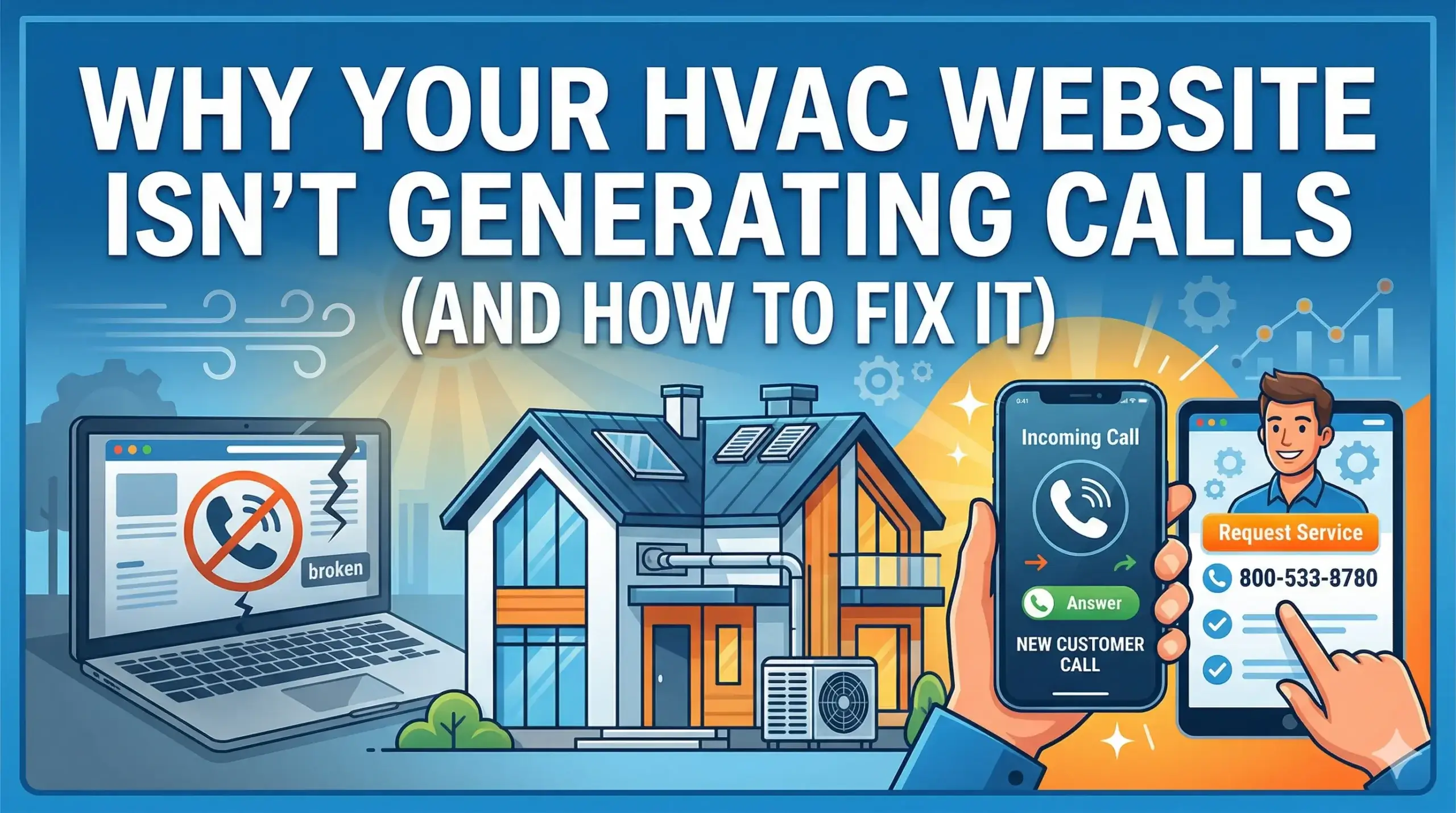
    For most HVAC business owners, a website is often viewed as a digital brochure. You paid for it, it looks “fine,” and it lists your services. However, if your phone isn’t ringing despite having a web presence, your website isn’t an asset—it’s a liability.

    In the high-stakes US heating and cooling market, customers don’t browse; they search with urgency. If your site doesn’t load instantly, display perfectly on a smartphone, or build immediate trust, that potential customer has already clicked “back” and called your competitor.

    At Digital Trace, we see the same technical gaps across dozens of heating and cooling websites. Here is why your current site is failing and the professional benchmarks required to fix it.

    1. The Mobile-First Performance Gap

    Google transitioned to mobile-first indexing years ago. This means Google evaluates the mobile version of your site to determine your rank. If your AC repair website is a “shrunken down” version of your desktop site, you are being penalized.

    • The Fix: Your site must use responsive design, but more importantly, it must prioritize “thumb-friendly” navigation. Emergency service buttons and “Click-to-Call” icons should be persistent and reachable within a split second of landing.

    2. Speed is a Conversion Killer

    Page speed isn’t just a technical metric; it’s a psychological one. A delay of just three seconds increases bounce rates by 90%. In the HVAC industry, where users are often searching in a hot or freezing house, their patience is even lower.

    • The Business Benefit: Improving your Core Web Vitals (Google’s speed benchmarks) reduces your cost-per-lead. When you pay for Google Ads, a faster site ensures you aren’t paying for clicks that bounce before the page even loads.

    3. Lack of “Local Authority” Signals

    To rank for “hvac services near me” and local service terms, your site needs more than just a list of cities. You need localized technical SEO.

    • Schema Markup: This is code that tells search engines exactly what you do, your service area, and your ratings. Without it, you’re invisible to the “near me” searches that drive the most profitable emergency calls.
    • Trust Signals: Top HVAC websites prominently feature NATE certifications, BBB ratings, and real-time Google Reviews. If these are buried on a “Contact” page, you are losing the trust battle.

    4. ADA Compliance and Legal Liability

    In the US, website accessibility (ADA compliance) is no longer optional. Small businesses are increasingly targeted by “drive-by” lawsuits for websites that aren’t screen-reader friendly.

    • The Professional Edge: A high-end hvac web design agency ensures your site meets WCAG 2.1 standards. This doesn’t just protect you legally; it expands your market reach to all potential customers.

    Professional Agency vs. DIY/Template Sites

    FeatureDIY / Cheap TemplatesDigital Trace Professional Design
    Load SpeedBloated code; 4+ secondsOptimized assets; Under 2 seconds
    SEOBasic metadata onlyAdvanced Schema & Local SEO Silos
    ConversionPassive contact formsActive CRO & Click-to-Call
    ComplianceRarely ADA compliantFull ADA & Privacy Standard Audit
    MobileScaled-down desktopMobile-first UI/UX

    5. High-End Aesthetics Meet Technical Precision

    A great HVAC website shouldn’t just look “clean.” It should guide the user toward a single goal: booking a technician. This is where most HVAC website design companies fail—they focus on the visual but forget the “Digital Trace” left by the user.

    Professional hvac web design services analyze heatmaps to see where users click and where they drop off. We use high-fidelity imagery and clear typography to communicate authority, ensuring that your company looks like the market leader you are.

    Optimize Your Digital Trace

    Your website should be your hardest-working employee. If it isn’t generating a measurable ROI, it’s time to stop guessing and start optimizing.

    Ready to see why your competitors are outranking you?

    Visit Digital Trace today for a Free Website Audit. We’ll analyze your speed, SEO, and conversion path to show you exactly how to turn your site into a lead-generation powerhouse.

    [Get My Free HVAC Website Audit]

  • Scaling Your Air Duct Cleaning Business with a Specialized Website Strategy

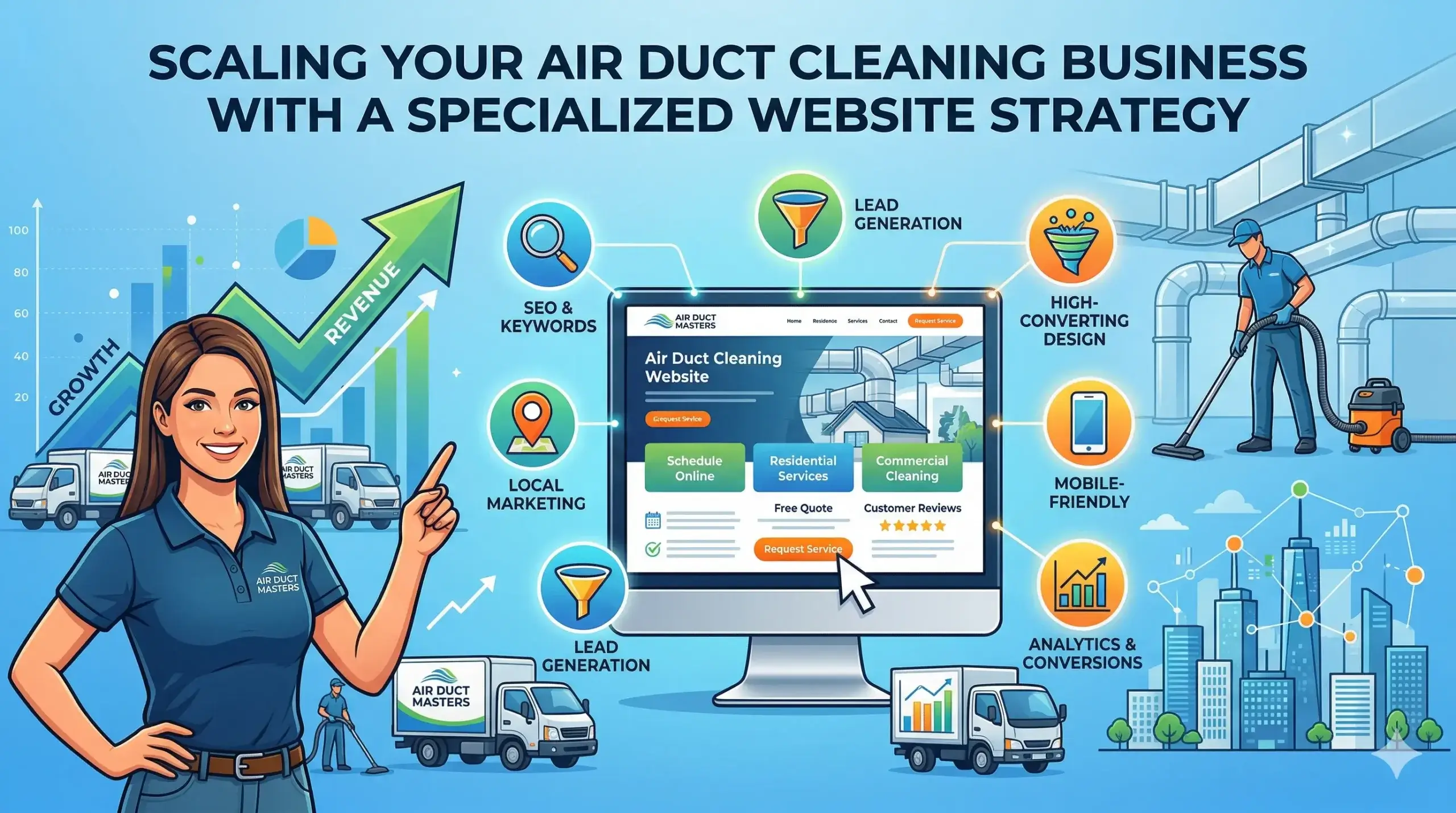
    Scaling Your Air Duct Cleaning Business with a Specialized Website Strategy

    In the air duct cleaning and HVAC industry, your website is often the first “technician” a customer meets. If that technician is slow, unresponsive, or looks unprofessional, the homeowner will call your competitor before they even see your pricing.

    For US small business owners, the gap between a “digital brochure” and a lead-generation machine is the difference between stagnation and scaling. A specialized hvac website design isn’t just about looking modern; it is about engineering a path from a Google search to a scheduled service call.

    Why “Good Enough” is Costing Your HVAC Business Revenue

    Many air duct cleaning companies rely on generic templates that fail to address the specific intent of their customers. When a homeowner searches for “ac repair website” or “air duct cleaning near me,” they are usually in a state of high intent or urgency.

    If your site takes more than three seconds to load, you lose 53% of mobile visitors. In the context of hvac services, speed isn’t just a technical metric—it’s a customer service metric. A slow site tells the customer that your business is inefficient. To scale, you need a platform built for conversion, not just a placeholder on the web.

    The Anatomy of the Best HVAC Websites

    The top hvac websites in the US market share three critical pillars that Digital Trace integrates into every build:

    1. Mobile-First Indexing & Responsive UX

    The majority of HVAC leads are generated via mobile devices—often by homeowners standing in their mechanical rooms. We prioritize mobile-first indexing to ensure your site ranks higher on Google and provides a seamless “click-to-call” experience. If your air conditioning website isn’t optimized for a thumb-driven interface, you are handing leads to your competitors.

    2. Local SEO and Authority Architecture

    Ranking for hvac website design companies is one thing, but ranking in your specific service area requires a deep dive into Local SEO. This includes:

    • Schema Markup: Telling search engines exactly what services you offer (e.g., duct sealing, dryer vent cleaning).
    • Localized Service Pages: Creating dedicated landing pages for every city you serve to dominate local map packs.
    • ADA Compliance: Ensuring your site is accessible to all users, which is a critical legal and SEO standard in the US.

    3. Trust Signals and Conversion Optimization

    High-end aesthetics must be backed by social proof. We integrate real-time reviews, “Before & After” galleries of duct cleaning projects, and clear certifications. These elements transform a standard heating and cooling website into an authoritative brand that justifies premium pricing.

    The Digital Trace Angle: Performance Meets Aesthetics

    At Digital Trace, we believe that hvac website design should be as precise as the equipment you use. We move beyond generic layouts to provide:

    • Custom API Integrations: Sync your website directly with your CRM (like Housecall Pro or Jobber) to allow for real-time booking.
    • Core Web Vitals Optimization: We optimize LCP (Largest Contentful Paint) and CLS (Cumulative Layout Shift) to ensure your site passes Google’s strictest performance tests, giving you a competitive edge in search rankings.
    • Conversion-Centric Copywriting: We replace industry jargon with value-driven language that speaks to the homeowner’s needs: indoor air quality, energy efficiency, and family health.

    Choosing a Partner vs. a Vendor

    There are many hvac website design companies, but scaling requires a partner who understands the HVAC lifecycle. A generalist agency doesn’t understand the seasonality of air conditioning or the specific search behavior of a homeowner worried about mold in their vents.

    Investing in professional hvac web design agency services is an investment in your company’s infrastructure. It is the “digital trace” you leave behind—and it should lead customers straight to your door.

    Optimize Your Growth Strategy

    Your current website is either an asset or a liability. Is it generating the ROI your business deserves?

    [Get a Free Website Audit from Digital Trace]
    Let’s analyze your current performance and show you exactly how a specialized HVAC strategy can turn your website into your most productive employee.

  • Why Your HVAC Contractor Website Isn’t Ranking on Page 1 (And How to Fix It)

    Why Your HVAC Contractor Website Isn’t Ranking on Page 1 (And How to Fix It)

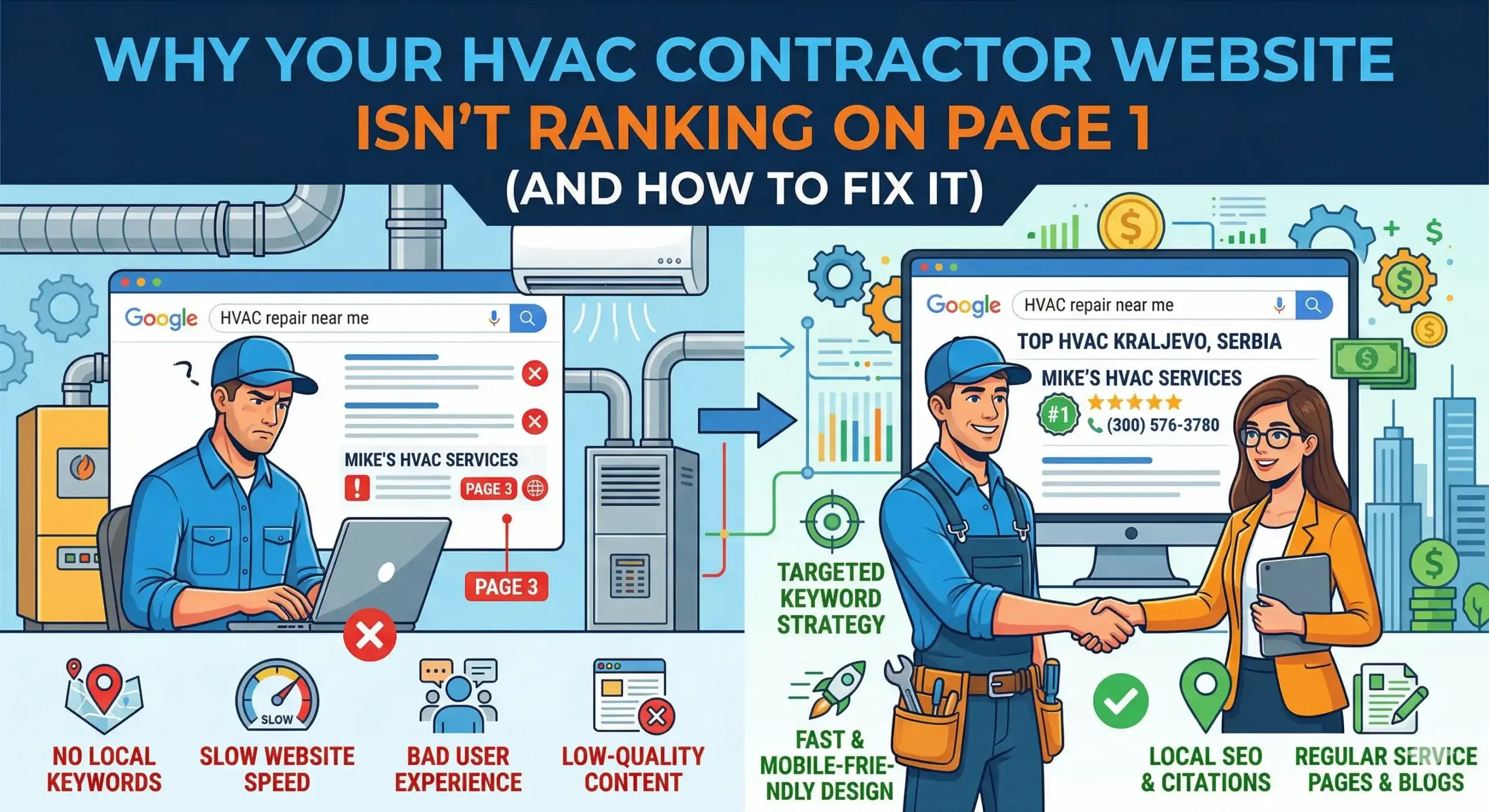
    In the HVAC industry, Page 2 of Google is a graveyard. When a homeowner’s AC fails in a heatwave or a furnace quits in mid-January, they don’t scroll through pages of search results. They click the first three companies that look professional, trustworthy, and ready to help.

    If your phone isn’t ringing, your “digital trace” is likely invisible to your target market. Having a basic hvac website is no longer enough; you need a high-performance sales engine. Most heating and cooling websites fail not because the owner lacks expertise, but because the site fails to meet the rigid technical and psychological standards required by Google and US consumers.

    Here is why your site is lagging and the strategic shifts needed to claim Page 1.

    1. Failure to Optimize for Mobile-First Indexing

    Google primarily uses the mobile version of your content for indexing and ranking. Many hvac company websites were built for desktops, with mobile being an afterthought.

    • The Problem: If your site takes more than three seconds to load on a 4G connection, or if buttons are too close together for a thumb to click, your bounce rate will skyrocket.
    • The Fix: Transition to a responsive framework. Ensure your “Emergency Service” button is “sticky” at the bottom of the mobile screen. Speed is a ranking factor; optimizing image delivery and leveraging browser caching is a prerequisite for any hvac web design agency worth its salt.

    2. Low “Trust Signals” and Poor User Experience (UX)

    The best hvac websites do more than list services; they build immediate authority. Homeowners are inviting a stranger into their homes; your website must bridge that trust gap.

    Technical Trust Markers

    • SSL Encryption: If your site says “Not Secure” in the browser bar, Google will penalize your ranking.
    • ADA Compliance: In the US market, ensuring your site is accessible to users with disabilities isn’t just a best practice—it’s a legal necessity that prevents costly lawsuits and improves overall SEO.

    Visual Trust Markers

    • Real Imagery: Stock photos of generic technicians hurt your brand. Use high-resolution photos of your actual branded vans and team.
    • Social Proof Integration: Don’t just link to Yelp. Embed live Google Reviews directly onto your ac repair website to show real-time reliability.

    3. Lack of Local Intent and Schema Markup

    You aren’t competing with HVAC companies nationwide; you’re competing with the guy three miles down the road. Generic hvac web design services often miss the “Local” in Local SEO.

    • Local Inventory: Your site needs dedicated landing pages for every city you service. A page optimized for “AC Repair in [City Name]” will always outrank a generic “Services” page.
    • Schema Markup: This is backend code that tells search engines exactly what your business is. It identifies your phone number, service area, and ratings so Google can display them as “Rich Snippets” in search results. Without this, you are invisible to the “Map Pack.”

    4. Content That Doesn’t Answer the “Emergency”

    Google rewards “Search Intent.” When someone searches for air conditioning website help, they usually have a specific problem (e.g., “AC blowing warm air”).

    If your content is thin or overly technical, you lose the lead. To rank among the top hvac websites, your content must:

    1. Identify the symptom.
    2. Explain the potential cause in simple terms.
    3. Provide a clear “Book Now” solution.

    5. The “Digital Trace” Advantage: Aesthetics vs. Performance

    Many hvac website design companies focus on making a site look “nice.” At Digital Trace, we know that a beautiful site that doesn’t rank is a liability, not an asset.

    High-end aesthetics must be balanced with technical performance. We focus on the “Core Web Vitals”—the specific metrics Google uses to measure a user’s experience. If your current site has high “Cumulative Layout Shift” (elements jumping around as they load), Google will suppress your ranking, regardless of how good your logo looks.


    Audit Your Digital Footprint

    Your website should be your hardest-working salesperson, generating leads while you’re out on service calls. If it’s not appearing on Page 1, you are actively handing market share to your competitors.

    Is your website working for you, or against you?

    Stop guessing why your rankings are stagnant. Visit Digital Trace today for a comprehensive website audit. We will analyze your current performance, identify the technical bottlenecks, and show you exactly how to optimize your digital trace for maximum ROI and growth.

    Get Your Free HVAC Website Audit at Digital Trace

  • HVAC Website Builder vs. Professional Agency: What’s the Real ROI?

    HVAC Website Builder vs. Professional Agency: What’s the Real ROI?

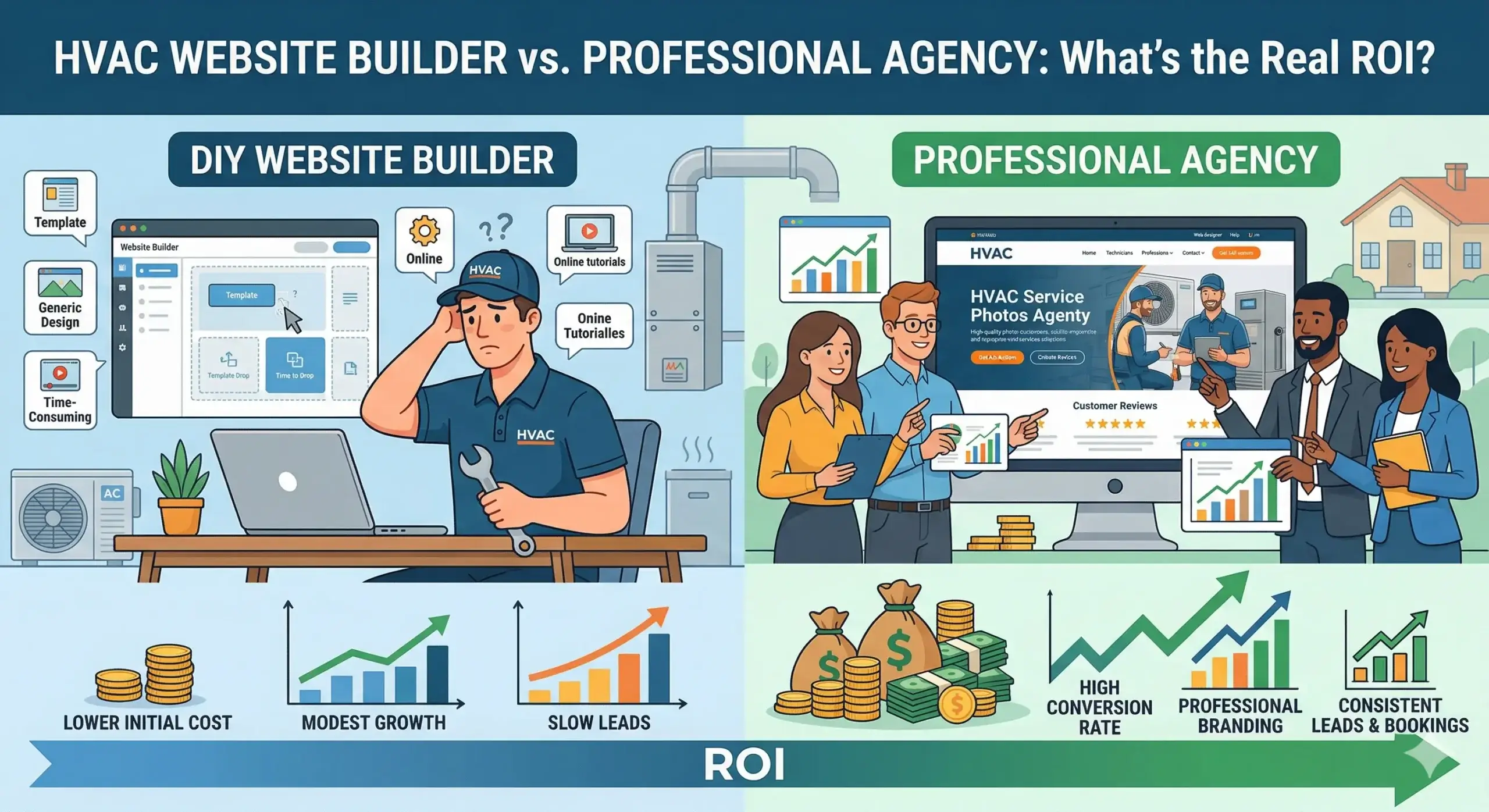
    For many US-based HVAC business owners, the appeal of a “DIY” website builder like Wix, Squarespace, or GoDaddy is obvious: it’s cheap, fast, and looks “good enough.” You pick a template, drag in a few photos of your fleet, and launch.

    But six months later, the phone isn’t ringing. Your site is buried on page four of Google, and the few visitors you do get leave within seconds.

    In the high-stakes world of residential and commercial service, your website isn’t a digital brochure—it’s your 24/7 dispatcher. If that dispatcher is slow, confusing, or invisible, you aren’t saving money; you’re losing market share. To understand the real ROI of hvac website design, we have to look past the monthly subscription fee and into the mechanics of lead generation.

    The “Drag-and-Drop” Ceiling: Why Builders Stunt Growth

    Website builders are designed for generalists. They prioritize ease of use over technical performance. For a local service business, this creates three critical “performance ceilings”:

    1. Bloated Code and Slow Load Times

    Generic builders use heavy, “one-size-fits-all” code to make drag-and-drop possible. This results in slow page speeds. In the HVAC industry, speed is a conversion factor. If a homeowner’s AC dies in a 90-degree heatwave, they won’t wait five seconds for your “About Us” page to load. They will click the next result in the Google Map Pack.

    2. The SEO “Black Box”

    While builders offer basic SEO tools, they often lack the “technical depth” required for competitive hvac services. Professional agencies implement advanced Schema Markup (LocalBusiness data), which tells Google exactly which zip codes you service and what your average rating is. Without this, you’re fighting for visibility with one hand tied behind your back.

    3. Lack of True Mobile-First Architecture

    Most builders “respond” to mobile screens, but they aren’t built for them. Mobile-first indexing is the standard for Google in the US. A professional hvac web design agency builds for the thumb—placing “Click to Call” buttons and “Schedule Now” forms in high-conversion zones that templates simply can’t accommodate.

    Precision Engineering: The Digital Trace Approach

    At Digital Trace, we view hvac company websites as high-performance machinery. Just as you wouldn’t install a generic, unbranded furnace in a 5,000-square-foot home, you shouldn’t install a generic template for your business.

    Technical Performance as a Revenue Driver

    We focus on the “Core Web Vitals”—a set of metrics Google uses to measure user experience. High scores in these areas lead to higher rankings. When we provide hvac website design, we ensure:

    • LCP (Largest Contentful Paint): Ensuring your main offer is visible in under 2.5 seconds.
    • CLS (Cumulative Layout Shift): Preventing annoying shifts in content that cause users to click the wrong button.

    Local SEO and ADA Compliance

    The US market has specific legal and algorithmic requirements. ADA Compliance (Web Content Accessibility Guidelines) isn’t just about avoiding lawsuits; it’s about ensuring every potential customer, regardless of ability, can book your services. Furthermore, we optimize for Local SEO, ensuring your “AC repair website” appears exactly when a local user searches for “emergency cooling repair near me.”

    Calculating the ROI: The Math of Professional Design

    Let’s look at the numbers.

    • The DIY Route: Costs $30/month. If it generates 2 leads a month with a 10% closing rate, and your average job is $5,000, your monthly revenue from the site is $1,000.
    • The Professional Route: Requires a larger upfront investment. However, through expert hvac web design services, your site now ranks in the top 3 of the Map Pack. You generate 20 leads a month. With a professional UI/UX, your closing rate moves to 20%. Your monthly revenue is now $20,000.

    The “expensive” agency isn’t a cost; it’s a multiplier. The best hvac websites aren’t just pretty; they are engineered to reduce the cost per lead (CPL) and increase the lifetime value of a customer.

    Does Your Current “Digital Trace” Command Authority?

    A website that looks outdated or functions poorly tells a customer that your service might be outdated or poor, too. In an industry built on trust and technical expertise, your digital presence must mirror the quality of your field tech’s work.

    Top hvac website design companies don’t just give you a site; they give you a competitive advantage. If your current site is a liability rather than an asset, it’s time to shift from a “builder” mindset to an “authority” mindset.

    Optimize Your Growth

    Is your website helping you scale, or is it holding you back? Contact Digital Trace today for a free website audit. Let’s analyze your current performance and show you exactly how much revenue you’re leaving on the table.

  • HVAC Web Design: 7 Must-Have Features for High-Converting Service Pages

    HVAC Web Design: 7 Must-Have Features for High-Converting Service Pages

    In the competitive US residential services market, your website is no longer just a digital business card; it is your 24/7 sales representative. Most heating and cooling websites suffer from a “leaky bucket” syndrome—spending thousands on local ads only to send traffic to a site that fails to convert.

    If your hvac website design isn’t actively generating booked appointments, it’s a liability. To dominate your local territory in 2026, your site must balance high-end aesthetics with “trust architecture.”

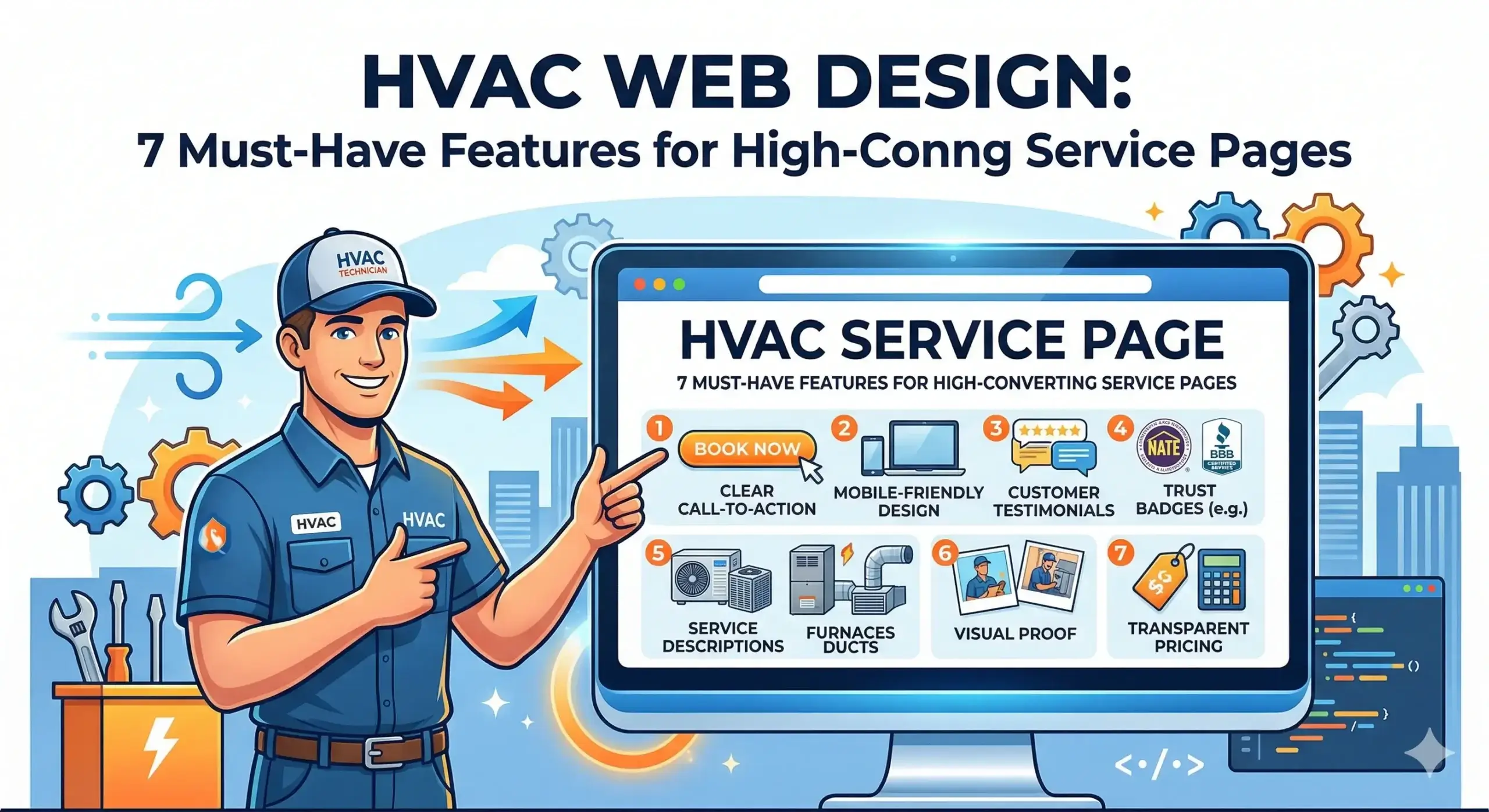
    Here are the seven non-negotiable features every high-converting HVAC service page needs.


    1. Instant Booking & Low-Friction Lead Capture

    Modern homeowners expect Amazon-level convenience. If a customer has to search for a “Contact Us” page or fill out a 10-field form to get an ac repair website quote, they will bounce to a competitor.

    • The Fix: Integrate direct scheduling tools (like Housecall Pro or ServiceTitan) directly above the fold.
    • The Business Benefit: Reducing the steps to book an appointment directly correlates with a lower cost-per-acquisition (CPA).

    2. Localized SEO Architecture & Schema Markup

    For an hvac web design business, visibility is about more than just keywords. You need technical “Local Business” Schema markup so Google and AI search engines understand exactly which zip codes you service.

    • The Fix: Create dedicated landing pages for each service area (e.g., “Furnace Repair in Chicago”) rather than one generic service page.
    • Technical Depth: Use Geo-coordinates in your metadata to ensure your air conditioning website appears in the “Map Pack” and AI-generated local recommendations.

    3. Mobile-First Performance (Core Web Vitals)

    Over 70% of HVAC leads are generated on mobile devices, often during an emergency. If your hvac website takes more than 2.5 seconds to load (the LCP threshold), you’ve lost the lead.

    • The Digital Trace Angle: We don’t just build “pretty” sites; we optimize for performance. Fast load times are a ranking factor and a psychological trust signal. A slow site implies a slow service response.

    4. Trust Signals: Real-Time Social Proof

    Stock photos of “happy families” don’t sell HVAC services in 2026. US consumers are skeptical of generic branding.

    • The Fix: Embed live Google Review widgets and high-resolution, original photos of your branded trucks and uniformed technicians.
    • AEO Strategy: Use structured data for “AggregateRating” to ensure your 5-star rating appears directly in search results and AI snapshots.

    5. ADA Compliance & Accessible Design

    In the US, web accessibility is both a legal necessity and a conversion booster. Top hvac websites ensure that senior citizens or those with visual impairments can easily navigate their services.

    • The Fix: High-contrast buttons, screen-reader compatibility, and keyboard-navigable menus.
    • The Business Benefit: ADA compliance protects you from litigation while expanding your reachable audience.

    6. Visual Proof & Case Studies

    Heating and cooling is a “invisible” service until it fails. Use your hvac company websites to make the value visible.

    • The Fix: Include a “Before & After” gallery of complex installations. Documenting a messy attic-to-clean-install transition proves your team’s professionalism better than any marketing copy.

    7. The “Above the Fold” Value Proposition

    You have roughly three seconds to answer three questions for a visitor:

    1. What do you do?
    2. Where do you do it?
    3. How do I book you?
    • The Fix: Your H1 should be specific (e.g., “Professional AC Repair & Installation in Dallas”). Your CTA should be a high-contrast button like “Get Emergency Service Now.”

    Optimize Your Digital Trace

    Your website is either an engine for growth or a roadblock to your success. Is your current “digital trace” helping you win more local jobs, or is it handing them to your competitors?

    Visit Digital Trace today for a free HVAC website audit. Let’s turn your site into a high-performance lead machine.