Category: Auto Repair

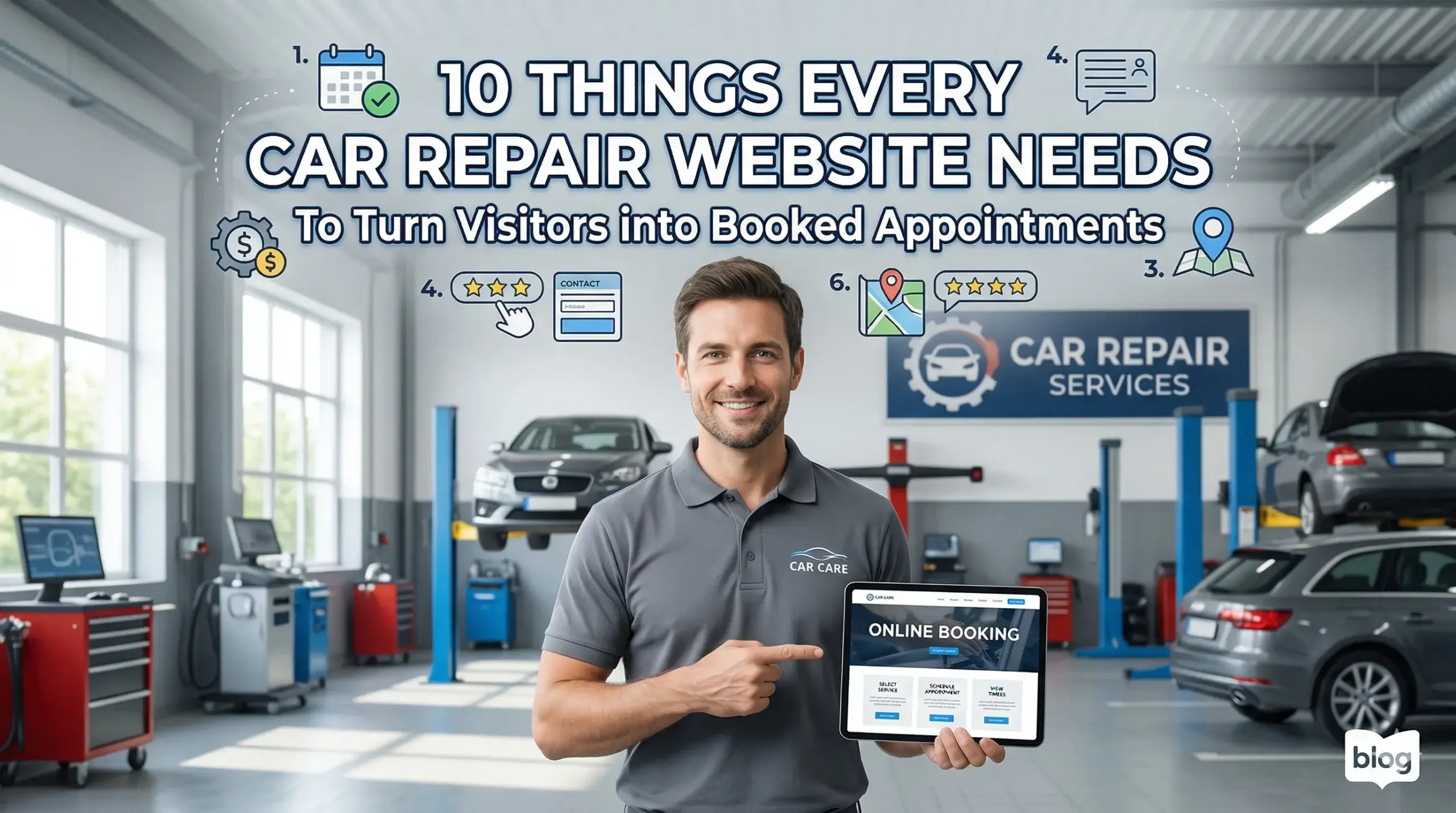
  • 10 Things Every Car Repair Website Needs to Turn Visitors into Booked Appointments

    10 Things Every Car Repair Website Needs to Turn Visitors into Booked Appointments

    You built a reputation as a great mechanic — word of mouth has kept your bays busy for years. But lately, you’ve noticed something: people are searching for auto repair near them online, and your phone isn’t ringing the way it should. Your website is up. Your business is listed. So why aren’t they calling?

    The honest answer most shop owners don’t want to hear: your website might be sending customers straight to your competitor down the street — without you even knowing it.

    Most auto repair websites were built to look professional, not to work professionally. There’s a big difference. A good-looking site that loads slowly, buries your phone number, or doesn’t show up in search results is as useless as a shop with no sign on the door.

    This article breaks down the 10 things your auto repair website actually needs to turn visitors into booked appointments — written for shop owners, not web developers.


    1. A Phone Number That’s Impossible to Miss

    The problem: A customer pulls over, searches “brake repair near me,” clicks your site — and has to hunt for your phone number. They give up in 10 seconds and call the next result.

    Why it happens: Most website templates bury contact info in a footer or “Contact” page. Designers think it looks cleaner. It costs you calls.

    What to do instead: Your phone number should be clickable (tap-to-call), large, and visible at the very top of every single page — not just the homepage. On mobile, this is non-negotiable.

    The best auto repair websites put the phone number in the header so it’s always visible, no matter where on the site a visitor lands.


    2. A Site That Loads in Under 3 Seconds

    The problem: Your site takes 6–8 seconds to fully load. By second 4, more than half your visitors are already gone — and they never saw your phone number.

    Why it happens: Old websites often have oversized images, outdated code, or cheap hosting that can’t handle traffic. Every extra second of load time costs you real customers.

    The real cost: Think of it this way — if your shop door took 7 seconds to open every time a customer walked up, most people would just walk to the next shop. That’s exactly what a slow website does.

    Digital Trace builds websites for auto repair businesses on fast, optimized infrastructure — because speed isn’t a feature, it’s the foundation.


    3. A Mobile-First Design (Not Just “Mobile Friendly”)

    The problem: More than 60% of local searches happen on a phone. If your site is hard to navigate on mobile — tiny buttons, text that requires pinching to read, menus that don’t work — those visitors leave without calling.

    Why it happens: Older websites were built for desktop screens and then shrunk down to fit phones. That’s not the same as being designed for mobile.

    What the difference looks like:

    • Large tap-friendly buttons (especially “Call Now” and “Book Appointment”)
    • Text that’s readable without zooming
    • Services listed in a way that’s easy to scroll through on a small screen
    • No pop-ups that block the entire screen

    4. A Clear List of Your Services (With Real Detail)

    The problem: Your website says “Auto Repair” and lists: oil changes, brakes, tires. That’s it. Google doesn’t know enough about you to show your site when someone searches “radiator flush near me” or “transmission repair [your city].”

    Why it happens: Most shop owners think a general services list is enough. It’s not — for Google or for customers.

    What to do instead: Create a dedicated page (or at minimum a detailed section) for each major service. Describe what the service includes, why it matters, and what signs mean a car needs it. This is what helps you show up for specific searches — and it builds trust with customers who are already nervous about repair costs.


    5. Reviews That Show Up Where It Counts

    The problem: You have 80 five-star Google reviews. A potential customer visits your website and sees… nothing. No reviews, no trust signals, no reason to choose you over the shop a mile away.

    Why it happens: Reviews live on Google or Yelp, but most websites don’t pull them in or display them prominently.

    What to do instead: Embed your best reviews directly on your homepage and service pages. Better yet, add a review count badge and a direct link to your Google listing. Customers making repair decisions — often when stressed and pressed for time — want immediate reassurance that you’re trustworthy.

    💡 Pro Tip: One of the most common mistakes auto repair shops make is hiding their Google rating from their website visitors. If someone lands on your site after searching online, they haven’t seen your Google listing yet — they don’t know you have 4.9 stars unless you tell them. Display your star rating prominently above the fold on your homepage. The technical fix is simple: embed a live Google review widget or use a review schema that shows your rating in search results directly.


    6. A Google Business Profile That Matches Your Website

    The problem: A customer searches for you, finds your Google listing, clicks through to your website — and the phone number, address, or hours don’t match what’s on the site. Instantly, trust is broken. Some customers think it’s a scam. Others just get confused and leave.

    Why it happens: Hours change, phones get updated, someone edits one place but not the other. It happens constantly.

    What to do instead: Your Name, Address, and Phone number (NAP) must be identical across your website, Google Business Profile, Yelp, and any other directory. This also helps Google understand your business is real and established — which directly affects how often you show up in local search results.


    7. A “Book an Appointment” Option That Actually Works

    The problem: A customer is ready to book at 9 PM. Your website has no way to do that. They’re not going to call and leave a voicemail. They move on.

    Why it happens: Many shop owners skip online booking because it seems complicated to set up, or they worry about no-shows.

    The real cost: You’re losing every customer who researches shops outside business hours — and that’s a bigger slice of your market than you might think. A simple booking form or integration with a tool like Appointy or Google’s booking feature can capture those leads automatically.


    8. A Website That Google Can Actually Read

    The problem: Your competitor’s website shows up right at the top of Google when someone searches “oil change [your city].” Yours is on page three. You both offer the same services. Why?

    Why it happens: Google reads websites differently than humans do. If your site isn’t structured correctly — with proper page titles, header tags, and location information — Google doesn’t know where to rank you or for what searches.

    In plain terms: Imagine sending a car to a diagnostic test with all the sensors disconnected. The technician can’t get any reading. That’s what your website is like to Google if it’s not set up right — Google can’t get a clear signal about who you are, where you are, or what you do.

    Mechanic website design done right means Google gets a clear, consistent signal — which is what gets you ranked above your competitors.


    9. Real Photos of Your Shop and Team

    The problem: Your website uses stock photos — generic cars on lifts, smiling people who’ve never held a wrench. Customers notice. It makes your business feel impersonal and harder to trust.

    Why it happens: Stock photos are easy. Real photos take effort.

    Why real photos convert better:

    • They show customers what to expect when they walk in
    • They build a personal connection before the first phone call
    • They reassure customers that your shop is clean, professional, and real
    • They differentiate you from every other shop using the same Shutterstock images

    Even a handful of good smartphone photos of your team, your bays, and your equipment will outperform any stock image library.


    10. A Website That’s Set Up to Convert — Not Just Inform

    The problem: Someone visits your site, reads your services, looks at your location — and then just… leaves. No call, no form, no booking. They weren’t pushed to do anything.

    Why it happens: Most auto repair websites are built like brochures. They share information but never tell the visitor what to do next.

    What the best auto repair websites do differently:

    • Every page has a clear, single call to action (“Call Now,” “Book Your Appointment,” “Get a Free Estimate”)
    • CTAs are visible without scrolling
    • The site makes it feel easy and low-risk to reach out
    • There’s a sense of urgency without being pushy (limited same-day slots, fast turnaround messaging, etc.)

    A website that doesn’t guide visitors toward action is like a service advisor who walks a customer to the car, explains everything that’s wrong — and then says nothing when the customer starts heading for the door.


    Real-World Example: From Ghost Town to Fully Booked

    Consider a transmission and general repair shop in the Phoenix metro area. They’d been in business for 11 years, had strong word of mouth, and a decent Google rating. But their website was built in 2017, loaded slowly on mobile, had no online booking, and didn’t rank for a single local search term beyond their own business name.

    After a full website redesign — optimized for speed, built with service-specific pages for their top 8 repair categories, and integrated with a simple online booking form — the results shifted quickly. Within 90 days, the site ranked on the first page for five local search terms. Organic phone calls from the website more than doubled. And for the first time, they were getting appointment requests submitted overnight that were ready to confirm first thing in the morning.

    The shop didn’t change what it did. They just stopped being invisible.


    Not sure if your auto repair website has these issues? Get a free website audit — no obligation, just a clear picture of what’s costing you leads.


    Your Path to More Leads: 5 Steps to Get Started

    1. Check your site on your phone right now. Is your number easy to tap? Does it load fast? If not, that’s your first problem to fix.
    2. Google your own business. Search “auto repair [your city]” and see where you appear — or don’t.
    3. Count your calls from the website. If you don’t know how many calls or form submissions your site generates each month, you have no way to know if it’s working.
    4. List every service you offer. Make sure each one has its own section or page on your site with real detail.
    5. Talk to a team that knows the auto repair industry. A generic web agency will build you a generic site. You need someone who understands how your customers think and what makes them pick up the phone.

    Frequently Asked Questions

    Why am I not getting calls from my website even though I have one?

    Having a website and having a website that works are two very different things. If your site is slow, not showing up in search results, or doesn’t clearly direct visitors to call or book — you’ll get traffic that goes nowhere. The fix usually starts with understanding exactly where in that process you’re losing people.

    How do I know if my auto repair website is actually working?

    If you can’t answer “how many phone calls or form submissions did my website generate last month” — it’s probably not working as hard as it should be. A properly set up site tracks calls, form fills, and appointment requests so you know exactly what’s coming from your web presence.

    How long does it take to see results from a new website?

    Most auto repair shops start seeing measurable improvements in local search visibility within 60–90 days of launching a properly optimized site. That said, some quick wins — like mobile usability, tap-to-call buttons, and faster load times — can start converting better visitors almost immediately.

    What makes an auto repair website different from a regular business website?

    Your customers are usually stressed, in a hurry, and making a decision they don’t fully understand. That means your site needs to do three things fast: build trust, answer their immediate question (do you fix what I need?), and make it dead simple to reach you. A generic website template doesn’t account for any of that.

    Do I really need a fast website if all my customers are local?

    Especially local. When someone’s car is making a noise and they’re searching on their phone from a parking lot, they’re not going to wait for a slow site. They’ll tap back and call your competitor. Speed matters more for local businesses because the decision to call happens in seconds.

    How do I know if my website is costing me leads right now?

    The easiest starting point is a professional audit. Book a free website audit with Digital Trace and you’ll get a clear, plain-English breakdown of exactly what’s working, what isn’t, and what it’s costing you in missed calls and bookings.


    Stop Leaving Appointments on the Table

    Your reputation as a mechanic is built one honest job at a time. Your website should work just as hard.

    If your site isn’t fast, easy to navigate, showing up in local search, and designed to turn visitors into calls — it’s not just underperforming. It’s actively losing you revenue every single day.

    A proper auto repair website isn’t a luxury. It’s the difference between a full schedule and empty bays.

    Get your free website audit today — no jargon, no pressure, just a clear look at exactly what your website is doing (and what it’s costing you). Auto repair shop owners across the US are surprised by what a 30-minute review uncovers.

    You’ve already built a shop worth recommending. Let’s make sure your website reflects that.
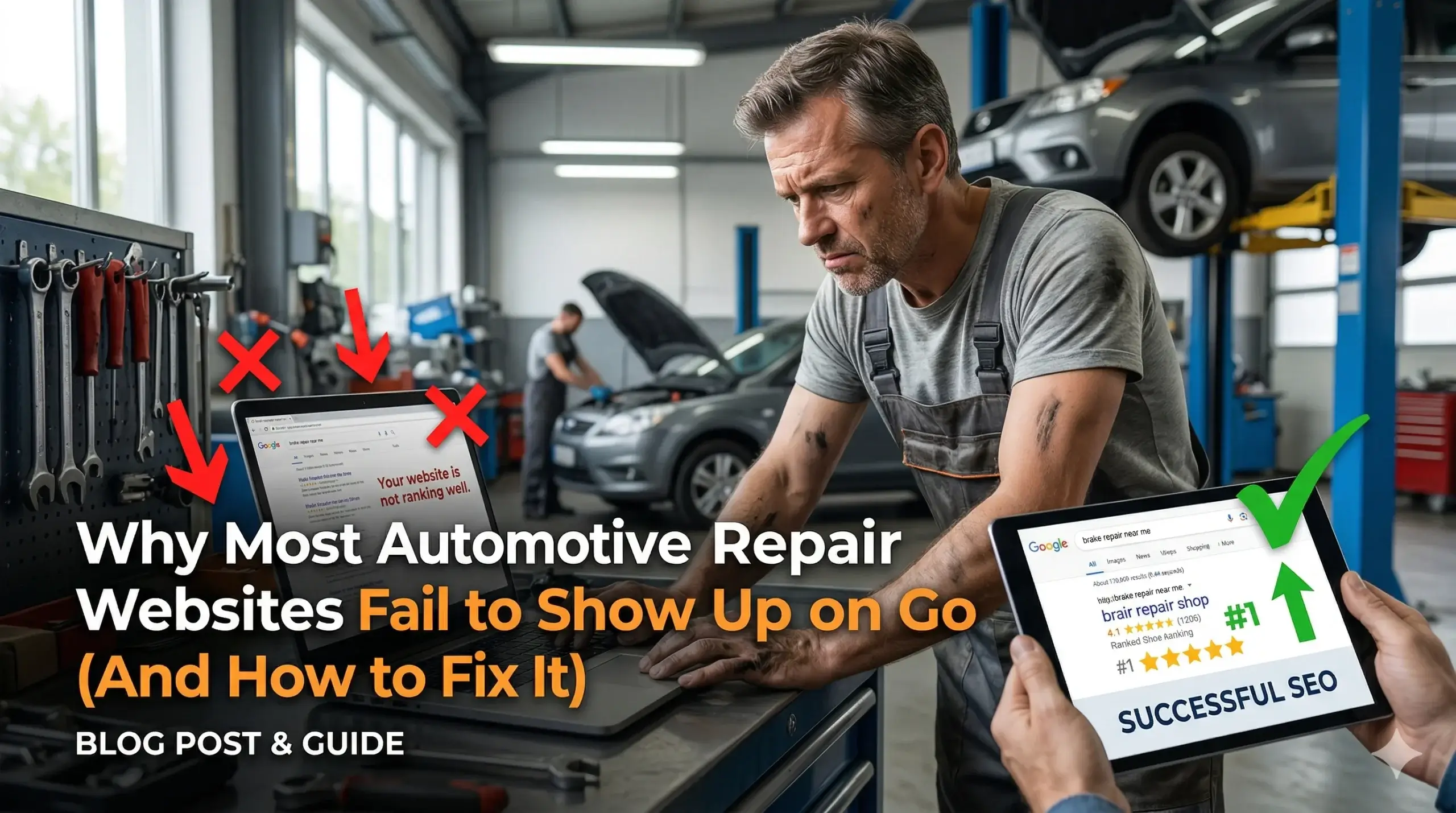
  • Why Most Automotive Repair Websites Fail to Show Up on Google (And How to Fix It)

    Why Most Automotive Repair Websites Fail to Show Up on Google (And How to Fix It)

    You’ve got a website. You paid someone to build it. It has your phone number, your services, maybe even a few photos of the shop. And yet — your phone isn’t ringing the way it should.

    Meanwhile, the shop across town somehow keeps showing up when people search “auto repair near me.” You know your work is better. Your prices are fair. Your customers love you. But none of that matters if people can’t find you.

    Here’s the truth most web designers won’t tell you: having a website and having a website that works are two completely different things. Most auto repair websites are invisible on Google — not because of bad luck, but because of a handful of fixable problems that most shop owners never even know to look for.

    By the end of this post, you’ll know exactly what those problems are, why they’re costing you customers, and what a website built to actually rank and convert looks like.


    Your Website Loads Too Slowly — And Customers Are Leaving Before They See Your Phone Number

    Picture this: a driver’s check engine light just came on. They’re anxious. They pull out their phone and search for a nearby shop. Your site comes up — but it takes six seconds to load. They’re gone. They already called your competitor.

    Most auto repair websites are loaded down with oversized images, bloated code, and hosting plans that weren’t built for performance. The result is a slow site that frustrates visitors on mobile — which is exactly how most of your customers are searching.

    Google knows when your site loads slowly, and it penalizes you for it. Slower sites rank lower. And even if a slow site does show up in results, most visitors bounce before they ever see your services or your phone number.

    What Digital Trace does instead: Every auto repair website we build is optimized from the ground up for speed — compressed images, clean code, and hosting configured for real-world performance on mobile. The goal is simple: your phone number should be the first thing a customer sees, not a loading spinner.


    Google Doesn’t Actually Know What Your Shop Does

    Think of Google like a new customer walking past your shop for the first time. If your signage is vague — no hours, no services listed, no clear name — they keep walking. That’s exactly what happens when your website doesn’t give Google the right information.

    Most auto repair websites are missing what’s called “structured data” — a simple layer of code that tells Google your shop’s name, location, services, hours, and phone number in a way search engines can confidently read and display. Without it, Google isn’t sure enough about your business to show it prominently in local results.

    This isn’t a small detail. It’s often the difference between showing up in the Google “map pack” — those top three local results that get the most clicks — and being buried on page two.

    What Digital Trace does instead: We build structured data directly into every auto repair shop website, so Google gets a complete, confident picture of your business. It’s one of the most impactful fixes most shops are missing — and most visitors never even see it’s there.


    Your Site Talks About You — But Not About What Your Customers Are Searching For

    Here’s a question worth sitting with: does your website use the same words your customers type into Google?

    Most shop owners write their website like a brochure — “Family owned since 1987,” “Serving the community,” “ASE certified technicians.” That’s all fine, but it’s not what people type when their transmission is slipping or their brakes are grinding.

    Customers search things like “brake repair [city],” “check engine light diagnostic near me,” or “best oil change shop open Saturday.” If your website doesn’t include those specific phrases — on the right pages, in the right places — Google has no reason to show your site for those searches.

    This is the gap between a website that exists and one that actually earns you business.

    What Digital Trace does instead: We build every mechanic website design around the actual search terms your local customers use. That means dedicated service pages, location-specific content, and copy written to rank — not just to look good.


    💡 Pro Tip: Your Homepage Alone Isn’t Enough

    One of the most common mistakes auto repair shops make is treating their homepage like their entire website. A single page can only rank for a handful of search terms. If you want to show up when someone searches “transmission repair,” “AC recharge,” or “wheel alignment near me” — you need separate, focused pages for each service. Think of it like your service menu: you wouldn’t list every repair under one vague “we fix cars” header. Your website shouldn’t either. Each service deserves its own page, with its own targeted content, to give Google a clear signal for each search.


    Your Site Looks Like It Was Built in 2014 — And Customers Notice

    When a driver lands on your website, they make a snap judgment about your shop in about three seconds. A cluttered layout, tiny text, outdated photos, or a site that doesn’t work properly on a phone sends one message: this shop might not be up to date with their repairs either.

    That’s unfair. You might run the most professional shop in town. But your website is your first impression — and a poor one sends people back to the search results to find someone else.

    The best auto repair websites are clean, mobile-friendly, and built to answer the customer’s three core questions instantly: What do you fix? Where are you? How do I reach you?

    What Digital Trace does instead: We design auto repair shop websites that look sharp on every device, load fast, and immediately answer what local customers need to know. No clutter. No guessing. Just a clear path from “I found your site” to “I’m calling your shop.”


    A Real-World Example: How One Shop Went From Invisible to Fully Booked

    A mid-sized auto repair shop in the Midwest — let’s call them Central Auto Care — had a website that looked decent enough. It had been built by a local freelancer a few years back and hadn’t been touched since. The owner figured it was “good enough.”

    The problem: the site was loading in over seven seconds on mobile, had no service-specific pages, and wasn’t set up with any local SEO signals. When someone in town searched “oil change near me” or “transmission shop [city],” Central Auto Care wasn’t showing up — even though they’d been in business for 12 years.

    After a full rebuild focused on speed, structured data, and service-specific content, the results shifted significantly. Within 90 days, the shop was appearing in the local map pack for eight of their core services. Call volume from the website increased by over 60%. And for the first time, the owner could see — through simple analytics — exactly which services people were searching for before they called.

    The shop didn’t change what they did. They changed how Google and customers could find them.


    Not sure if your auto repair website has these same issues? Get a free website audit — no obligation, just a clear picture of what’s costing you leads.


    Your Path to More Leads: 5 Steps That Actually Move the Needle

    Getting your auto repair website working isn’t about tricks or chasing algorithms. It comes down to getting the fundamentals right:

    1. Fix your load speed. If your site takes more than three seconds to load on a phone, you’re losing customers before they see a single word. This is usually the fastest win.
    2. Create a page for every core service. Brake repair, oil changes, diagnostics, transmission work — each deserves its own page with clear, specific content.
    3. Tell Google exactly who you are. Set up your Google Business Profile correctly and make sure your website matches it precisely — same name, address, phone number, and hours everywhere.
    4. Write for your customers, not for yourself. Use the words your customers actually search. Describe problems they’re experiencing, not just services you offer.
    5. Make it dead simple to contact you. Your phone number should be visible at the top of every page. A one-click call button on mobile is non-negotiable.

    If all of that sounds like a lot to figure out on top of running a shop — that’s exactly why Digital Trace builds auto repair websites that handle every one of these from day one.


    FAQ: Real Questions From Auto Repair Shop Owners

    Why am I not getting calls from my website?

    The most common reasons are: your site doesn’t rank for the searches your customers are actually doing, it loads too slowly on mobile and people leave, or your contact information isn’t easy to find. Often it’s a combination of all three. A quick audit will usually reveal the exact issue within minutes.

    How do I know if my auto repair website is actually working?

    If you can’t answer “how many calls did my website generate last month,” your site probably isn’t working as hard as it should. A properly set up website gives you clear data — calls, form submissions, which pages people visit most. If you’re flying blind, something’s missing.

    How long does it take to see results from a new website?

    For local SEO, most shops start seeing meaningful movement in Google rankings within 60–90 days of launching a properly built site. The speed improvements and design changes tend to have an immediate impact on how visitors behave once they land on the site. It’s not instant, but it’s not years either.

    What makes an auto repair website different from a regular business website?

    Local search behavior, service-specific pages, mobile-first design, and integration with Google Business Profile all matter more for auto repair than most industries. Your customers are searching in moments of urgency — a broken-down car doesn’t wait. Your website has to be fast, clear, and optimized for exactly those high-intent local searches.

    Do I really need a fast website if my customers are local?

    Especially if your customers are local. Local searchers are almost always on their phones, often in the middle of a stressful situation. A slow site on mobile is a dealbreaker — Google’s own data shows the majority of mobile users abandon a page that takes more than three seconds to load. Speed isn’t a luxury for local businesses; it’s table stakes.

    I’ve had a website for years and it’s never brought in much business. Can that actually change?

    Almost always, yes — but only if the underlying problems are actually fixed, not just patched over with a fresh coat of design. A new look doesn’t help if the SEO structure, speed, and content strategy are still broken. Get a free website audit and you’ll know within days exactly what’s holding your site back and what a realistic fix looks like.


    Your Competitors Are Getting Those Calls. Here’s How to Change That.

    Every day your website sits invisible on Google is a day a potential customer finds your competitor instead. That’s not a traffic problem — it’s a revenue problem, playing out quietly in the background while you’re focused on running your shop.

    The good news: these aren’t complicated problems. They’re fixable. And once they’re fixed, a well-built auto repair website works for you 24 hours a day — bringing in leads while you’re under a hood, at home, or closed for the weekend.

    Digital Trace specializes in building websites that do exactly that for auto repair shops across the US. No generic templates. No vague promises. Just a site built to rank, load fast, and turn local searchers into customers who call.

    Get your free website audit today — we’ll show you exactly what’s costing your shop leads and what it would take to fix it. No hard sell, no obligation. Just a clear, honest look at where your site stands and what’s possible.

  • Mechanic Website Design: Should You Build It Yourself or Hire a Pro?

    Mechanic Website Design: Should You Build It Yourself or Hire a Pro?

    You’ve got a solid reputation in your area. Customers who find you love you. Word of mouth keeps the bays busy — most days. But you’ve heard you should have a website, maybe you even built one on Wix or Squarespace a couple years back, and yet… your phone doesn’t ring from it. Not really.

    Here’s the thing most auto repair shops don’t realize: having a website and having a website that actually brings in customers are two completely different things. A lot of shops are sitting on digital storefronts that look fine on the surface but are quietly leaking leads every single day — and the owner has no idea.

    This article breaks down exactly what separates a site that works from one that just exists, whether you should build it yourself or hire someone who knows auto repair marketing, and what to look for so you’re not wasting another month without results.


    Your Website Is Like Your Shop’s Front Lot — First Impressions Are Everything

    When a driver pulls onto your street for the first time, they’re already making a judgment call. Is this place legit? Does it look like they know what they’re doing? Do I feel comfortable leaving my car here?

    Your website does the exact same job — except the judgment happens in about three seconds, before anyone even picks up the phone.

    If your site loads slowly, looks cluttered on a phone screen, or doesn’t immediately answer “where are you, what do you fix, and how do I call you?” — that potential customer is already hitting the back button. They’re not going to dig around. They’re going to call the next shop on the list.

    The brutal part? You’ll never know they were there.


    Why DIY Websites Fall Short for Auto Repair Shops

    Template builders like Wix, Squarespace, and GoDaddy make it easy to get something online. And for a lot of business types, something is fine. But auto repair is a local search game — meaning your customers are searching things like “oil change near me” or “brake repair [city name]” right now, on their phone, often from the side of the road.

    To show up for those searches, your site needs more than a nice logo and a photo of your shop. It needs to be built in a way that Google understands — and that takes specific, intentional choices that most DIY builders don’t make automatically.

    Here’s where most self-built auto repair sites quietly fail:

    • They load too slowly on mobile. Most auto repair customers are searching on their phones. If your site takes more than three seconds to load, a large portion of those visitors leave before they ever see your phone number. Google also ranks faster sites higher, so slow = invisible.
    • Google can’t tell exactly what you do or where you are. There’s a behind-the-scenes way of labeling your business information so search engines can read it clearly — called structured data. Without it, Google isn’t confident enough to show your shop in the results that matter most, like the map pack.
    • Your pages aren’t targeting the right searches. A generic homepage with “Welcome to Mike’s Auto Repair” isn’t going to rank for “transmission repair in [city]” or “check engine light diagnosis near me.” You need pages that speak directly to what people are actually searching.
    • No clear call to action. If a visitor has to hunt for your phone number or figure out how to book an appointment, they won’t. The path from landing on your site to calling your shop needs to be obvious and immediate.

    The Real Cost of a Website That Doesn’t Convert

    Think about what one new customer is worth to your shop. An average repair ticket — let’s say $400. If a customer comes back twice a year and sends one referral over their lifetime, that’s potentially thousands of dollars in revenue from a single relationship.

    Now think about how many people visit your website each month and leave without calling. Even if it’s just five or ten people a week, that adds up fast. Over a year, a website that converts at 1% instead of 5% could mean the difference between a slow month and a packed schedule.

    A website that doesn’t work isn’t free. It’s just costing you in a way that doesn’t show up on an invoice.


    💡 Pro Tip

    The #1 mistake auto repair shops make with their website: They build it once and never touch it again.

    Google rewards websites that are actively maintained — updated content, new service pages, consistent business information. A site that hasn’t been touched in two years sends a quiet signal that says “this business might not be active.” Meanwhile, your competitor who added a “brake service” page three months ago is showing up above you in search.

    The fix isn’t complicated — but it has to be intentional. New service pages, location-specific content, and regular updates signal to Google that your shop is the real deal.


    What the Best Auto Repair Websites Actually Do Differently

    The best auto repair websites aren’t just pretty — they’re built around one goal: getting the phone to ring. Here’s what separates a high-performing mechanic website from one that’s just taking up space online.

    They make the phone number impossible to miss. On every page. At the top. On mobile, it’s a tap-to-call button. No hunting, no scrolling.

    They speak to specific services. Instead of one generic “services” page, they have individual pages for oil changes, brake repair, transmission work, AC service — whatever the shop specializes in. Each page targets the exact phrase a customer would search.

    They build trust before the customer calls. Real reviews, real photos of the shop and team, clear information about certifications. A customer who’s never been to your shop is making a trust decision. The site’s job is to earn it.

    They load fast — everywhere. Especially on phones with slower connections. Speed isn’t a technical nicety, it’s a business requirement.

    They show up in the local map pack. This is the box with three local businesses that shows up near the top of Google search results. Getting there requires a combination of your Google Business Profile, website signals, and consistent information across the web — all working together.


    Before & After: What a Real Fix Looks Like

    Consider a shop like Garcia’s Auto Care — a two-bay independent shop in suburban Ohio. They had a website built by a family friend about four years ago. It looked decent, but the phone rarely rang from it. Most of their business was word-of-mouth and returning customers.

    When they had their site audited, three major problems surfaced immediately: the site wasn’t showing up in Google’s map results at all, the pages loaded in over six seconds on mobile (well above the threshold where most users leave), and there were no service-specific pages — just one generic list buried halfway down the homepage.

    After rebuilding the site with proper local SEO structure, faster hosting, individual service pages, and a cleaned-up Google Business Profile, the shop started appearing in the top three local results for searches like “oil change [city]” and “brake repair near me.” Within 90 days, they were fielding several new inbound calls per week from people who had never heard of them before — customers who found them directly through search.

    The shop didn’t change its pricing or services. The work was the same. The only thing that changed was making sure the right people could actually find them.


    Not sure if your auto repair website has these issues? Get a free website audit — no obligation, just a clear picture of what’s costing you leads.


    Your Path to More Leads: What the Process Actually Looks Like

    If you’re ready to stop guessing and start getting results, here’s what a smart path forward looks like:

    1. Find out what’s actually broken. Before spending money on anything, get an honest look at your current site — speed, local visibility, content gaps, and conversion issues. You can’t fix what you don’t know is broken.
    2. Get the technical foundation right. Fast loading, mobile-friendly design, and proper local business signals aren’t optional anymore — they’re the baseline Google expects before it shows your site to anyone.
    3. Build pages around what your customers are searching. Every service you offer, every city or suburb you serve — these should have their own dedicated page. Think of each one as another door someone can walk through to find your shop.
    4. Make it easy to contact you. Phone number at the top, a simple booking or contact form, clear hours and directions. Every step between “visitor” and “customer” needs to be frictionless.
    5. Keep it current. Add a new page, update your hours for the holidays, share a seasonal maintenance tip. Consistency signals credibility — to both Google and potential customers.

    Frequently Asked Questions

    Why am I not getting calls from my website even though I have one?

    Having a website and having a website that ranks are two different things. If Google isn’t confident in what your shop does, where you’re located, or how fast and mobile-friendly your site is, it won’t show your site to people searching for auto repair nearby. A free audit can pinpoint exactly why — start here.

    How do I know if my auto repair website is actually working?

    If you can’t tell you how many visitors your site gets each month, where they came from, and how many called or contacted you — your site isn’t working. A functioning auto repair website has tracking set up and shows measurable results: phone calls, form submissions, direction requests.

    How long does it take to see results from a new website?

    Most shops start seeing measurable improvement in local search visibility within 60–90 days of launching a properly built site. Significant results in competitive markets can take four to six months. Realistic timelines depend on your local competition and how much of a head start they have.

    What makes an auto repair website different from a regular business website?

    Auto repair is a local, high-trust, mobile-first business. Your customers are often searching from their car, in a stressful situation, and they need to make a fast decision. Your site needs to load instantly, clearly communicate trust signals (reviews, certifications, experience), and make calling as easy as one tap. Generic website templates aren’t built with any of that in mind.

    Do I really need a fast website if most of my customers are local?

    Yes — especially because they’re local. Local customers search on their phones, often on the go, sometimes with a spotty connection. Google’s own data consistently shows that most mobile users abandon a page that takes more than a few seconds to load. Speed directly affects whether your site even appears in search results in the first place.

    Can I just improve my current site, or do I need to start from scratch?

    It depends on what you’re working with. Some sites can be improved with targeted fixes — better page structure, faster hosting, added content. Others have foundational problems that make it more efficient to rebuild properly from the start. The only way to know is a proper audit of what you currently have. See what your site is doing (or not doing).


    Stop Leaving Leads on the Table

    Every week your website isn’t performing, real customers in your area are finding your competitors instead of you. They’re not choosing those shops because the service is better — they’re choosing them because those shops showed up when it mattered.

    Websites built for auto repair businesses aren’t complicated, but they are specific. The difference between a site that generates calls and one that just sits there is a set of intentional, industry-aware decisions — from how pages are built, to how fast they load, to how clearly Google can understand your business.

    If you want to know exactly what’s holding your current site back — no guesswork, no generic report — get your free website audit today. There’s no cost, no commitment, and no jargon. Just a clear look at what’s costing your shop leads every day, and what it would take to fix it.


    Ready to see what your site is really doing? Book your free audit →

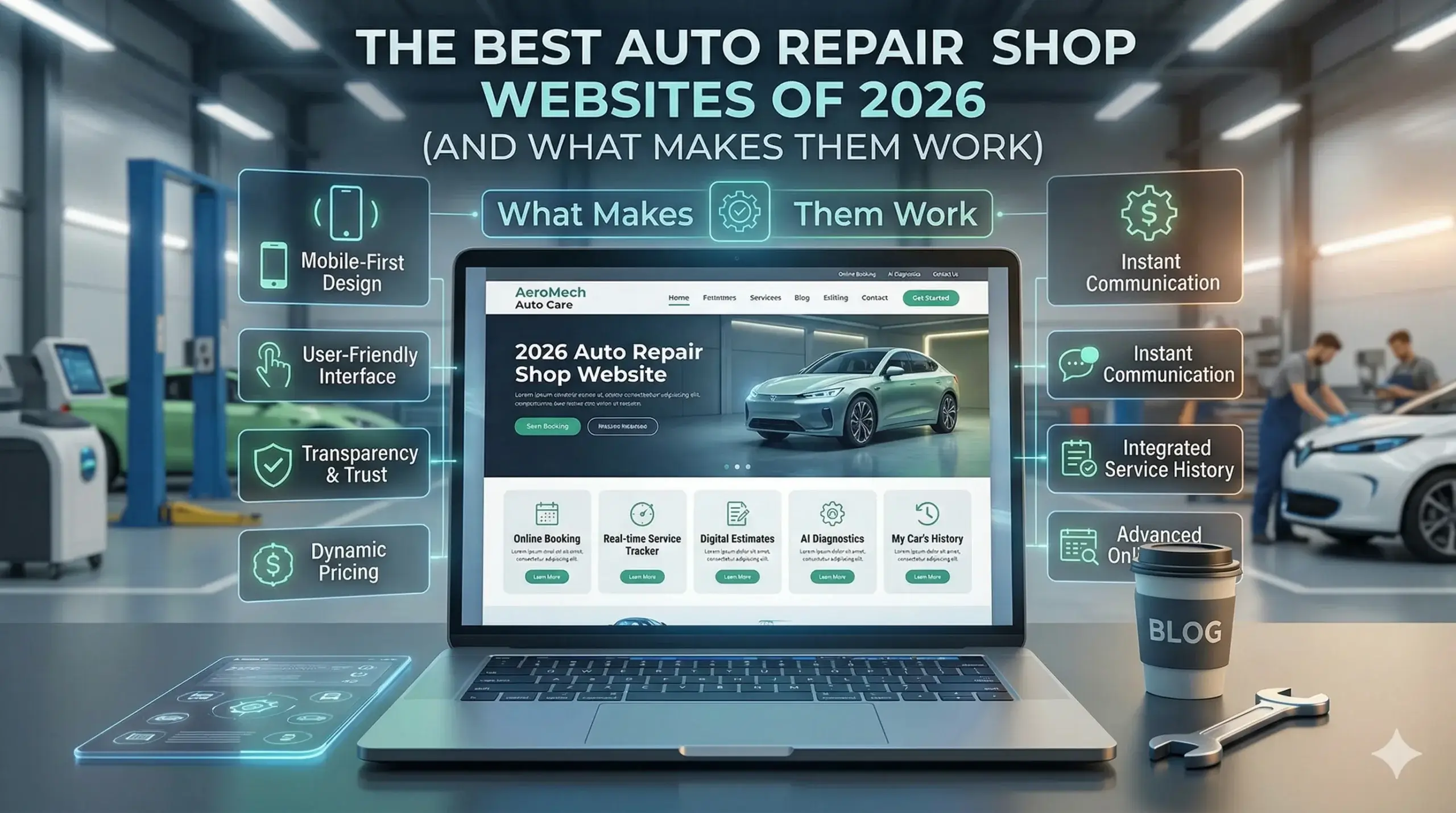
  • The Best Auto Repair Shop Websites of 2026 (And What Makes Them Work)

    The Best Auto Repair Shop Websites of 2026 (And What Makes Them Work)

    Your shop does great work. Your lifts are full, your techs are skilled, and your customers leave happy. So why does it feel like your website is the one part of your business that never pulls its weight?

    Most auto repair shop owners think their website just needs to “look better.” But the shops that are consistently pulling in new customers from Google aren’t winning on looks — they’re winning because their site is built to convert. Speed, trust signals, local search presence, and a clear path to booking: these are the things separating the shops with packed appointment books from the ones waiting for the phone to ring.

    This guide breaks down exactly what the best auto repair shop websites have in common — and what the average shop is quietly getting wrong every single day.


    Your Website Has 3 Seconds to Make Someone Call You

    Think about what happens when a car breaks down and the driver pulls over to search for a repair shop. They’re not browsing — they’re choosing fast. They tap the first result that looks trustworthy, and if that page takes more than a few seconds to load, they hit the back button and call your competitor.

    This happens constantly, and most shop owners have no idea.

    A slow site doesn’t just frustrate visitors — it actively pushes them away before they ever see your phone number, your services, or your years in business. And Google knows this. A site that loads slowly gets ranked lower, so not only are you losing visitors who find you, fewer people are finding you in the first place.

    The best auto repair websites load in under two seconds on a phone. If yours doesn’t, you’re paying for a website that’s turning away customers.

    Here’s what a fast, converting auto repair site does right:

    • Loads on mobile in under 2 seconds
    • Shows your phone number prominently at the top — clickable on mobile
    • States your location and core services immediately (no scrolling required)
    • Has a clear, single call-to-action: “Call Now,” “Book an Appointment,” or “Get a Quote”

    Most Mechanic Websites Look Fine But Don’t Actually Rank

    Here’s the frustrating part: your site might look decent and still be invisible on Google. That’s because looking good and being found are two completely different things.

    Google needs specific information to confidently show your business in local search results. If your site doesn’t have that information structured the right way, Google essentially guesses — and usually guesses wrong, showing competitors instead.

    Think of it like a diagnosis. Your car might look clean sitting in the lot, but if there’s a fault code buried in the ECU, the engine warning light’s going to come on. Your website can look clean on the surface and still have underlying issues costing you search visibility every day.

    The common gaps that kill local rankings:

    • Your Google Business Profile and website have slightly different addresses or business names
    • Your site doesn’t have location-specific content (just “Auto Repair” with no city or region)
    • Google doesn’t have structured data telling it what services you offer, your hours, or your service area
    • You have no reviews connected to your site or no review strategy at all

    The best auto repair websites built for US shops address all of these from day one — because ranking locally is the whole point.


    The Trust Problem Nobody Talks About

    A potential customer lands on your site at 7pm on a Tuesday. They need to know: Is this shop legit? Will they rip me off? Do real people use them?

    They’re making that decision in about 8 seconds. And if your site doesn’t answer those questions fast — with real reviews, real photos, real credentials — they’re gone.

    This isn’t about design. It’s about what’s on the page and how quickly it communicates trust. Stock photos of random cars don’t cut it. A wall of text about your “commitment to quality” doesn’t either.

    What actually builds trust on an auto repair website:

    • Real photos of your shop, your team, and your actual work
    • Google Reviews displayed directly on the site (or a widget pulling them in)
    • Certifications visible above the fold (ASE, AAA-approved, etc.)
    • A short “About Us” that sounds like a real person — not a press release
    • Clear pricing signals, even if just a starting price range for common services

    When Digital Trace builds auto repair websites, trust signals are treated as core structure, not an afterthought. They’re baked into the page layout from the first wireframe.


    💡 Pro Tip

    The #1 mistake auto repair shops make: no mobile call button.

    More than 70% of local service searches happen on a phone. If your phone number isn’t a tappable “Call Now” button at the top of your mobile site, you’re forcing people to copy-paste a number — and most won’t bother. They’ll just call the next shop. This is one of the fastest, highest-impact fixes any mechanic website can make, and it takes about 10 minutes to implement correctly.


    Before & After: What a Real Rebuild Looks Like

    The Shop: A family-owned auto repair shop in suburban Ohio — three bays, two full-time techs, been in business for 14 years. Their website was built in 2019 by a nephew and hadn’t been touched since.

    The Problem: The site took over 6 seconds to load on mobile. The phone number was buried in the footer. There were no reviews visible anywhere. Their Google Business Profile listed a slightly different address than the website, which was quietly tanking their local ranking. They were showing up on page 2 for “[city] auto repair” — essentially invisible.

    What Changed: The site was rebuilt from scratch with mobile-first design, a clickable call button at the top, a services page optimized for local search terms, Google Reviews pulled in automatically, and proper structured data added so Google could confidently rank them. The Google Business Profile was synced and optimized.

    The Result: Within 90 days, they moved from page 2 to the top 3 results for their core local search terms. Phone calls from the website went up significantly — the owner estimated roughly 12–15 new appointment calls per month that weren’t coming in before. Two of those were transmission jobs. One call alone more than covered the cost of the new site.


    Not sure if your auto repair website has these issues? Get a free website audit — no obligation, just a clear picture of what’s costing you leads.


    What the Best Auto Repair Websites Have That Yours Probably Doesn’t

    After reviewing hundreds of mechanic and auto repair websites across the US, the pattern is clear. The ones that consistently win in local search and convert visitors into calls share a handful of traits that most shops overlook.

    They’re built for the customer’s first question, not the shop owner’s ego.

    The best sites don’t lead with “Welcome to Smith’s Auto.” They lead with “Fast, Honest Auto Repair in [City] — Call for Same-Day Service.” The visitor’s first thought is answered before they scroll.

    They have service pages that actually rank.

    One generic “Services” page listing oil changes, brakes, and transmission work won’t cut it. The shops ranking well have individual pages — or at least dedicated sections — for their most searched services. “Brake Repair in [City]” and “Check Engine Light Diagnosis in [City]” are searches people make. A generic services list doesn’t capture them.

    They make booking stupidly easy.

    Phone number at the top. “Book Online” button visible on mobile. A simple contact form that doesn’t ask for 15 pieces of information. The fewer clicks between a visitor and an appointment confirmation, the more appointments you book.

    They earn Google’s trust through consistency.

    Same name, address, and phone number everywhere — on the site, Google Business Profile, Yelp, and any directory listing. Google rewards consistency and penalizes confusion.


    Your Path to More Leads: 5 Steps to a Website That Works

    You don’t have to overhaul everything at once. Here’s a clear, practical starting point:

    1. Check your mobile load speed. Go to Google’s PageSpeed Insights and enter your URL. If your mobile score is below 70, your site is actively losing you leads.
    2. Add a tap-to-call button. Your phone number should be a tappable button at the very top of your mobile site — not just text, not buried in a footer.
    3. Sync your information everywhere. Make sure your business name, address, and phone number are identical on your website, Google Business Profile, and any directory listings.
    4. Add visible reviews. If your Google Reviews aren’t showing up on your site, you’re hiding your best sales tool. Add a widget or embed them directly.
    5. Get a professional audit. Before spending money rebuilding anything, find out exactly what’s broken and what it’s costing you. A good audit pays for itself.

    Frequently Asked Questions

    Why am I not getting calls from my website even though it looks fine?

    Looking fine and performing well are two different things. Your site might have a slow load time, a phone number that isn’t clickable on mobile, or poor local SEO — any of which can quietly kill your incoming calls. The only way to know for sure is to audit the site’s actual performance, not just how it looks on screen.

    How do I know if my auto repair website is actually working?

    If you can’t tell you exactly how many calls or contact form submissions came from your website last month, your site isn’t set up to measure results. A properly built site has call tracking and analytics in place so you can see what’s working. Without that, you’re flying blind.

    How long does it take to see results from a new or rebuilt website?

    For local SEO improvements, most shops start seeing meaningful movement in Google rankings within 60–90 days. Design and conversion changes — like a better call button or a cleaner mobile layout — can produce results almost immediately. It’s not overnight, but it’s also not years. Book a free review and Digital Trace can give you a realistic timeline based on your current situation.

    What makes an auto repair website different from a regular business website?

    Auto repair customers are local, they’re often in a hurry, and they’re making a trust decision fast. That means local SEO, mobile speed, and trust signals (reviews, certifications, real photos) matter far more than fancy design. A website built for an e-commerce brand won’t serve a repair shop well — the goals and user behavior are completely different.

    Do I really need a fast website if my customers are local?

    Especially if your customers are local. Local searchers are usually on their phones, often in urgent situations, and comparing multiple shops in seconds. A slow site means they’ve already moved on before your page finishes loading. Google also uses page speed as a ranking factor — a slow site ranks lower, which means fewer locals even find you.

    I’ve paid for web design before and got nothing. Why would this be different?

    Most web design agencies build pretty sites and move on. They don’t specialize in auto repair, they don’t think about local search from the ground up, and they don’t track whether the site actually produces calls. The difference is working with someone who understands how auto repair customers search, what makes them call, and how to build a site that does both.


    Stop Leaving Leads on the Table

    Every day your website underperforms, there’s a real cost — calls that didn’t happen, appointments that went to the shop down the street, customers who found you on Google and left before they ever saw your phone number.

    The good news: these are fixable problems. And finding them doesn’t have to cost you anything.

    Digital Trace offers a free website audit for auto repair shops across the US. No pitch, no pressure — just an honest look at what your site is doing well, what’s broken, and what it’s likely costing you in missed leads every month.

    Get your free audit now →

    There’s no obligation. Just a clear picture of where you stand — and what’s possible.

  • How to Get a Professional Auto Repair Shop Website That Actually Brings in Customers

    How to Get a Professional Auto Repair Shop Website That Actually Brings in Customers

    Your bays are ready. Your techs are skilled. Your prices are fair. But your phone isn’t ringing the way it should — and you can’t figure out why.

    Most auto repair shop owners blame slow seasons or word-of-mouth drying up. The real culprit is usually sitting right on their phone: a website that looks fine on the surface but is quietly turning away customers every single day.

    The hard truth is that the majority of people searching for auto repair in your area are choosing a shop before they ever pick up the phone. They go to Google, compare the first few results, scan a few websites in about 10 seconds, and call the one that feels trustworthy. If your site isn’t built to win that 10-second judgment, you’re not losing to better mechanics — you’re losing to better websites.

    This guide breaks down exactly what separates an auto repair shop website that generates real business from one that just exists on the internet. By the end, you’ll know what to fix, what to look for, and how to stop leaving customers on the table.


    Why Most Auto Repair Websites Don’t Generate Calls

    Think of your website like your shop’s front lot. If a customer drives by and the lot looks cluttered, the signage is hard to read, and they can’t tell what services you offer or how to pull in — they keep driving. They don’t call to ask. They just go somewhere else.

    That’s exactly what happens online when your website is slow to load, hard to navigate on a phone, or buried on page two of Google. Most visitors make a decision in under 10 seconds. If your name, location, services, and phone number aren’t immediately obvious, they’re gone.

    The most common problems that kill calls from auto repair websites:

    • The site loads slowly on mobile (most customers are searching from their phones while their car acts up)
    • The phone number isn’t clickable or visible above the fold
    • There’s no clear list of services — customers aren’t sure if you handle their specific repair
    • The site looks outdated, making them wonder if the shop is still open or trustworthy
    • There are no reviews or trust signals visible without scrolling down

    Any one of these problems costs you calls. Several of them together can nearly silence your phone.


    The Speed Problem Nobody Tells You About

    Here’s the most overlooked issue in auto repair website design: your site is probably too slow, and it’s costing you customers before they even see what you offer.

    When someone’s car starts making a noise, they pull out their phone and search “auto repair near me.” Google loads a list of results. They tap on your site. If it takes more than 3 seconds to load — and many shop websites take 6, 8, even 12 seconds — a large portion of those visitors leave immediately. They don’t wait. They go back and tap the next result.

    The technical reason is usually bloated images, cheap hosting, or a website built on a platform that wasn’t designed for performance. The business reason is that you’re paying for a website that’s actively pushing customers toward your competitors.

    At Digital Trace, every auto repair website is built for speed first — because a fast site isn’t a luxury, it’s the cost of staying competitive. Fast load times also directly impact how high Google ranks your site, so fixing speed does double duty: it keeps visitors on your page and it helps more people find you in the first place.


    💡 Pro Tip: Your Contact Info Shouldn’t Require Scrolling

    One of the most common and costly mistakes on auto repair websites: the phone number is buried at the bottom of the page or hidden in the top navigation bar in tiny text.

    On mobile — where most of your customers are searching — people expect to tap a phone number and call instantly. If they have to scroll to find it, most won’t bother. Make sure your phone number is large, visible, and clickable at the very top of every page. On mobile, that button should practically jump off the screen. The same goes for your address and a “Get Directions” link. These aren’t design choices — they’re revenue decisions.


    Google Doesn’t Know Enough About Your Shop to Recommend It

    You might have a great reputation in your area. But if Google can’t clearly understand what your shop does, where it’s located, and who it serves — Google won’t show it confidently in search results.

    This isn’t about tricking the algorithm. It’s about giving Google the clear, structured information it needs to match your shop with the right searches. A shop in Denver that offers transmission repair, brake service, and oil changes needs pages (or at minimum, sections) dedicated to each of those services — with the city name naturally included. Without that, Google sees a vague “auto repair” website and doesn’t know when to show it.

    The fix involves building out your site with service-specific content and location context. It also means making sure your Google Business Profile connects properly with your website, so the two reinforce each other. When this is done right, shops that were invisible on page two start showing up in the map pack — the three listings that appear at the top of local search results and capture the majority of clicks.

    This is exactly what websites built for auto repair businesses by Digital Trace are designed to accomplish: combining the right structure, the right content, and the right technical foundation so Google knows exactly what your shop offers and who to send your way.


    Trust Is Decided in Seconds — Your Website Either Builds It or Kills It

    When a customer lands on your site, they’re not just looking for your services. They’re asking themselves: Can I trust these people with my car?

    An outdated website design — even if it has all the right information — creates doubt. Stock photos that look nothing like your actual shop, a wall of text with no photos of your team, no reviews visible, no clear indication of how long you’ve been in business — these all quietly signal “maybe don’t call them.”

    The best auto repair shop websites lead with trust:

    • Real photos of the shop, the team, and actual repair work in progress
    • Google and Facebook reviews pulled in automatically so customers see social proof immediately
    • Clear experience signals — years in business, certifications, brands you service
    • A simple, confident design that says “we’re professional and we know what we’re doing”

    None of this needs to be fancy. It just needs to be intentional. A clean, fast website with real photos and visible reviews will consistently outperform a flashy site with none of those elements.


    Before & After: What a Better Website Actually Does for a Shop

    The situation: A family-owned auto repair shop in the Dallas–Fort Worth area had been in business for 14 years. They had loyal repeat customers, strong word-of-mouth, and good reviews on Google. But their website was built in 2016, wasn’t mobile-friendly, and had no service-specific pages — just a homepage with a general description and a contact form.

    They were showing up on the second page of Google for most local searches, getting only a handful of website inquiries per month, and watching newer shops with shinier online presences pull in customers who would have been a natural fit.

    What changed: A new website was built with a fast, mobile-first design. Service pages were created for their top offerings — brake repair, oil changes, transmission service, and AC repair — each with local keywords naturally woven in. Real shop photos replaced generic stock images. Their Google reviews were integrated directly on the homepage. Their phone number became a one-tap button on mobile.

    The result: Within three months, the shop was ranking in the local map pack for their top service keywords. Website-generated phone calls went from a handful per month to over 60. One of their service pages alone was bringing in an average of 20+ new customer inquiries monthly. Their slow season barely felt slow.


    Not sure if your auto repair website has these issues? Get a free website audit — no obligation, just a clear picture of what’s costing you leads.


    Your Path to More Leads: 5 Steps That Actually Move the Needle

    Getting more calls from your website doesn’t require a full marketing overhaul. It requires fixing the right things in the right order.

    Step 1: Fix how your site loads on mobile. If your site takes more than 3 seconds to load on a phone, you’re losing customers before they see anything. Speed is the foundation everything else is built on.

    Step 2: Make your phone number impossible to miss. Every page on your site should have a large, tappable phone number at the top. Don’t make people hunt for it.

    Step 3: Create a dedicated page for each of your main services. One general “services” page isn’t enough. Google — and customers — respond better to specific pages for brake repair, oil changes, transmission work, and so on.

    Step 4: Get your reviews on your homepage. If you have 50 great Google reviews and none of them are visible on your website, you’re leaving your best marketing tool unused. Integrate them prominently.

    Step 5: Make sure Google understands your location and services. Your website and your Google Business Profile should tell the same story, clearly and consistently. When they do, local rankings improve.


    Frequently Asked Questions

    Why am I not getting calls from my website even though it shows up on Google?

    Showing up on Google and converting visitors into calls are two different problems. Your site might rank on page one for your shop name but rank nowhere for “auto repair near me” or specific services. Or your site loads too slowly on mobile, customers leave before they see your phone number, or there’s nothing on the page that builds enough trust to make them call. A quick audit usually reveals which of these is the issue.

    How do I actually know if my auto repair website is working or just sitting there?

    If you don’t know how many calls or form submissions your website generates each month, you have no way to measure whether it’s working. Basic analytics — easy to set up — show you how many people visit, where they come from, and what they do when they get there. If visits are happening but calls aren’t, that points to a conversion problem. If visits are low, that’s a visibility problem. Both are fixable. Book a free review and we’ll show you exactly what the numbers look like for your site.

    How long does it take to see results from a new website?

    Most shops start seeing meaningful changes within 60–90 days of launching a properly built website — faster if the Google Business Profile is also optimized at the same time. Some improvements, like more calls from mobile visitors or a better click-through rate from search, can show up within the first few weeks. SEO results that target competitive search terms take a little longer, but the foundation gets laid immediately.

    What makes an auto repair website different from a regular small business website?

    Auto repair customers are often in a stressful situation — something’s wrong with their car and they need help fast. Your website needs to eliminate friction instantly: clear phone number, quick summary of services, trust signals like reviews and certifications, and a simple path to call or get a quote. It also needs to rank for service-specific and location-specific searches that are unique to the auto repair industry. A generic website template built for a boutique or a consultant won’t check those boxes.

    Do I really need a fast website if most of my customers are just locals who already know me?

    Repeat customers might already have your number. But new customers — the ones who just moved to the area, whose usual shop closed, or who had a breakdown away from home — are finding you (or not finding you) through Google. That audience is entirely dependent on how your website performs. A slow, hard-to-navigate site doesn’t just lose you leads today; it pushes those customers toward competitors who may now become their go-to shop for years.

    I tried a web agency before and saw no results. Why would this be different?

    Most agencies build websites that look good in screenshots but aren’t built around how people actually find and choose local service businesses. The difference is in the details: how fast it loads, how it’s structured for local search, how clearly it communicates trust, and whether it’s actually optimized for the way your customers search. Results come from getting all of those pieces right together — not from a template with your logo dropped in.


    Ready to Find Out What Your Website Is Costing You?

    Every week your auto repair website has speed problems, missing service pages, or weak trust signals is another week of potential customers choosing the shop down the street — not because they’re better, but because their website made a stronger first impression.

    A free audit from Digital Trace will show you exactly where your site is losing leads, what it would take to fix it, and what kind of results you can realistically expect. There’s no pitch, no pressure, and no obligation — just a clear, honest look at what’s working and what isn’t.

    Get your free website audit today — and find out what’s standing between your shop and the phone ringing more consistently.