Category: Auto Detailing

  • Car Detailing Website Design vs. DIY Website Builders: What Actually Gets You Customers?

    Car Detailing Website Design vs. DIY Website Builders: What Actually Gets You Customers?

    You spent a weekend setting up your Wix or Squarespace site. It looks decent. You’ve got your services listed, a few photos of your work, and your phone number at the top. And yet — the phone barely rings from it.

    Meanwhile, another detailer in your area seems to be staying busy. They’re showing up on Google. Customers are finding them. You’re not sure what they’re doing differently, but something is working for them that isn’t working for you.

    Here’s the hard truth most web designers won’t tell you: a website that looks good and a website that gets you customers are two completely different things. This post breaks down exactly why DIY builders fall short, what a real auto detailing website design actually does, and how you can start getting more calls from your site — starting now.


    Your Website Is a Sales Rep, Not a Sign

    Think about the best employee you’ve ever had — someone who could talk to a potential customer, understand what they needed, build trust fast, and get them to book. Now imagine that person standing outside your shop holding a sign that just says “We Detail Cars.” That’s what most DIY detailing websites are doing.

    A site that converts isn’t just showing information. It’s actively guiding a potential customer from “I found this site” to “I’m calling right now.” Every second they spend confused, scrolling, or waiting for a page to load is a second they’re about to go back to Google and call your competitor.

    The gap between a site that sits there and a site that sells for you isn’t about fancy design — it’s about knowing what detailing customers actually need to see before they pick up the phone.


    Why DIY Website Builders Are Quietly Costing You Leads

    Speed: The Problem You Can’t See

    Most DIY builder sites load slowly on phones. And most of your potential customers are searching for a detailer on their phone while they’re sitting in a parking lot or waiting for their lunch to heat up.

    When a site takes more than 3 seconds to load, a large percentage of visitors leave — without ever seeing your services, your prices, or your phone number. You’ll never know they were there.

    DIY platforms like Wix and Squarespace load extra code behind the scenes that slows everything down. It’s not your fault — it’s built into how those tools work. But the result is real: slow site, fewer calls.

    What Digital Trace does instead: Every auto detailing website we build is optimized for mobile speed from the ground up. We strip out the bloat so your site loads fast — because a fast site is a site that gets you customers.

    Google Doesn’t Know Enough About Your Business to Show It

    You’ve probably heard of SEO. But here’s what that actually means for a detailing business: Google needs to understand who you are, where you serve, and what services you offer before it’ll confidently show your site to someone searching nearby.

    DIY builders give you a generic template. They don’t structure your site in a way that tells Google “this is a mobile detailing business serving [your city].” They don’t include the behind-the-scenes signals that help your business show up in local search results.

    The result: you’re invisible to customers who are actively looking for what you do, right in your area.

    What Digital Trace does instead: We build your site with proper local SEO signals built in from day one — the technical stuff that tells Google exactly what you do and where you do it, so you start showing up where your customers are searching.

    Your Homepage Isn’t Answering the Right Questions

    When someone lands on your site, they have one thing on their mind: “Can I trust this person with my car?” They’re not reading your about page. They’re scanning fast, looking for answers to questions they haven’t even consciously formed yet.

    Questions like:

    • Are they legit? (reviews, before/after photos)
    • Do they serve my area?
    • What does it cost, roughly?
    • How do I book?

    If those answers aren’t front and center — immediately visible without scrolling — most visitors leave. They didn’t bounce because they didn’t want your service. They bounced because the site didn’t make them feel confident fast enough.


    The Hidden Cost of a “Good Enough” Website

    Here’s a way to think about it. If your site gets 200 visitors a month (not unusual for a local business with any online presence), and your conversion rate is 1% instead of 5%, you’re missing out on roughly 8 potential customers every single month. If an average detail job is worth $150–$300, that’s $1,200–$2,400 in potential revenue walking out the door every month because the website isn’t doing its job.

    That math adds up fast. And it’s happening quietly, invisibly, every day.


    💡 Pro Tip for Auto Detailers

    The single most common mistake we see on detailing websites: the phone number is buried at the bottom — or worse, only in the “Contact” page. Most customers who want to book won’t hunt for it. They’ll leave and call the next detailer they find.

    Your phone number should appear at the top of every page, clickable on mobile. That one change alone can increase calls significantly. It sounds obvious, but the majority of DIY-built detailing sites get this wrong. A well-built site makes it impossible for a ready customer to not know how to reach you.


    Before & After: What a Real Detailing Website Overhaul Looks Like

    The Business: A two-person mobile detailing operation in the Phoenix, AZ area. Fully booked through word-of-mouth, but slow in the off-season. Had a DIY Wix site they’d built themselves two years prior.

    The Problem: Despite being in a large metro area with tons of search volume for mobile detailing, they were getting maybe 2–3 website inquiries per month. The site loaded slowly on mobile, had no local SEO foundation, and the booking process required filling out a contact form and waiting for a callback — too many steps for a customer who wanted to book and move on.

    What Changed: Their site was rebuilt with mobile speed as the priority, a click-to-call button above the fold, a simple service + pricing overview on the homepage, real customer reviews pulled in automatically, and local SEO structure targeting their specific service area.

    The Result: Within 60 days of the new site going live, inbound website leads went from roughly 2–3 per month to 18–22 per month. Their slow season was meaningfully busier than the previous year. They didn’t change their services, their prices, or their advertising budget. The website just started doing its job.


    Not sure if your detailing website has these issues? Get a free website audit — no obligation, just a clear picture of what’s costing you leads.


    What the Best Auto Detailing Websites Actually Have in Common

    You can look at the best auto detailing websites out there and a pattern emerges fast. The ones that generate steady leads share these traits:

    • Mobile-first design — built to look and work perfectly on a phone, not just a desktop
    • Fast load times — under 2–3 seconds, every time
    • Click-to-call prominently placed — no hunting, no friction
    • Real photos of their work — before/afters, in-progress shots, finished results
    • Clear service descriptions — not just “interior detailing” but what’s included and what it costs
    • Social proof — Google reviews, before/afters, or client testimonials
    • Local SEO structure — so Google knows where to show the site and for what searches

    Most DIY builders can give you some of these. Very few give you all of them working together properly.


    Your Path to More Leads: Simple Steps Forward

    You don’t need to overhaul everything at once. Here’s a practical path:

    1. Test your site on your phone right now. Pull it up on mobile, start a timer, and see how long it takes to load. If it’s more than 3 seconds, that’s the first problem to fix.
    2. Check your phone number. Is it visible immediately, without scrolling? Is it clickable? If not, that’s a quick win.
    3. Look at your homepage like a stranger. If someone landed there and had never heard of you, would they feel confident enough to call? If not, your homepage isn’t selling.
    4. Search for yourself on Google. Type in “mobile detailing [your city]” or “car detailing near me” and see where you show up. If you’re not on the first page, your SEO foundation needs work.
    5. Get an honest assessment. Not from the builder that hosts your site — they have a reason to tell you everything is fine. A real audit from someone who specializes in detailing businesses will show you what’s actually happening.

    Frequently Asked Questions

    Why am I not getting calls from my website even though it looks professional?

    Looking professional and converting visitors into callers are two different things. A site can look polished and still fail at speed, local SEO, and mobile usability — the three things that actually determine whether someone picks up the phone. Most professional-looking DIY sites have all three problems hiding under the surface.

    How do I know if my auto detailing website is actually working?

    The simplest test: how many people contact you directly from your website each month? If you don’t know, or if the number is very low compared to your traffic, your site isn’t converting. A proper audit will tell you exactly where people are dropping off and why.

    How long does it take to see results from a new detailing website?

    Most detailing businesses start seeing meaningful improvement in inbound inquiries within 30–90 days of a properly built site going live. Local SEO takes a little longer to fully kick in, but quick wins like mobile speed and better conversion design often show results faster.

    What makes an auto detailing website different from a regular business website?

    Detailing customers make fast decisions and they’re usually on their phone. They want to know cost, availability, and whether they can trust you — fast. A generic business website isn’t built around that buying behavior. A detailing-specific site is designed to answer those questions before the customer has to ask, and to make booking as frictionless as possible.

    Do I really need a fast website if my customers are local?

    Especially if they’re local. Local customers are searching from their phones while they’re out running errands or on their lunch break. If your site is slow, they’re gone before they ever see your services — and they’ll call the next detailer who shows up. Speed isn’t a luxury; it’s the price of entry for local search.

    How do I know if my site has problems I can’t see?

    That’s exactly what a free audit is for. Book a free website review and we’ll show you specifically what’s costing your detailing business leads — no jargon, no pressure, just a clear look at what’s working and what isn’t.


    Ready to See What Your Website Is Actually Costing You?

    Most detailing business owners are surprised by what a real audit turns up — not because their site is terrible, but because the problems are invisible until someone shows them. Slow load times, missing local signals, a phone number that’s one click too hard to find — small things that quietly drain revenue every single month.

    There’s no risk and no obligation. We’ll look at your current site, identify the specific issues that are costing you leads, and show you what a site built for the auto detailing industry actually looks like.

    Get your free website audit now →

    Your next customer is already searching. Make sure they find you first.

  • Auto Detailing Website Cost in 2026: What Should Your Shop Actually Pay?

    Auto Detailing Website Cost in 2026: What Should Your Shop Actually Pay?

    You spent money on a website. Maybe a few hundred bucks through some template builder, or a couple thousand with a local freelancer who promised “great results.” And yet — the phone stays quiet. A few people visit, most leave, and you’re not sure if your website is actually doing anything at all.

    Here’s the uncomfortable truth: most auto detailing websites aren’t built to convert. They’re built to exist. They check a box. But a website that just exists is like parking a perfectly detailed car in a lot with no signage, no address, and no lights on after dark — nobody’s finding it, and even if they do, they’re not calling.

    This guide breaks down exactly what a car detailing website design actually costs in 2026, what’s worth paying for, what’s a waste, and what most shop owners never realize is silently costing them customers every single day.


    Why Most Auto Detailing Websites Don’t Generate Calls

    Here’s what usually happens: a detailer gets a cheap website built, posts it online, and waits. A few months pass. Nothing. So they assume “SEO takes time” or “social media is where it’s at now.”

    But the real problem is usually the website itself.

    When someone in your area searches “mobile detailing near me” or “ceramic coating [your city],” Google is deciding which businesses to show. It’s not random. Google looks at dozens of signals — how fast your site loads, how clear your services are, whether your location and contact info are structured properly. If your site doesn’t send those signals clearly, your competitor down the street gets the call instead.

    The business pain is real: you’re doing great work, but the customers who need you most can’t find you.


    What Auto Detailing Website Design Actually Costs in 2026

    Here’s the honest breakdown. Prices vary significantly depending on who builds it and what they actually deliver.

    Template builders (DIY platforms like Wix, Squarespace): $15–$50/month You get a site that looks okay on desktop but often loads slowly on mobile — which is where 70%+ of local searches happen. These platforms are built for everyone, meaning they’re optimized for no one. The result: a decent-looking website that quietly bleeds leads because it’s slow, hard to edit for SEO, and doesn’t convert mobile visitors into calls.

    Freelancers or general web designers: $500–$3,000 (one-time) This range is wide because quality is wildly inconsistent. A good freelancer can build something clean. But most general web designers don’t understand what makes an auto detailing website convert. They’ll give you a beautiful homepage with zero thought given to where a customer’s eye goes, whether your booking button is visible on mobile, or how Google interprets your service pages.

    Industry-specific agencies: $2,500–$6,000+ This is where you get a site built specifically to rank for local detailing searches, convert mobile visitors into calls, and grow over time. The upfront cost is higher — but the math changes fast when you factor in even two or three extra jobs per month.

    The real question isn’t “what’s the cheapest option?” — it’s “what’s the cost of a website that doesn’t work?”

    If your site is losing you just five leads a month at $150 per detail job, that’s $750/month — or $9,000/year — walking out the door.


    The 4 Things That Separate a High-Converting Detailing Website from a Digital Ghost

    1. Speed on Mobile — Your Customers Decide in 3 Seconds

    Most people searching for auto detailing services are doing it from their phone, often while they’re standing next to their car thinking “this thing needs a detail.” If your site takes more than 3 seconds to load, a huge portion of those visitors leave before they ever see your phone number.

    This isn’t an exaggeration — it’s how people actually behave on mobile. They’re impatient, distracted, and one tap away from your competitor.

    A properly built auto detailing website is optimized specifically for fast mobile loading: compressed images, minimal unnecessary code, clean hosting. The result is a site that loads fast, keeps visitors engaged, and gets more of them to actually call.

    2. Clear Service Pages That Tell Google (and Customers) What You Do

    If your website has one page that says “We offer detailing services” and lists everything in two sentences, you’re missing out on a massive amount of search traffic.

    Someone searching “paint correction [city]” or “ceramic coating near me” is a high-intent buyer. They’re ready. But Google won’t connect them to your business if your website doesn’t have a dedicated page for that service — with clear descriptions, pricing context, and location signals.

    The fix: every core service gets its own page. Interior detailing. Paint correction. Ceramic coating. Mobile detailing packages. Each page targets a specific search, answers the questions a buyer has, and makes it dead simple to call or book.

    3. Trust Signals That Convert Visitors Who Don’t Know You

    When someone lands on your site for the first time, they’re asking one question in their head: “Can I trust these people with my car?”

    Most auto detailing websites answer that question with nothing. Stock photos, vague promises, and a contact form nobody fills out.

    What actually converts: real before/after photos of your work, genuine reviews from Google or other platforms pulled directly onto the page, a clear “about” section that shows the real person behind the business, and a mobile phone number that’s visible without scrolling.

    Trust isn’t built with a flashy design. It’s built with evidence.

    4. Local SEO Signals That Tell Google Exactly Who You Are

    Google doesn’t show businesses it’s uncertain about. If your website doesn’t clearly communicate your location, your services, and your credibility, Google hedges and shows someone else.

    The fix involves properly structured service area pages, consistent business information across your site and online listings, and specific on-page signals that tell Google: “This is an auto detailer serving [your city], and here’s proof.”

    Most detailers have never had this done properly — which means even a modest investment in fixing it can move the needle fast.


    💡 Pro Tip: Your Homepage Is Not a Brochure — It’s a Salesperson

    Here’s a common mistake in the detailing industry: treating the homepage like a cover page. Shop name, logo, beautiful car photo, a few words about passion for detail. Looks nice. Converts terribly.

    Your homepage needs to do one thing in the first few seconds: tell the visitor exactly what you do, where you do it, and make it easy to take the next step (call or book). If a customer has to scroll or click to find your phone number or services, most of them won’t bother. Put your primary call-to-action above the fold — visible the second the page loads on mobile — and watch your contact rate improve without changing anything else.


    A Real-World Example: From Invisible to 40+ Leads Per Month

    Mike runs a two-van mobile detailing operation out of Charlotte, NC. He’d had a website for three years — built through a popular DIY platform — and was getting most of his work through word of mouth and Instagram. The website “existed” but he couldn’t remember the last time someone found him through Google.

    The core problems: his site loaded in over 6 seconds on mobile, had one combined services page with no location-specific content, and his Google Business Profile wasn’t connected to any structured service information on his site.

    After rebuilding with a properly structured mobile detailing website — dedicated service pages for interior detailing, ceramic coating, and paint correction, location-specific content for Charlotte and surrounding areas, and a fast-loading mobile experience with click-to-call prominently placed — results came in within 60 days.

    Within three months, Mike was averaging 40+ inbound leads per month from organic search alone. His close rate on those leads was high because customers were arriving pre-sold, having read his service pages, seen his work, and found his reviews before ever calling.

    He didn’t change his pricing. He didn’t run ads. He just had a website that actually worked.


    Not sure if your detailing website has these issues? Get a free website audit — no obligation, just a clear picture of what’s costing you leads.


    Your Path to More Leads: 5 Steps That Actually Move the Needle

    Step 1: Audit what you have right now. Pull up your website on your phone (not desktop) and ask yourself: Can a new visitor find your phone number in 3 seconds? Is it clear what you do and where you serve? If not, you know where the leak is.

    Step 2: Fix your mobile speed. This one change alone can meaningfully improve how many visitors turn into calls. A developer can often identify and fix speed issues in a matter of hours — or an agency like Digital Trace builds speed in from the ground up.

    Step 3: Build out individual service pages. Every major service you offer deserves its own page. This isn’t just good for SEO — it’s how you pre-sell customers who are researching before they call.

    Step 4: Add real proof to every page. Photos of actual jobs, embedded Google reviews, a short bio. This is what turns browsers into callers.

    Step 5: Get your local signals right. Make sure your address, service areas, phone number, and business name are consistent and clearly structured across your website and all online listings. This is often the final piece that moves you up in local search results.


    Frequently Asked Questions

    Why am I not getting calls from my website even though I have one?

    Having a website and having a website that generates calls are two very different things. Most detailing websites aren’t built to rank in local searches or to convert mobile visitors who land on them. If your site loads slowly, lacks individual service pages, or buries your phone number — visitors leave without calling. The fix usually involves a combination of technical speed work, SEO structure, and clearer conversion-focused design.

    How do I know if my auto detailing website is actually working?

    The simplest test: go to Google and search “[your service] [your city]” — do you show up? Then pull your site up on a phone you’ve never visited it on before and see if you’d actually call yourself based on what you see in the first 5 seconds. If the answer to either is “not really,” your site isn’t working. A free website audit will give you a specific breakdown of what’s underperforming and why.

    How long does it take to see results from a new detailing website?

    A properly built site typically starts showing movement in organic search within 60–90 days. Significant lead volume often builds between months 3 and 6. This timeline depends on how competitive your local market is and how well the site is structured from day one — which is why getting the build right matters more than just getting it done fast.

    What makes an auto detailing website different from a regular business website?

    Detailing customers make decisions based on trust and visual evidence. They want to see the work, understand the exact services offered, and feel confident before they hand over their car. A generic business website doesn’t account for any of that. An auto detailing-specific site is built around high-quality before/after imagery, service-specific pages that answer buyer questions, and local SEO signals that connect you to people searching for exactly what you offer in your area.

    Do I really need a fast website if my customers are mostly local?

    Yes — especially because they’re local. Local customers are searching from their phones while they’re out and about. A 5-second load time on mobile is enough to lose a large portion of those visitors before they ever see your services. Speed isn’t a “nice to have” anymore; it’s a basic requirement for showing up in local search results and keeping mobile visitors engaged.

    What should I realistically budget for a website that actually generates leads?

    A website that reliably generates leads for a detailing business in a competitive US market typically costs between $2,500 and $5,500 depending on the number of services, service areas, and complexity. That might feel like a lot compared to a $300 template site — until you calculate what even a few extra jobs per month are worth. The right question is: what’s the return, not what’s the cost?


    Your Next Move

    Most auto detailing business owners who aren’t getting leads from their website aren’t failing because of bad work or wrong pricing. They’re failing because their website isn’t doing its job — and they don’t know exactly where it’s breaking down.

    The fastest way to find out is a free audit. Digital Trace will review your current site, show you exactly what’s costing you leads, and give you a clear picture of what a high-performing auto detailing website looks like for your market — no pressure, no sales pitch.

    See what’s costing you leads — get your free website audit

    You built a great detailing business. Your website should reflect that — and it should be working for you around the clock to bring in the customers who need exactly what you offer.

  • How to Get More Customers for Your Auto Detailing Business (Without Paid Ads)

    How to Get More Customers for Your Auto Detailing Business (Without Paid Ads)

    You do excellent work. Your before-and-after photos are sharp, your reviews are solid, and you’ve been in the game long enough to know what customers want. But the phone isn’t ringing as often as it should—and you’re not sure why.

    Here’s what most auto detailing business owners miss: the problem isn’t your service, your prices, or even your reputation. The problem is that when potential customers go looking for someone like you online, your business either doesn’t show up, or it shows up and immediately loses their trust. Both scenarios cost you jobs every single day.

    This guide breaks down exactly why that happens, what to look for on your own website, and what a properly built auto detailing website actually does to turn visitors into booked appointments—no paid ads required.


    Your Website Is Either Earning You Money or Costing You Money — There’s No Middle Ground

    Think about the last time a customer found your business by searching “auto detailing near me” or “mobile detailing [city].” If they landed on your website and it looked outdated, loaded slowly, or made them work to find your phone number — they clicked away and called your competitor instead.

    That’s not a maybe. That’s what happens. Visitors decide whether to trust a business within a few seconds of landing on a page. If your site doesn’t immediately signal “professional, trustworthy, easy to book,” they’re gone.

    A well-built auto detailing website works the way a great detailer works: every detail is intentional, nothing is out of place, and the result makes people feel confident before they’ve even made the call.


    Why Your Phone Isn’t Ringing (Even When You’re Ranking)

    A lot of detailing businesses assume that if they show up on Google, the leads will follow. But ranking is only half the equation. The other half is what happens after the click.

    Visitors leave without calling for three main reasons:

    • Your site loads slowly on mobile — and most people searching for detailing services are on their phones
    • Your pricing, services, or location aren’t clear within the first few seconds
    • There’s no obvious, easy next step — like a phone number at the top of the page or a simple booking button

    The fix isn’t complicated, but it has to be done right. Speed, clarity, and a frictionless path to contact are the foundation of every high-converting auto detailing website design.


    The Mobile Problem That’s Silently Killing Your Leads

    More than 70% of local service searches happen on a smartphone. When someone’s sitting in a parking lot after work, searching for someone to detail their SUV this weekend, they’re on their phone. If your site takes more than 3 seconds to load, most of them won’t wait.

    Here’s the real cost: Every slow-loading page is a potential customer who found you, considered you, and then called someone else.

    This isn’t about how nice your site looks on a desktop — it’s about how fast and easy it is on a 4G connection on an iPhone. A mobile detailing website needs to be built mobile-first: fast-loading images, tap-to-call buttons, and a layout that doesn’t require zooming or scrolling past a wall of text just to find your number.


    💡 Pro Tip

    Common mistake: Many auto detailing websites have their phone number buried at the bottom of the page or only inside a “Contact Us” form. On mobile, that’s a conversion killer.

    The fix: Your phone number should appear in the header — visible without scrolling — on every single page of your site. On mobile, it should be a tap-to-call link. This one change alone can noticeably increase the number of calls you get from your existing traffic. No new visitors needed, just removing the friction that’s already there.


    Google Doesn’t Know Enough About You to Show You Confidently

    You might have a website, a Google Business Profile, and a handful of good reviews — and still not show up when someone in your area searches for detailing services. Here’s why.

    Google ranks businesses it trusts. To build that trust, your website needs to send clear signals: what you do, where you do it, what specific services you offer, and that real customers have had good experiences. When those signals are missing or inconsistent — different phone number on your site versus your Google listing, no mention of the specific cities you serve, no structured service pages — Google gets uncertain, and uncertain means lower rankings.

    This is one of the most common issues Digital Trace finds when auditing auto detailing websites. It’s not a hard fix, but it requires knowing exactly what to look for and what to correct.


    What the Best Auto Detailing Websites Actually Do Differently

    Browse the best auto detailing websites in competitive markets and a pattern emerges. The ones that consistently generate leads aren’t necessarily the flashiest — they’re the clearest.

    What separates high-performing detailing websites from the rest:

    • Separate service pages for each offering (paint correction, ceramic coating, interior detail, etc.) so Google can rank them individually
    • Location-specific content that tells Google exactly where you work
    • Clear, professional before-and-after photo galleries that build trust fast
    • A simple booking or contact form that takes under 60 seconds to complete
    • Fast load times — under 2 seconds on mobile
    • Consistent contact information across the site, Google profile, and directories

    Most detailing websites have maybe two or three of these. The ones taking the most business in their market have all of them.


    Real Example: What a Difference a Proper Website Makes

    Before: A mobile detailing operation in the Nashville area had been running for four years, mostly on word-of-mouth. They had a basic website built on a free template — it had their services listed, a gallery, and a contact form. On paper, it should have worked. In practice, the site took nearly 6 seconds to load on mobile, had no separate service pages, and the only call to action was buried at the bottom.

    They were getting roughly 3–4 new customer inquiries per week from their website.

    After: After rebuilding with a mobile-first design, adding dedicated pages for each service, fixing the load speed, and placing a tap-to-call button at the top of every page, their inquiries climbed to 12–15 per week within 60 days — without running a single paid ad. Same market, same services, same pricing. The only thing that changed was the website.

    That jump didn’t come from more traffic. It came from stopping the leak — all the visitors who were already finding them but leaving without ever making contact.


    Not sure if your auto detailing website has these issues? Get a free website audit — no obligation, just a clear picture of what’s costing you leads.


    Your Path to More Leads: 5 Steps That Actually Work

    Getting more customers from your website isn’t about gimmicks or spending more money. It’s about fixing the things that are quietly blocking the people already looking for you.

    Step 1 — Check your mobile speed. Pull up your website on your own phone. If it takes more than 2–3 seconds to load, you’re losing customers before they even see your services.

    Step 2 — Put your phone number front and center. It should be at the top of your site, on every page, and clickable on mobile. If someone has to search for your number, they won’t.

    Step 3 — Create individual pages for your main services. One page for ceramic coating, one for paint correction, one for interior detailing. This helps Google rank you for specific searches, not just a general “auto detailing” term.

    Step 4 — Add your service areas clearly. List the cities and areas you serve — on your homepage, your service pages, and in your Google Business Profile. Consistency across all three builds Google’s trust.

    Step 5 — Get a professional eye on it. You can handle the basics, but having someone who builds websites for auto detailing businesses review your site will surface problems you can’t see from the inside.


    Frequently Asked Questions

    Why am I not getting calls from my website even though I have one?

    Having a website and having a website that generates calls are two very different things. Most detailing sites fail to convert visitors because the phone number is hard to find, the site loads too slowly on mobile, or there’s no clear next step for the visitor to take. The good news is these are all fixable problems — they just need to be identified first.

    How do I know if my auto detailing website is actually working?

    If you can’t tell how many visitors your site gets, where they come from, or how many of them contact you, your site isn’t working for you — it’s just sitting there. A properly set-up website has tracking in place so you know exactly what’s happening. If you want a quick answer, book a free audit and we’ll show you what your site is actually doing.

    How long does it take to see results from a new website?

    For local detailing businesses, a well-built site typically starts showing measurable improvement in calls and inquiries within 30–60 days. SEO builds over time, but the conversion improvements — more visitors actually calling — can happen immediately after launch. You don’t need to wait months to see a difference.

    What makes an auto detailing website different from a regular business website?

    A generic website is built to look good. An auto detailing website is built to rank for local service searches, load fast on mobile, and make it effortless for someone to call or book. It needs service-specific pages, location targeting, and photo galleries that do the selling. The strategy behind it is specific to how people search for and choose local service businesses.

    Do I really need a fast website if all my customers are local anyway?

    Yes — especially because they’re local. Local customers are almost always searching on their phones, often while they’re on the go. A slow site on a mobile network frustrates people immediately. Google also uses page speed as a ranking factor for local results, so a slow site doesn’t just lose people after they click — it may stop them from finding you at all.

    I’ve worked with marketing agencies before and it didn’t go anywhere. Why would this be different?

    That’s a fair concern. Most agencies build generic websites and move on. What matters for a detailing business is a site built around how your specific customers search, what they need to see to trust you, and how to make it as easy as possible to contact you. The proof is in the results — not promises.


    Stop Leaving Jobs on the Table

    Every week your website has these issues is another week of potential customers finding you, leaving without calling, and booking with someone else. That’s not a traffic problem — it’s a fixable problem.

    Digital Trace builds websites specifically for auto detailing businesses that need to show up, build trust fast, and turn visitors into paying customers. No generic templates, no guesswork.

    Get your free website audit — we’ll show you exactly what’s costing you leads, with no obligation and no sales pressure. Just a clear picture of where you stand and what it would take to fix it.

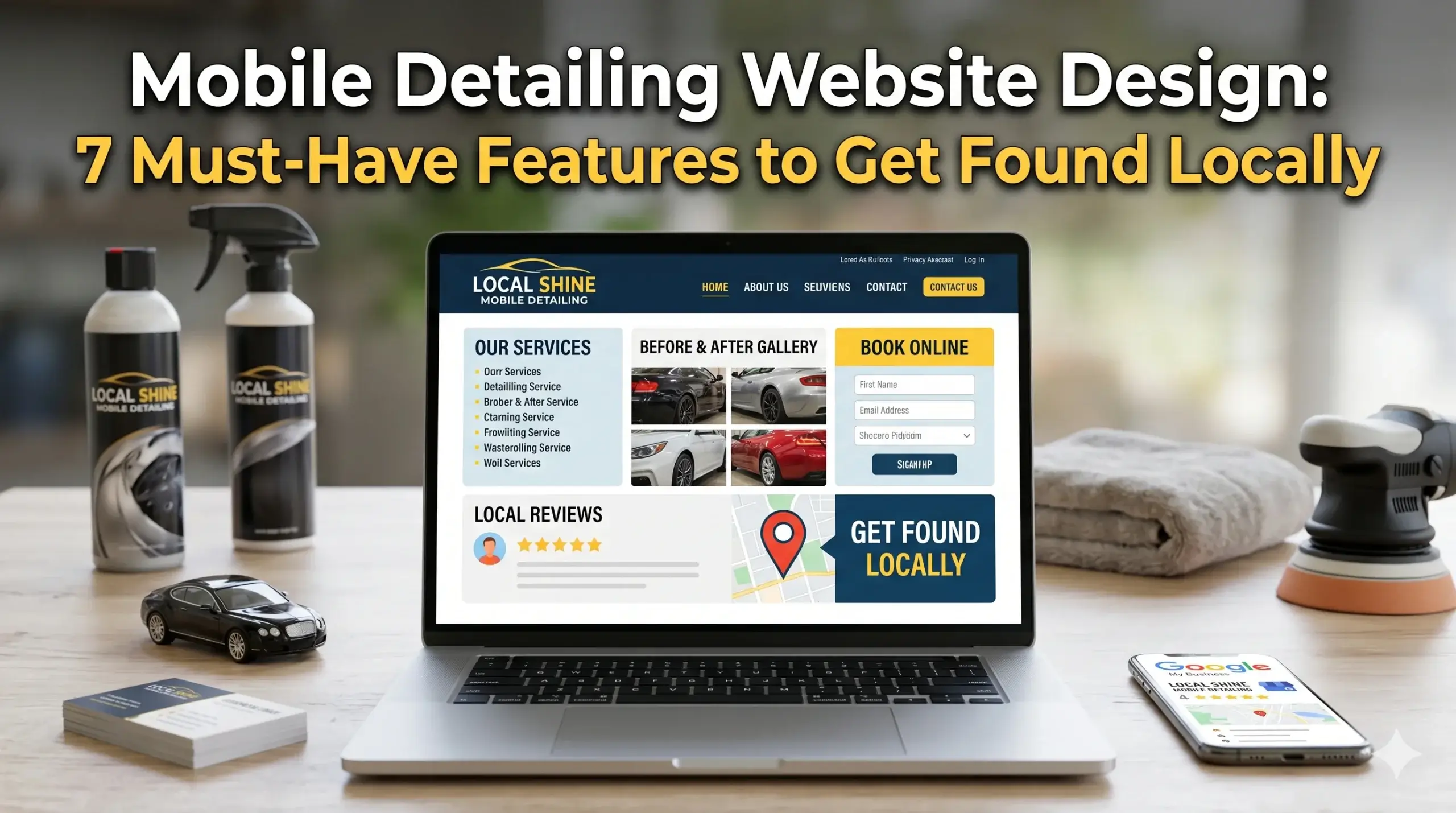
  • Mobile Detailing Website Design: 7 Must-Have Features to Get Found Locally

    Mobile Detailing Website Design: 7 Must-Have Features to Get Found Locally

    You’re out in the field five days a week, doing flawless work — paint correction, ceramic coatings, full interior details. Your customers love you. But your phone? It’s quiet. And somewhere across town, a competitor with a half-decent website is picking up the jobs that should be yours.

    That’s not a luck problem. That’s a website problem.

    Most mobile detailing businesses in the US built their website once, posted it, and never thought about it again. The result is a site that looks fine on a desktop, loads like it’s running on a 2009 laptop, and gives Google zero reason to show it to anyone searching “mobile detailer near me.”

    The good news: most of these issues are fixable. Here are the 7 features your mobile detailing website design absolutely needs if you want to get found, get calls, and grow your business — without spending every evening trying to figure out marketing.


    1. A Homepage That Tells Google (and Customers) Exactly What You Do

    Your homepage has about 3 seconds to communicate three things: what you do, where you do it, and why someone should call you. Most auto detailing websites fail all three.

    A generic headline like “Professional Auto Detailing Services” tells Google almost nothing. It doesn’t mention your city, your specialty, or who you serve. You might as well be invisible.

    What you lose: Google needs location signals to rank you for local searches. Without them, your site won’t show up when someone in your city types “mobile detailer near me” — even if you’ve been in business for years.

    The fix: Your H1 headline should say something like “Mobile Auto Detailing in [Your City] — We Come to You.” Then your first paragraph should name your service area, your core service, and your phone number. That’s what the websites built for auto detailing businesses at Digital Trace are structured around from the very first line of code.


    2. Mobile-First Design That Works for People Searching From a Parking Lot

    Think about who’s looking for a mobile detailer. It’s someone sitting in their car, glancing at their phone, trying to find someone fast. If your site takes more than 3 seconds to load or forces them to pinch and zoom to read your prices, they’re gone — and calling the next result.

    More than 70% of local service searches happen on mobile devices. If your site was built for a desktop and “adjusted” for phones, that’s not the same thing as being designed mobile-first.

    The real cost: Every visitor who lands on a slow or clunky mobile site and bounces back to Google is a lost lead. You didn’t even get a chance to impress them.

    What a proper mobile detailing website looks like:

    • One-tap call button visible above the fold
    • Services and pricing readable without zooming
    • Photos that load fast (under 1MB each)
    • A contact or booking form that works without pinching

    Think of your website like your detail van showing up to a job. If it arrives late, dirty, and disorganized, the customer questions everything before you’ve even opened the door. Your site is your first impression — and on mobile, it needs to show up sharp.


    3. Local SEO Built Into Every Page — Not Bolted On After

    Here’s why your competitor shows up in Google and you don’t: their site is structured in a way that tells Google exactly what city they serve, what services they offer, and that real customers have confirmed this. Yours probably isn’t.

    Local SEO for a mobile detailing website isn’t about stuffing your city name into every sentence. It’s about building a site with the right technical structure, consistent service area pages, and business signals Google trusts.

    What’s likely missing from your site right now:

    • No dedicated page for each major service (paint correction, ceramic coating, interior detailing)
    • No Google Business Profile connected and optimized
    • No consistent NAP (Name, Address, Phone) across the web
    • No service area pages targeting surrounding cities

    Google is trying to match searchers with the most relevant local business. If your site doesn’t give Google clear signals, it won’t take the risk of showing you. That’s not personal — it’s algorithmic.


    4. A Fast-Loading Site (Because Slow Sites Are Invisible Sites)

    Your site could look incredible. Full-page hero images, smooth transitions, a video background. And it could still be completely tanking your leads — because it loads in 8 seconds.

    Speed is not just a “nice to have.” Google uses page speed as a direct ranking factor for mobile searches. A site that loads slowly gets pushed down in results, often below competitors whose services aren’t even as good as yours.

    Plain English translation: A slow site is like a detail van that takes 45 minutes to show up for a “mobile” service. No matter how good the work is, you’ve already lost the customer’s trust.

    💡 Pro Tip: Your Images Are Probably Killing Your Load Time

    The single most common issue on auto detailing websites is uncompressed images. You upload a beautiful high-res photo of a ceramic-coated hood — straight from your iPhone at 6MB — and your site’s load time doubles. The fix is simple: compress every image before uploading (tools like TinyPNG work), and use modern formats like WebP instead of JPEG or PNG where possible. This one change alone can cut your load time in half.


    5. Clear Service Pages With Pricing Signals (Not Just a Services List)

    Most auto detailing websites have a “Services” page that lists: Basic Wash, Interior Detail, Full Detail, Ceramic Coating. That’s it. No descriptions, no photos, no pricing guidance.

    Here’s the problem: your customer is comparison shopping. They’re looking at your site and two competitors’. If your site doesn’t give them enough information to feel confident, they’ll call the site that does — even if your work is better.

    What a high-converting service page includes:

    • Clear description of what’s included (and what’s not)
    • A pricing range or starting price (even “from $X” helps)
    • Before/after photos specific to that service
    • A call-to-action after every service description, not just at the bottom

    You’re not giving away the farm by sharing this information. You’re qualifying the customer before they even call — and that means better calls, fewer tire-kickers, and more booked jobs.


    6. Social Proof That Shows Up Where People Are Looking

    Reviews matter. But where those reviews appear — and how your website uses them — is what separates a site that converts from one that doesn’t.

    A wall of five-star stars on your homepage feels generic. What converts is specific, named, photo-verified testimonials placed near the decision points on your page. Right next to your “Book Now” button. Right below your pricing section.

    What actually builds trust with skeptical customers:

    • Google reviews embedded on your site (not just linked to)
    • Before/after photo galleries organized by service type
    • Named testimonials with the customer’s city (e.g., “— James R., Tampa”)
    • A visible review count and average rating in your header or hero section

    Your work is visible in every parking lot you’ve ever detailed a car in. Make sure your website shows that same proof, in the places where it matters most.


    7. A Lead Capture System That Works Even When You’re on the Job

    Here’s a scenario you’ve probably lived: someone visits your site at 7pm while you’re finishing a job, fills out your contact form, and you don’t see it until the next morning. By then, they’ve already booked with someone else.

    Your website needs a lead system that captures inquiries, sends you an immediate notification, and gives the customer an instant confirmation — even when you can’t pick up the phone.

    What a proper lead capture system includes:

    • A short, mobile-friendly booking or quote request form (name, vehicle, service, preferred date — that’s it)
    • Instant email/SMS notification sent to you
    • An auto-reply to the customer confirming their request and setting expectations
    • A clear phone number displayed at the top of every page, click-to-call on mobile

    If your current contact form is a generic “Name / Email / Message” box with no auto-reply, you’re leaving leads in limbo — and in local service businesses, speed of response is often the whole game.


    Before & After: What Happens When You Fix the Foundation

    Meet Marcus, who runs a solo mobile detailing operation in the Phoenix metro area. He’d been in business for four years, had solid reviews on Google, and did great work. But his website — something he’d built himself on a free platform — was getting fewer than 40 visitors a month, and maybe 2–3 contact form submissions. He was relying entirely on word of mouth and a Facebook page.

    After a complete rebuild focused on mobile detailing website design — local SEO structure, fast-loading pages, service-specific landing pages, and a proper lead form — his site traffic climbed to over 300 organic visitors per month within 90 days. More importantly, his inbound lead volume went from 2–3 per month to 18–22 qualified inquiries. He booked out his schedule three weeks in advance for the first time in his business’s history.

    His work didn’t change. His prices didn’t change. His website finally started doing its job.


    Not sure if your auto detailing website has these issues? Get a free website audit — no obligation, just a clear picture of what’s costing you leads.


    Your Path to More Leads: 5 Steps That Actually Work

    You don’t need to become a web designer or SEO expert. You just need a site that’s built right from the start. Here’s what that process looks like:

    1. Audit what you have. Before changing anything, understand what’s broken. A free audit will show you exactly where your site is leaking leads.
    2. Fix your mobile experience first. If your site doesn’t work flawlessly on a phone, nothing else matters — that’s where your customers are.
    3. Build location-specific pages. Create a page for every city or neighborhood you serve. This is how you show up in more local searches without paid ads.
    4. Add real social proof. Get your Google reviews onto your site. Add before/after photos organized by service. Make your work visible.
    5. Set up a lead capture that works while you’re working. A form, an auto-reply, and an SMS alert to your phone. Simple, effective, and it pays for itself with the first job it captures.

    Frequently Asked Questions

    Why am I not getting calls from my website?

    The most common reasons are slow load speed, missing local SEO signals, and a homepage that doesn’t clearly state what you do and where you do it. If Google doesn’t understand your site, it won’t show it — and if visitors land on it and can’t find your number in two seconds, they’re gone. A free website audit will show you exactly which of these issues is affecting your site.

    How do I know if my auto detailing website is actually working?

    If you can’t answer “how many people visited my site last month” and “how many of them contacted me,” your site isn’t being tracked properly. A working website should generate measurable leads — not just look good. At minimum, you should have Google Analytics installed and a way to track form submissions or call clicks.

    How long does it take to see results from a new website?

    For local SEO, most auto detailing businesses start seeing meaningful traffic improvements within 60–90 days of a properly built site going live. Paid traffic can start immediately. The key is that the site has to be built right — a fast, locally optimized site will outperform a slow, generic one within a few months and keep compounding over time.

    What makes an auto detailing website different from a regular business website?

    Auto detailing is a visual, trust-based, location-dependent service. Your website needs to show your work with high-quality photos, establish local credibility through reviews and service area pages, and convert mobile visitors quickly — because most people searching for a detailer are on their phone and ready to book. A generic business website template won’t do any of those things well.

    Do I really need a fast website if my customers are local?

    Yes — especially because they’re local. Local customers are searching on mobile, often in the moment. Google penalizes slow sites in mobile search rankings, which means a slow site doesn’t just frustrate visitors; it doesn’t even show up for them. Speed isn’t a luxury feature for mobile detailing websites — it’s the entry point.

    I’ve had a website for years and it’s never brought in leads. Is it worth fixing or should I start over?

    That depends on the specific issues. Sometimes a structural rebuild is faster and cheaper than trying to retrofit a broken foundation. Other times, targeted fixes to speed, content, and local SEO can turn an underperforming site around. The only way to know is an honest audit — which is exactly what Digital Trace offers at no cost.


    Ready to Find Out What Your Website Is Really Costing You?

    Every week your site isn’t performing is a week your competitors are picking up the calls that should be yours. The jobs are out there — people in your city are searching for a mobile detailer right now.

    The question is whether your website gives them a reason to call you.

    Book a free website audit and find out exactly what’s holding your site back. No jargon, no pressure — just a clear look at what’s working, what isn’t, and what it would take to fix it.

    Your detail van is ready. Let’s make sure your website is too.

    → Get Your Free Audit Now

  • How to Design the Best Auto Detailing Website That Books More Clients (2026 Guide)

    How to Design the Best Auto Detailing Website That Books More Clients (2026 Guide)

    You do great work. Your customers love you. You’ve got before-and-after photos that would make any car enthusiast stop scrolling — but your phone isn’t ringing from people who found you online.

    That’s not a luck problem. That’s a website problem.

    Most auto detailing business owners assume their site is “fine.” It loads. It has a phone number. It lists their services. But “fine” doesn’t fill your schedule. Every day your site underperforms, someone in your area is Googling “mobile detailing near me” — and booking your competitor instead of you.

    This guide breaks down exactly what separates an auto detailing website that generates consistent bookings from one that just sits there. No fluff, no generic marketing advice — just what actually works for detailing businesses in 2026.


    Your Website Is Like Your Detail Bay — First Impressions Are Everything

    Walk a customer into a dirty, disorganized shop and they’re already skeptical before you touch their car. The same thing happens online.

    When someone lands on your website, they make a judgment call in about three seconds. If the page looks outdated, loads slowly, or doesn’t immediately tell them what you do and where you do it — they hit the back button. That person is gone forever.

    What kills first impressions on detailing websites:

    • A wall of text with no clear service menu
    • Stock photos instead of your own work
    • No pricing ballpark (even a starting price helps)
    • Phone number buried at the bottom of the page
    • A layout that breaks on mobile phones

    Most potential clients searching for a detailer are doing it from their phone, sitting in a parking lot or their driveway. If your site is hard to navigate on a small screen, you’ve already lost them.


    Why Your Phone Isn’t Ringing (Even When People Visit)

    Here’s something most detailing business owners don’t realize: getting traffic to your site is only half the battle. The other half is making sure visitors actually call or book.

    A visit with no booking is called a “bounce.” High bounce rates mean your site is attracting eyeballs but losing customers — and Google notices. When people consistently leave your site without taking action, Google quietly decides your site isn’t that helpful and starts ranking you lower.

    The most common reasons detailing visitors leave without calling:

    • No clear call-to-action (“Book Now” or “Get a Quote” buttons missing or hidden)
    • Slow load times — if your site takes more than 3 seconds to load on mobile, most visitors leave before your phone number even appears
    • No trust signals — reviews, certifications, or real photos of your work
    • Confusing navigation that makes it hard to find your services or service area

    The fix isn’t complicated, but it has to be intentional. Every page on your site should have one job: get that visitor to contact you.


    The Hidden Reason Your Competitor Shows Up and You Don’t

    You’ve probably noticed it. You search for detailing services in your own city and a competitor pops up on Google Maps and in the top results — even though you’ve been in business longer and do better work.

    That’s not an accident. They’ve almost certainly done something called local SEO setup on their website.

    In plain English, here’s what that means:

    Google needs signals to trust that your business is real, local, and relevant. When those signals are missing from your website, Google hedges its bets and shows your competitor instead.

    The signals Google looks for:

    • Your city and service area mentioned naturally throughout your site
    • A Google Business Profile that matches your website information exactly
    • Pages dedicated to specific services (paint correction, ceramic coating, interior detailing)
    • Structured data — a small piece of code that tells Google “this is a local business, here’s their address, phone, and hours”
    • Consistent reviews and genuine customer feedback

    None of this requires a computer science degree. But it does require knowing what to do and doing it right the first time. The websites built for auto detailing businesses by Digital Trace are built with all of these signals in place from day one — not patched in later.


    💡 Pro Tip

    The biggest mistake detailing websites make with photos: Using low-quality images or manufacturer stock shots instead of your own work.

    Your before-and-after photos are your most powerful sales tool. A crystal-clear shot of a paint correction on a black Mercedes does more convincing than three paragraphs of copy. Make sure your photos load quickly (large uncompressed images can slow a site dramatically), are labeled with descriptive file names like “ceramic-coating-atlanta.jpg” instead of “IMG_4892.jpg,” and are placed above the fold on key pages. Google indexes image names and can use them to understand what your business does — and where.


    What a Detailing Website Overhaul Actually Looks Like

    Before: Marcus ran a two-person mobile detailing operation in Phoenix. His website had been built by a friend three years ago on a free website builder. It loaded slowly, had no individual service pages, and his address wasn’t listed anywhere because he was mobile-only. When someone searched “mobile detailing Phoenix,” he appeared on page four of Google — essentially invisible. He was getting maybe one or two website inquiries per month and relying almost entirely on word-of-mouth.

    After: His new site was rebuilt with mobile-first design, dedicated pages for each service (interior detail, paint decontamination, ceramic coating packages), a clear service area section calling out Phoenix and surrounding cities, and a fast-loading gallery of his actual work. His Google Business Profile was synced to match the site. Within 90 days, his site appeared in the local map pack for “mobile detailing Phoenix.” Within six months, he went from 1–2 online inquiries per month to 15–20 — enough to add a third team member.

    The work was the same. The website just finally reflected it.


    Not sure if your detailing website has these issues? Get a free website audit — no obligation, just a clear picture of what’s costing you leads.


    Mobile Detailers Have a Specific Website Problem — Here’s the Fix

    If you run a mobile detailing operation, your website needs to solve a problem regular shops don’t have: you don’t have an address, but Google still wants to know where you work.

    Without a physical location, Google isn’t sure how to place you in local search results. The fix is building what’s called a service area page — a section of your site (or dedicated pages) that names every city, neighborhood, or zip code you operate in.

    What a strong mobile detailing website includes:

    • A clear “We Come to You” message on the homepage
    • A service area list that names specific cities and neighborhoods
    • A booking form or instant quote tool (removes friction to contact)
    • Customer reviews that mention locations (“Great job detailing my car in Scottsdale!”)

    How Digital Trace builds mobile detailing websites accounts for all of this — so Google knows exactly where to send customers looking for mobile detailing in your area.


    Your Path to More Leads: 5 Steps That Actually Matter

    You don’t need to overhaul everything overnight. Focus on these in order:

    1. Fix your mobile experience first. Pull up your site on your phone. Can you find the phone number in five seconds? Can you read the service menu without zooming? If not, this is your biggest immediate problem.
    2. Add real photos of your work. Replace any stock images with genuine before-and-after shots. Label the files with descriptive names and compress them so they load fast.
    3. Create individual pages for your main services. One page for interior detailing, one for paint correction, one for ceramic coatings. This is how Google decides to show you when someone searches for a specific service.
    4. Claim and optimize your Google Business Profile. Make sure your business name, phone number, and service area match exactly what’s on your website. Add photos. Respond to every review.
    5. Put a clear call-to-action on every page. “Book Now,” “Get a Free Quote,” or “Call Us Today” — visible without scrolling, on every page, linking to your contact form or phone number.

    If this list feels overwhelming, that’s exactly what Digital Trace is built for. The audit alone will tell you which of these you’ve already got right and which ones are quietly costing you bookings.


    Frequently Asked Questions

    Why am I not getting calls from my website even though I have one?

    Having a website and having a website that generates leads are two completely different things. Most detailing sites were built to exist, not to convert. If your site is slow, hard to navigate on mobile, has no reviews or trust signals, and lacks clear calls-to-action — visitors will leave without calling. The good news is these problems are fixable.

    How do I know if my auto detailing website is actually working?

    If you can’t point to a specific number of bookings or inquiries that came directly from your website each month, it’s probably not working. A functional detailing site should generate consistent, trackable leads. You can use free tools like Google Analytics to see how many people visit and what they do — or get a free website audit and let Digital Trace show you exactly what the data says.

    How long does it take to see results from a new website?

    Local SEO results typically start showing within 60–90 days of a properly built and optimized site going live. Some changes — like a faster load time or a clearer booking button — can impact conversions almost immediately. Building to page one of Google for competitive detailing keywords takes consistent effort over three to six months, but the traffic compounds over time.

    What makes an auto detailing website different from a generic business website?

    A detailing website needs to showcase visual work, build trust around high-ticket services like ceramic coatings, and compete in a very local search environment. It needs service-specific pages, local SEO signals, and a gallery that does the selling. A generic template from a website builder isn’t built with any of that in mind — it’s just a digital placeholder.

    Do I really need a fast website if most of my customers are local anyway?

    Yes — more so, actually. Local customers searching on their phones are often ready to book right now. If your site takes five seconds to load, they’re calling the next result before yours even appears. Google also uses page speed as a ranking factor, so a slow site doesn’t just lose visitors — it actively gets pushed down in local search results.

    I’ve been burned by agencies before. How is this different?

    That’s a fair concern and a common one. The difference is in the specifics: Digital Trace focuses on auto detailing businesses specifically, builds sites designed to rank and convert (not just look good in a pitch deck), and offers a free audit before asking for anything. You’ll see exactly what’s wrong with your current site before any money changes hands.


    Ready to Find Out What Your Website Is Costing You?

    Every month your website underperforms is revenue that goes to someone else in your market.

    A free audit from Digital Trace will show you specifically — not generically — which parts of your site are losing leads, why you’re not ranking in your area, and what it would take to fix it. There’s no sales pressure, no obligation, and no jargon. Just a clear look at what’s happening and what it would mean for your business to change it.

    Book your free website audit — and find out exactly where your site is leaving money on the table.